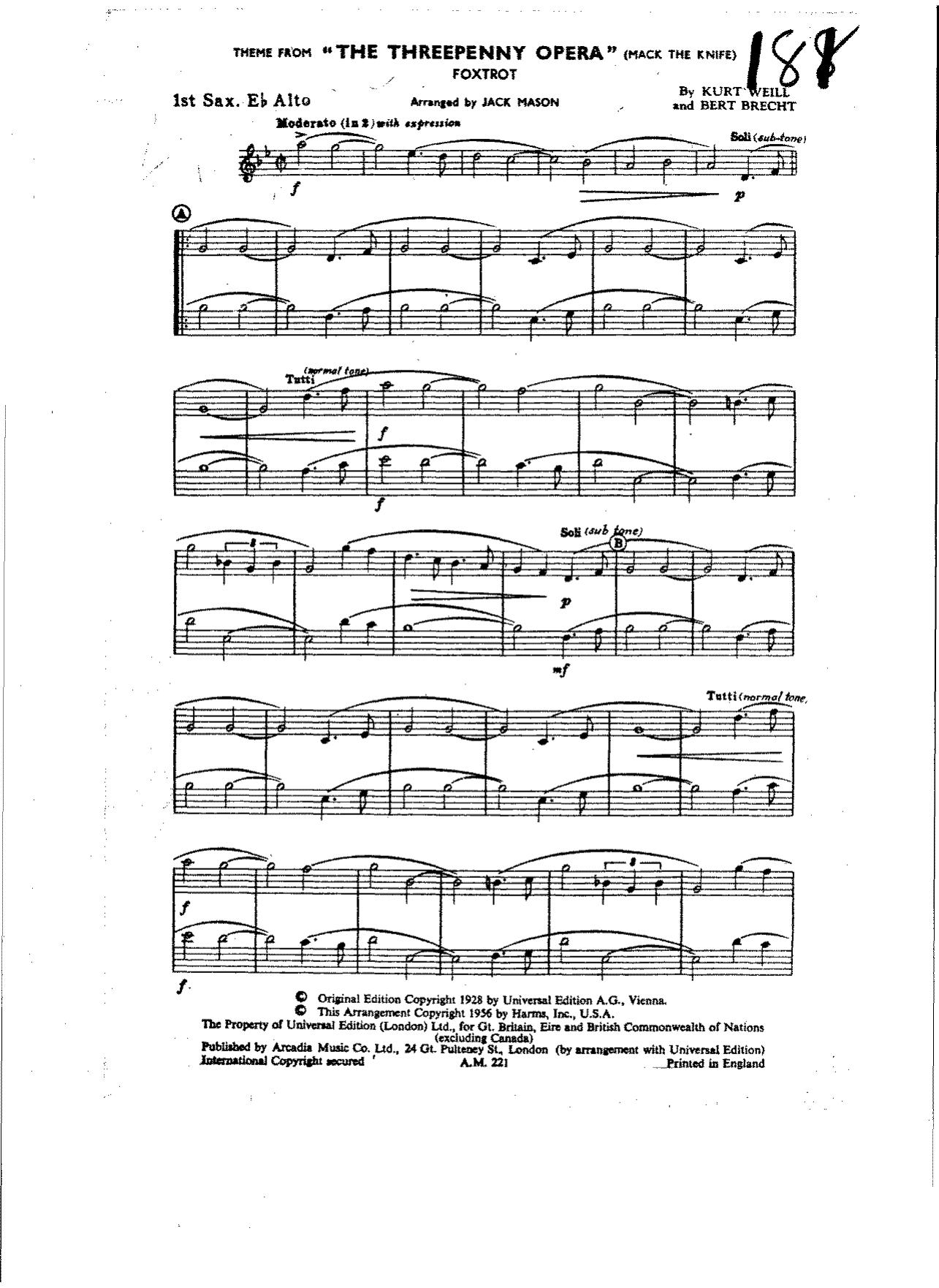
Mack The Knife (J.Mason) sheet music preview

Mack The Knife (J.Mason)

Composed by Kurt Weill

Arranged by Jack Mason

  • Ensemble: Big Band
  • Pages: 27
  • Instruments (17): 1st Sax. Eb Alto, 3rd Sax. Eb Alto, 2nd Sax. Bb Tenor, 4th Sax. Bb Tenor, 5th Sax. Eb Baritone, 1st Trumpet in Bb, 2nd Trumpet in Bb, 3rd Trumpet, 4th Trumpet, 1st Trombone, 2nd Trombone, 3rd Trombone, 4th Trombone, Guitar, Bass, Drums, Piano
  • Difficulty: medium
  • Content: Individual Parts
  • Format: PDF Download (Instant)
  • Price: $24.99

Originally introduced as "Die Moritat von Mackie Messer" in Kurt Weill and Bertolt Brecht’s landmark 1928 theatrical production *The Threepth Opera*, this timeless melody transitioned from Weimar-era cabaret into an indispensable cornerstone of the Great American Songbook. While Bobby Darin’s 1959 swinging vocal rendition cemented the tune’s status as a mid-century pop-culture phenomenon, instrumental jazz interpreters have long utilized its deceptively simple, four-bar harmonic framework as a vehicle for driving momentum and theatrical tension. The composition represents a brilliant intersection of European theatrical grit and American swing vernacular, thriving on an escalating sense of narrative excitement that builds naturally from understated cool to unbridled intensity. Jack Mason’s big band treatment captures this classic theatrical swagger through a crisp, medium-up swing groove set in a vibrant, brass-friendly key. The arrangement opens with a sly, understated vamp that immediately establishes a sophisticated, late-night atmosphere before unfolding into rich, full-ensemble textures. Mason utilizes classic Kansas City-style shout choruses and interlocking sax-and-brass counterlines that evoke the golden age of swing while maintaining a fresh, contemporary punch. The emotional trajectory shifts dynamically; muted brass interplay builds initial tension, which is periodically released through soaring woodwind solis and driving rhythmic pulses from the rhythm section. Melodic duties are distributed masterfully across the entire ensemble rather than resting solely on the lead trumpet or alto saxophone, giving every section a chance to shine. Open solo space is provided over standard changes, allowing a featured soloist to stretch out while the ensemble maintains a crisp, rhythmic backing bed. Technical challenges lie primarily in maintaining a light, articulate swing eighth-note feel at a brisk tempo, avoiding the trap of heavy-handedness. The brass section will encounter stylistic demands ranging from subtle cup-mute coloring to bright, open-bell staccato punches, making it immensely rewarding for players who relish dynamic contrast and sharp articulations. Advanced high school ensembles with strong section leaders, as well as collegiate and community big bands seeking a guaranteed crowd-pleaser with genuine historical weight, will find this chart exceptionally well-suited to their libraries. The writing respects the players' technical capabilities while offering enough sophisticated harmonic coloration to keep rehearsals engaging and intellectually stimulating. It serves as an ideal centerpiece for a vintage-themed concert set or as an educational masterclass in building dramatic tension across an arrangement. Achieving the proper stylistic integrity in this chart depends heavily on maintaining an authentic, relaxed medium-up swing feel; avoid rushing the tempo, even when the dynamics push toward a forte peak. The rhythm section is the engine here: the bassist should walk a steady, acoustic-sounding quarter-note line with strong emphasis on beats two and four, while the drummer keeps a crisp ride cymbal pattern alive without overplaying fills during ensemble solis. Horn players must execute short notes with a dry, precise tongue, ensuring that eighth notes are properly swung without degenerating into clunky triplets. Pay close attention to the dynamic markings in the sax soli; balance is critical so that the inner voices (Tenor 2 and Alto 3) project their counter-melodies clearly beneath the lead alto. Conductors should rehearse the transition into the final shout chorus slowly, ensuring that the dynamic swell from mezzo-piano to triple-forte feels organic rather than jarring. Q: What instruments and parts are included in this arrangement? A: This standard 17-instrument big band arrangement includes full instrumentation for Alto Saxophone 1, Alto Saxophone 3, Tenor Saxophone 2, Tenor Saxophone 4, Baritone Saxophone 5, four trumpets, four trombones, and a full rhythm section comprising piano, guitar, bass, and drums. Q: What is the difficulty level of Jack Mason's "Mack The Knife"? A: This chart is graded as medium-advanced, making it ideal for accomplished high school jazz bands, college ensembles, and community big bands looking to stretch their stylistic versatility and section blend. Q: What is the historical style and musical context of this chart? A: Rooted in Kurt Weill's 1928 cabaret masterpiece and popularized by the swinging vocal tradition of the mid-20th century, this arrangement frames the composition in a classic, high-energy big band swing style. Q: What makes this specific arrangement by Jack Mason unique? A: Mason’s treatment stands out through its clever distribution of melodic fragments across different sections, paired with sophisticated dynamic layering and dynamic shout choruses that evoke classic theatrical tension. Q: What is the performance duration and recommended tempo for this arrangement? A: The arrangement performs at a driving medium swing tempo of approximately 144 to 152 beats per minute, resulting in a total performance duration of roughly 3 to 4 minutes depending on solo choruses.

Questions and answers

What is included in the Mack The Knife (J.Mason) PDF?
The verified current file contains individual parts across 27 pages.
How many instruments or parts are listed for Mack The Knife (J.Mason)?
The verified instrumentation list contains 17 entries for this Big Band arrangement.
Who is credited for Mack The Knife (J.Mason)?
Composer: Kurt Weill. Arranger: Jack Mason.
What difficulty is listed for Mack The Knife (J.Mason)?
The verified difficulty level is medium.
Can I preview Mack The Knife (J.Mason) before buying?
Yes. The product page provides a preview generated from the current PDF file.
How is Mack The Knife (J.Mason) delivered?
After successful payment, the digital PDF is made available for download. The displayed price is $24.99.

Musicians Also Search For

Mack The Knife Jack Mason PDFMack The Knife Jack Mason sheet musicMack The Knife arranged by Jack MasonJack Mason big band chartsJack Mason jazz arrangements PDFMack The Knife Kurt Weill sheet musicMack The Knife Kurt Weill big band arrangementsKurt Weill big band chartsMack The Knife big band arrangementsMack The Knife big band PDF downloadMack The Knife jazz sheet musicbig band sheet music downloadMack The Knife individual parts downloadMack The Knife sheet music PDFbuy Mack The Knife sheet musicdownload Mack The Knife PDFMack The Knife jazz chartsbest Jack Mason big band arrangementsKurt Weill arranged by Jack MasonMack The Knife printable sheet musicbig band repertoire PDF

All arrangements by Jack Mason All Kurt Weill sheet music