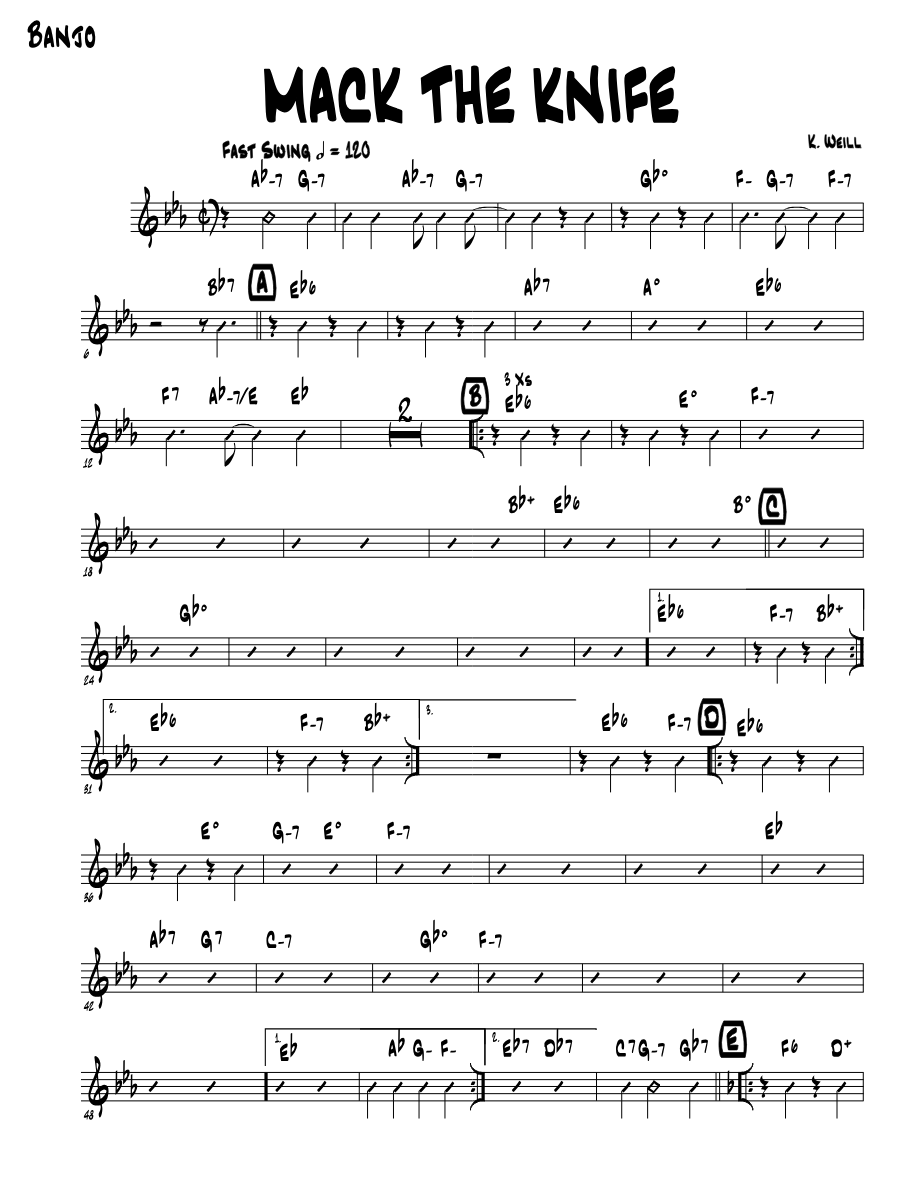
Mack The Knife (comp. K. Weill) sheet music preview

Mack The Knife (comp. K. Weill)

Composed by Kurt Weill

Arranged by Unknown Arranger

  • Ensemble: Dixieland Band
  • Style: Dixieland
  • Pages: 14
  • Difficulty: easy
  • Content: Sheet Music
  • Format: PDF Download (Instant)
  • Price: $18.99

Composed by Kurt Weill for Bertolt Brecht's 1928 German musical "The Threepenny Opera," "Mack The Knife" (Die Moritat von Mackie Messer) quickly transcended its theatrical origins to become one of the most enduring and recognizable standards in the jazz canon. While originally a dark, sardonic ballad describing the exploits of the criminal Macheath, it was Louis Armstrong's iconic 1956 recording that catapulted it into mainstream American popular culture, establishing it as a swing staple. Bobby Darin's 1959 rendition further cemented its status, earning him a Grammy and popularizing the English lyrics. The piece's enduring appeal lies in its compelling narrative, memorable melody, and harmonic versatility, allowing for diverse interpretations across various jazz styles. This particular arrangement reimagines "Mack The Knife" through the vibrant lens of Dixieland, capturing the joyous, collective improvisation and spirited ensemble playing characteristic of early New Orleans jazz. The musical character is decidedly up-tempo and ebullient, typically performed at a brisk 2-beat feel (or a very light 4-beat) in a bright, major key, often C or Bb, to amplify its celebratory mood. The energy is consistently high, designed to evoke the festive atmosphere of a street parade or a lively dance hall. Unlike later jazz styles that emphasize individual soloists, this Dixieland treatment prioritizes the interplay between instruments, creating a rich tapestry of interwoven melodic lines and rhythmic drive. The Unknown Arranger's approach to "Mack The Knife" is a masterclass in authentic Dixieland styling. The arrangement opens with a classic ensemble "head" statement, featuring the trumpet carrying the primary melody while the clarinet weaves a florid counter-melody above it, and the trombone provides a robust, often tailgate-style harmonic and rhythmic foundation. Soli sections are strategically placed, allowing different sections to shine, such as a clarinet trio or a brass choir, before returning to collective improvisation. There are ample opportunities for featured solos, typically for clarinet, trumpet, and trombone, allowing musicians to showcase their improvisational skills within the Dixieland idiom, emphasizing melodic paraphrase and blues-inflected phrases rather than complex harmonic superimposition. A driving rhythm section of piano, bass, and drums maintains the infectious pulse throughout, often employing a "two-feel" that propels the ensemble forward. Performing this Dixieland arrangement of "Mack The Knife" is a rewarding experience that demands both individual musicianship and a strong sense of ensemble. Technical challenges include maintaining a consistent, driving tempo, executing clean articulations in the brass, and achieving the characteristic "growl" and "smear" effects often found in trombone lines. The clarinet part requires agility for its obbligato lines, while the trumpet needs a strong lead voice. The true reward lies in the collective energy and the joy of creating a cohesive, swinging sound that honors the spirit of early jazz. This arrangement is ideally suited for high school and college jazz ensembles looking to explore the foundational styles of jazz, as well as community and professional Dixieland bands seeking a spirited and historically informed rendition of a beloved standard. Its clear structure and idiomatic writing make it an excellent teaching tool for understanding Dixieland conventions. This Dixieland arrangement of "Mack The Knife" thrives on an energetic, up-tempo 2-beat feel, typically around ♩=160-180. The primary technical challenge lies in achieving a cohesive, collective sound while maintaining individual melodic clarity. Encourage trumpets to play with a bright, focused tone, and clarinets to articulate their obligato lines with fluidity and precision. Trombones should embrace the characteristic "tailgate" style, utilizing glissandi and smears where indicated, but always with rhythmic accuracy. The rhythm section must provide a strong, unwavering foundation, emphasizing the two-beat pulse with a light, driving swing. For solos, encourage melodic improvisation rooted in the blues and the tune's primary melody, rather than complex harmonic substitutions. Rehearsal should focus on balancing the ensemble during the collective improvisation sections and ensuring clear hand-offs between featured soloists and the ensemble. Q: What instruments/parts are included in this arrangement? A: This Dixieland arrangement typically includes parts for Trumpet 1, Trumpet 2, Clarinet, Trombone, Piano, Bass, and Drums. Additional optional parts for Banjo or Tuba may be included depending on the specific edition. Q: What is the difficulty level of this arrangement? A: This arrangement is rated as Medium. It requires solid instrumental technique for individual parts, especially for the clarinet's obbligato lines and the trumpet's lead, and a strong understanding of ensemble playing and the Dixieland idiom. Q: What musical style and historical context does this arrangement represent? A: This arrangement is firmly rooted in the Dixieland style of jazz, characterized by collective improvisation, a driving 2-beat feel, and a focus on melodic interplay, reflecting the early jazz traditions of New Orleans from the 1910s and 1920s. Q: What makes this specific arrangement of "Mack The Knife" unique? A: This arrangement stands out for its authentic Dixieland treatment, featuring classic collective improvisation sections, idiomatic voicings for brass and clarinet, and opportunities for traditional Dixieland-style solos, providing a spirited and historically informed rendition of the standard. Q: What is the typical performance duration and recommended tempo for this piece? A: The typical performance duration for this arrangement is approximately 3:00-4:00 minutes, depending on the number and length of solos. It is best performed at an up-tempo 2-beat feel, with a recommended tempo range of ♩=160-180.

Musicians Also Search For

Mack The Knife Unknown Arranger PDFMack The Knife Unknown Arranger sheet musicMack The Knife arranged by Unknown ArrangerUnknown Arranger dixieland band chartsUnknown Arranger jazz arrangements PDFMack The Knife Kurt Weill sheet musicMack The Knife Kurt Weill dixieland band arrangementKurt Weill dixieland band chartsMack The Knife dixieland band arrangementMack The Knife dixieland band PDF downloadMack The Knife jazz ensemble sheet musicdixieland band sheet music instant downloadMack The Knife sheet music with partsMack The Knife Dixieland chartDixieland dixieland band arrangementsbuy Mack The Knife sheet music onlinedownload Mack The Knife PDFMack The Knife jazz chartbest Unknown Arranger dixieland band arrangementsKurt Weill songs arranged by Unknown ArrangerMack The Knife printable sheet musicdixieland band repertoire PDF

All arrangements by Unknown Arranger All Kurt Weill sheet music