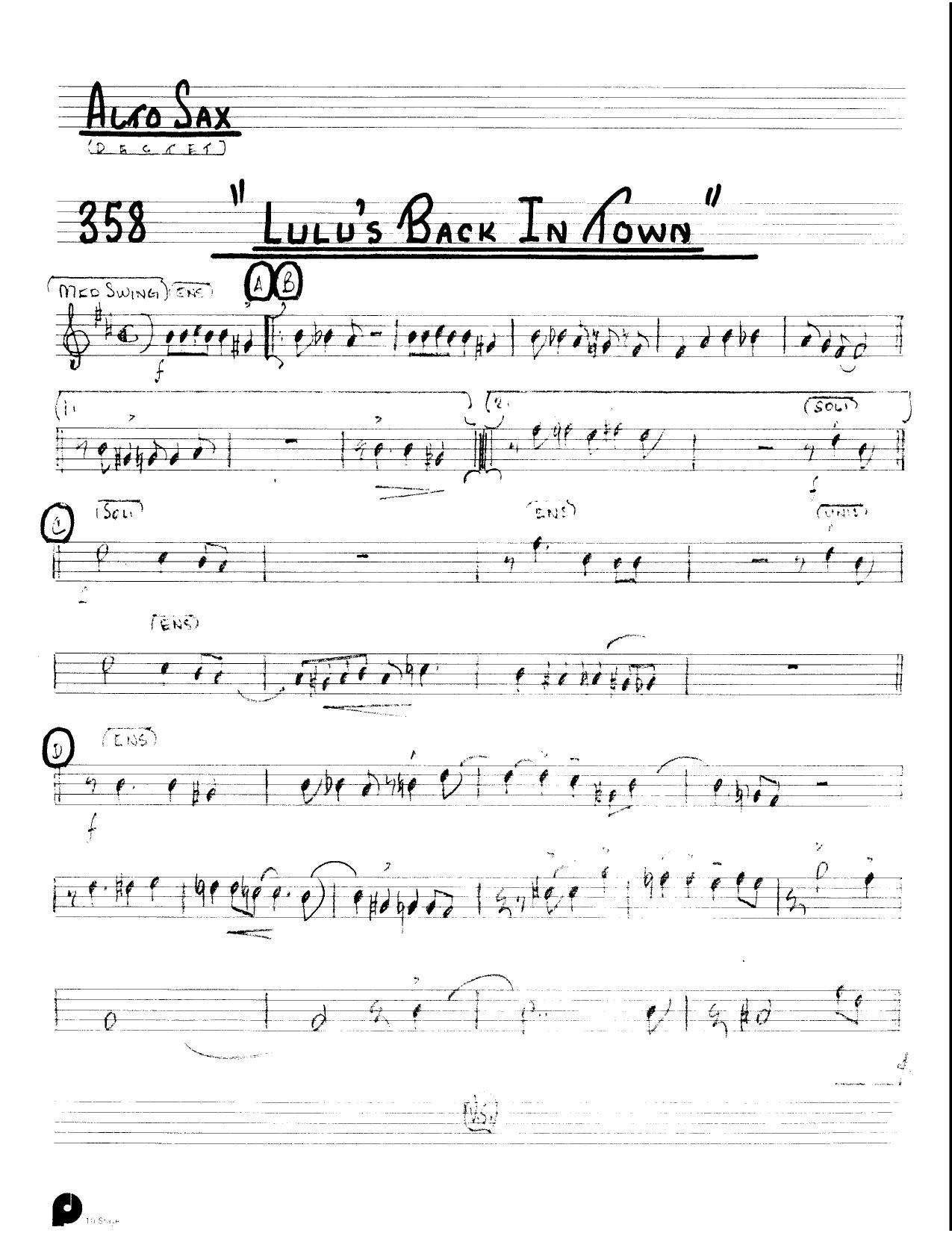
Lulu's Back In Town - 6 horns + Rhythm - Stan Kenton Dectet
Composed by Harry Warren
- Ensemble: Big Band
- Pages: 30
- Instruments (9): Alto Sax, Tenor Sax, Baritone Sax, Trumpet, Trombone, Bass Trombone, Piano, Bass, Drums
- Difficulty: medium
- Content: Individual Parts
- Format: PDF Download (Instant)
- Price: $24.99
"Lulu's Back In Town," a sprightly and enduring jazz standard, was originally composed by Harry Warren with lyrics by Al Dubin for the 1935 film *Broadway Gondolier*. While the song gained immediate popularity through various big band and vocal interpretations in the Swing Era, it was Stan Kenton's innovative and often audacious approach to big band jazz that solidified its place in the modern jazz canon. Kenton's orchestra, particularly his smaller Dectet formations, became renowned for pushing the boundaries of traditional big band sound, introducing complex harmonies, intricate voicings, and a powerful, driving energy that characterized the "progressive jazz" movement of the mid-20th century. This arrangement, echoing the spirit of Kenton's smaller, more agile ensembles, captures the essence of that era's sophisticated big band sound, making it a quintessential representation of a classic tune re-imagined through a distinctive jazz lens. This particular arrangement of "Lulu's Back In Town" is an exhilarating, up-tempo swing chart, set predominantly in the key of C major, radiating a mood of playful sophistication and high-octane energy. The arrangement immediately establishes a driving 4/4 swing feel, characterized by crisp articulation and a relentless rhythmic pulse. The musical character is bright and effervescent, evoking the joyous exuberance of a classic jazz club performance. The harmonic language is rich yet accessible, featuring characteristic Kenton-esque voicings that blend traditional big band sounds with more modern, extended harmonies, creating a full and resonant sound despite the reduced instrumentation. The overall energy is consistently high, building through dynamic contrasts and intricate ensemble passages. The arranger's approach to "Lulu's Back In Town" is marked by a clever use of the six-horn instrumentation, creating the illusion of a much larger ensemble. The melody is initially presented in a tightly voiced saxophone soli, showcasing the blend and precision required from the reed section. This is quickly followed by punchy brass interjections and call-and-response figures that drive the narrative forward. A standout feature is the inclusion of a well-crafted shout chorus, where the full ensemble unleashes a powerful, harmonically dense statement that is both thrilling and challenging. The arrangement also features opportunities for improvised solos, typically over the standard "Lulu's Back In Town" chord changes, allowing for individual expression within the structured framework. The interplay between the sections, the dynamic layering, and the rhythmic precision are hallmarks of this arrangement's distinctive character. Performing this arrangement is a highly rewarding experience for intermediate to advanced ensembles. The technical challenges lie in maintaining the relentless up-tempo swing feel, achieving precise ensemble attacks and releases, and navigating the intricate voicings and dynamic shifts. The lead trumpet often sits in the upper register, requiring endurance and strong intonation. The saxophones must execute fast, clean lines in unison and soli passages, while the trombone provides a robust foundation and occasional melodic counterpoint. This piece is particularly suitable for college jazz ensembles, advanced community bands, or professional groups looking for a vibrant, compact chart that delivers a full big band impact. Its combination of historical significance, musical sophistication, and sheer performance joy makes it an excellent choice for concert programs or competitive settings. Conductors should emphasize a crisp, driving up-tempo swing feel from the outset, maintaining a strong rhythmic pulse in the rhythm section. The tempo should be brisk, around quarter note = 200-220 bpm, to capture the intended energy. Key technical challenges include precise articulation in the saxophone soli sections and accurate intonation in the tightly voiced brass chords. Encourage the brass to use a bright, focused tone without overblowing, particularly in the lead trumpet's upper register passages. Rehearsal time should be dedicated to balancing the ensemble, ensuring that the intricate inner voices of the horn sections are heard clearly. Pay close attention to dynamic contrasts, building intensity towards the shout chorus. No special techniques like plunger mutes or falls are explicitly notated, allowing the ensemble to focus on fundamental swing performance practices. Q: What instruments and parts are included in this arrangement? A: This arrangement is scored for a 6-horn ensemble plus rhythm section. The horn parts include Alto Saxophone, Tenor Saxophone, Baritone Saxophone, Trumpet, Trombone, and an additional Trumpet 2 part. The rhythm section consists of Piano, Bass, and Drums. Q: What is the difficulty level of "Lulu's Back In Town - Stan Kenton Dectet"? A: This arrangement is considered advanced intermediate to advanced. It requires strong technical proficiency from all instrumentalists, particularly in maintaining a fast swing tempo, executing precise ensemble passages, and navigating challenging voicings and lead trumpet ranges. Q: What musical style and historical context does this arrangement represent? A: This arrangement embodies the "progressive jazz" style associated with Stan Kenton's smaller ensembles from the mid-20th century. It features an up-tempo swing feel, sophisticated harmonies, and a powerful, driving energy characteristic of that era's innovative big band sound. Q: What makes this particular arrangement unique compared to other versions of "Lulu's Back In Town"? A: This arrangement stands out due to its clever use of a 6-horn instrumentation to create a full big band sound, its characteristic Kenton-esque voicings, and a powerful shout chorus. It offers a compact yet impactful interpretation of the classic standard. Q: What is the typical performance duration and tempo for this piece? A: The typical performance duration for this arrangement is approximately 3-4 minutes, depending on the length of improvised solos. It is designed to be performed at a brisk, up-tempo swing pace, generally around quarter note = 200-220 bpm.
Musicians Also Search For
Lulu's Back In Town - 6 horns + Rhythm - Stan Kenton Dectet Harry Warren sheet music • Lulu's Back In Town - 6 horns + Rhythm - Stan Kenton Dectet Harry Warren big band arrangement • Harry Warren big band charts • Lulu's Back In Town - 6 horns + Rhythm - Stan Kenton Dectet big band arrangement • Lulu's Back In Town - 6 horns + Rhythm - Stan Kenton Dectet big band PDF download • Lulu's Back In Town - 6 horns + Rhythm - Stan Kenton Dectet jazz ensemble sheet music • big band sheet music instant download • Lulu's Back In Town - 6 horns + Rhythm - Stan Kenton Dectet individual parts download • Lulu's Back In Town - 6 horns + Rhythm - Stan Kenton Dectet sheet music with parts • buy Lulu's Back In Town - 6 horns + Rhythm - Stan Kenton Dectet sheet music online • download Lulu's Back In Town - 6 horns + Rhythm - Stan Kenton Dectet PDF • Lulu's Back In Town - 6 horns + Rhythm - Stan Kenton Dectet jazz chart • Lulu's Back In Town - 6 horns + Rhythm - Stan Kenton Dectet printable sheet music • big band repertoire PDF