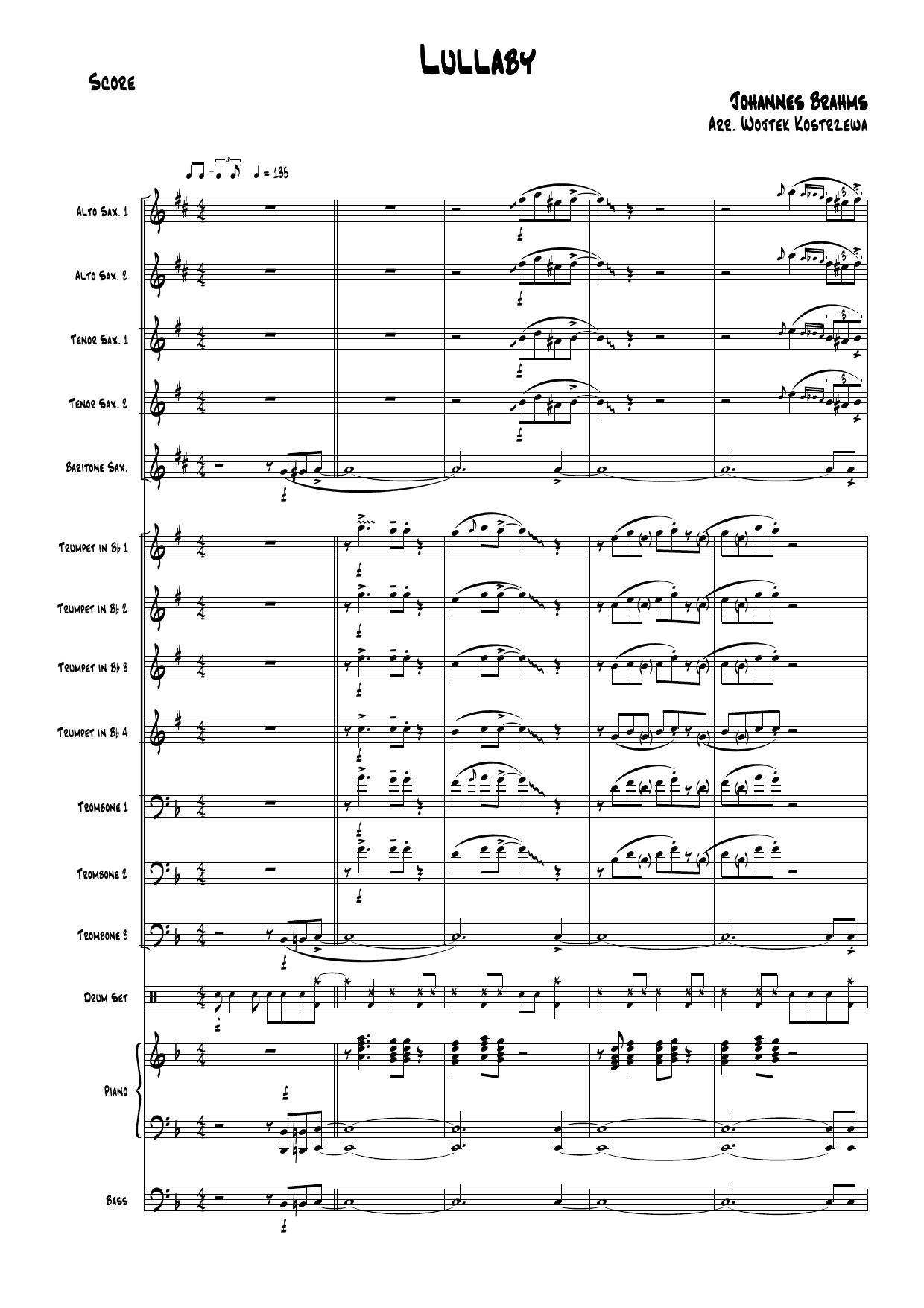
Lullaby (W.Kostrzewa)
Composed by W. Kostrzewa
Arranged by W.Kostrzewa
- Ensemble: Big Band
- Style: Jazz Standard
- Pages: 17
- Instruments (15): Alto Saxophone 1, Alto Saxophone 2, Tenor Saxophone 1, Tenor Saxophone 2, Baritone Saxophone, Trumpet in Bb 1, Trumpet in Bb 2, Trumpet in Bb 3, Trumpet in Bb 4, Trombone 1, Trombone 2, Trombone 3, Drum Set, Piano, Bass
- Difficulty: easy
- Content: Individual Parts
- Format: PDF Download (Instant)
- Price: $24.99
"Lullaby," composed and arranged by W. Kostrzewa, brings a sophisticated, contemporary European jazz aesthetic to the traditional big band repertoire. While rooted in the rich harmonic vocabulary of modern jazz standards, Kostrzewa’s composition reimagines the soothing, nocturnal qualities of a traditional lullaby through an expansive orchestral lens. The piece bridges the gap between classic swing-era mood writing and contemporary modal jazz harmony, offering an evocative listening experience that moves seamlessly between tender, introspective quietude and rich, full-ensemble dynamic swells. At a unhurried, expressive tempo with a subtle, flowing rhythmic undercurrent, the piece establishes an atmospheric, contemplative mood from the downbeat. The harmonic landscape is lush and sophisticated, utilizing extended tertian chords, chromatic mediant relationships, and subtle suspension-and-resolution devices that evoke a dreamy, twilight state. Rather than relying on a predictable blues or AABA form, Kostrzewa constructs a fluid, through-composed narrative arc that steadily builds in textural density, transforming a gentle melodic seed into a powerful, harmonically rich statement before gently receding into tranquility. Kostrzewa’s arrangement treats the standard 15-piece big band instrumentation with chamber-like precision. The woodwind section frequently doubles or works in tight, impressionistic clusters reminiscent of Gil Evans or Bob Brookmeyer voicings, while the brass section is utilized sparingly for maximum emotional impact. The melody is initially introduced intimately by the lead alto saxophone alongside muted trumpets, gradually drawing in the full saxophone soli section with intricate counterlines. Featured improvised solo space is provided for tenor saxophone and piano, allowing soloists to stretch out over modal vamps and sophisticated chord changes that reward lyrical, melodically focused phrasing over rapid-fire technical display. Advanced high school ensembles, collegiate jazz orchestras, and professional community big bands will find this arrangement an exceptional vehicle for developing sectional blend, intonation, and dynamic control. The primary technical demands lie not in breakneck velocities, but in breath support, balance across the ensemble, and the precise execution of nuanced dynamic markings. Directors will appreciate how the chart forces students to listen across sections to maintain a cohesive, warm ensemble blend. It serves as an ideal change-of-pace ballad or programmatic centerpiece for a competitive festival set or a formal concert hall performance. Achieving a successful performance of Kostrzewa's "Lullaby" requires a mature approach to balance, intonation, and rubato phrasing. The conductor must avoid a rigid, metronomic feel; the tempo should breathe naturally, particularly during transitional rubato interludes between major sections. The primary technical challenge rests in the extreme dynamic range required—from whisper-quiet sub-tone passages in the saxophones to rich, sustained ensemble climaxes that must never sound forced or harsh. Brass players should utilize cup or harmon mutes where indicated to maintain a warm, velvety timbre rather than a biting commercial edge. Rehearsal should begin by stripping away the rhythm section and working the horn voicings chorale-style to lock in intonation on the dense, extended harmonies. Pay close attention to the inner voices of the saxophone section; minor-second and major-seventh intervals must be tuned meticulously to achieve the characteristic shimmering effect intended by the arranger. Ensure the rhythm section exercises restraint, treating the groove as a gentle pulse rather than a heavy timekeeping anchor. Q: What instruments and parts are included in this big band arrangement? A: The arrangement is scored for a standard 15-instrument big band ensemble, including Alto Saxophone 1, Alto Saxophone 2, Tenor Saxophone 1, Tenor Saxophone 2, Baritone Saxophone, plus full brass and rhythm sections, accompanied by a comprehensive 17-page conductor score. Q: What is the difficulty level of W. Kostrzewa's "Lullaby"? A: This arrangement is graded as advanced intermediate to advanced, making it best suited for college jazz orchestras, advanced high school bands, and professional community ensembles due to its demanding harmonic reading and required dynamic control. Q: What is the musical style and historical background of the piece? A: Written in the style of a modern contemporary jazz standard, the piece functions as a sophisticated jazz ballad that blends traditional big band textures with impressionistic, modal harmony reminiscent of late-20th-century European jazz writing. Q: What makes this specific arrangement unique? A: Unlike standard swinging big band charts, Kostrzewa's arrangement stands out for its chamber-like orchestration, lush extended voicings, and a fluid, through-composed narrative arc that prioritizes subtle coloristic shifts and deep emotional resonance over traditional shout choruses. Q: What is the approximate performance duration and tempo feel of the arrangement? A: The piece is performed at a slow, expressive, ballad-like tempo with a flowing, rubato-influenced pulse, typically running between 5 to 6 minutes depending on the length of the improvised solos.
Questions and answers
- What is included in the Lullaby (W.Kostrzewa) PDF?
- The verified current file contains a conductor score across 17 pages.
- How many instruments or parts are listed for Lullaby (W.Kostrzewa)?
- The verified instrumentation list contains 15 entries for this Big Band arrangement.
- Who is credited for Lullaby (W.Kostrzewa)?
- Composer: W. Kostrzewa. Arranger: W.Kostrzewa.
- What difficulty is listed for Lullaby (W.Kostrzewa)?
- The verified difficulty level is easy.
- What style is listed for Lullaby (W.Kostrzewa)?
- The catalog lists the style as Jazz Standard.
- Can I preview Lullaby (W.Kostrzewa) before buying?
- Yes. The product page provides a preview generated from the current PDF file.
- How is Lullaby (W.Kostrzewa) delivered?
- After successful payment, the digital PDF is made available for download. The displayed price is $24.99.
Musicians Also Search For
Lullaby W.Kostrzewa PDF • Lullaby W.Kostrzewa sheet music • Lullaby arranged by W.Kostrzewa • W.Kostrzewa big band charts • W.Kostrzewa jazz arrangements PDF • Lullaby W. Kostrzewa sheet music • Lullaby W. Kostrzewa big band arrangements • W. Kostrzewa big band charts • Lullaby big band arrangements • Lullaby big band PDF download • Lullaby jazz sheet music • big band sheet music download • Lullaby conductor score PDF • Lullaby sheet music PDF • Lullaby Jazz Standard charts • Jazz Standard big band arrangements • buy Lullaby sheet music • download Lullaby PDF • Lullaby jazz charts • best W.Kostrzewa big band arrangements • W. Kostrzewa arranged by W.Kostrzewa • Lullaby printable sheet music • big band repertoire PDF