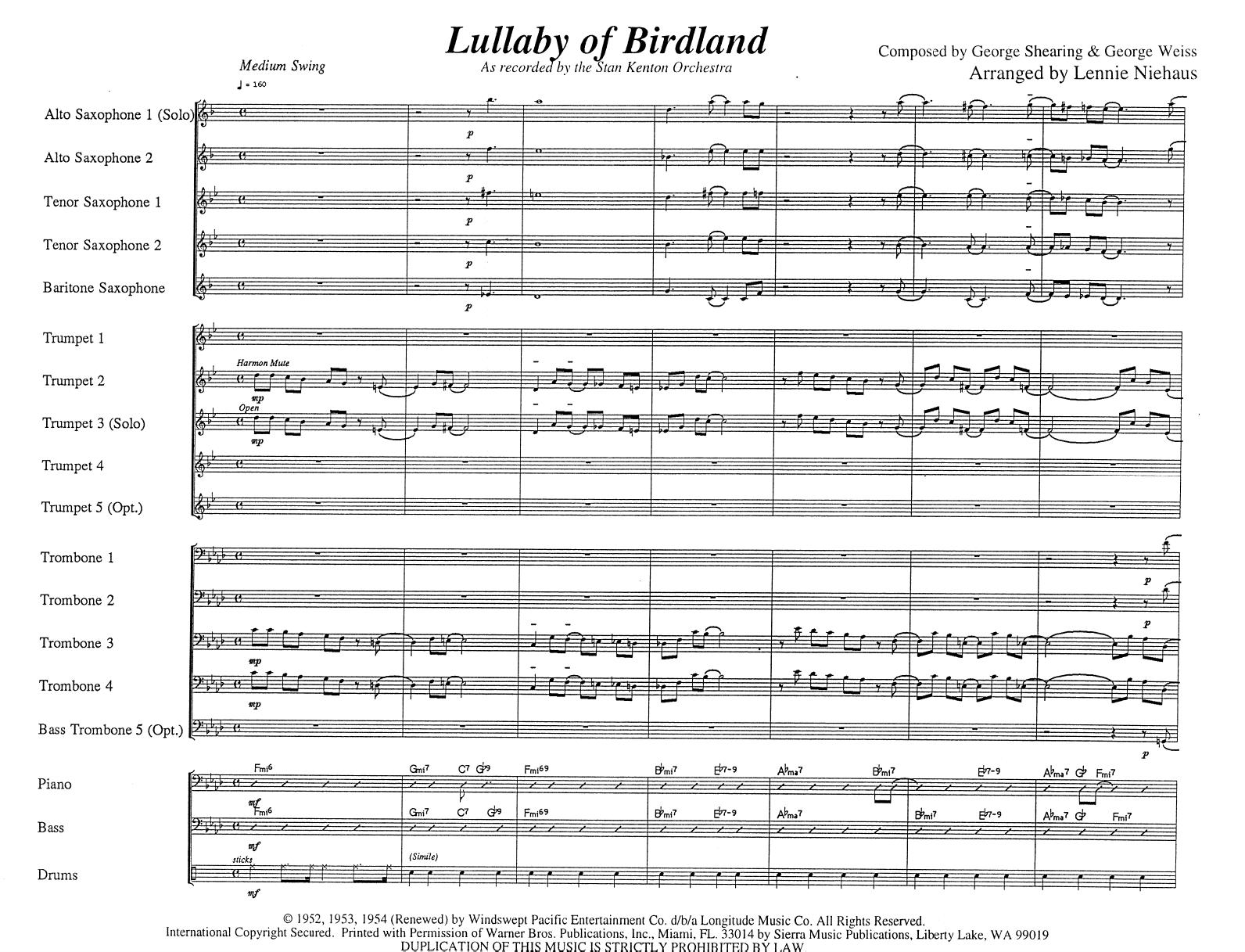
Lullaby Of Birdland (L.Niehaus) sheet music preview

Lullaby Of Birdland (L.Niehaus)

Composed by George Shearing

Arranged by Lennie Niehaus

  • Ensemble: Big Band
  • Pages: 13
  • Instruments (18): Alto Saxophone 1, Alto Saxophone 2, Tenor Saxophone 1, Tenor Saxophone 2, Baritone Saxophone, Trumpet 1, Trumpet 2, Trumpet 3, Trumpet 4, Trumpet 5 (Opt.), Trombone 1, Trombone 2, Trombone 3, Trombone 4, Bass Trombone 5 (Opt.), Piano, Bass, Drums
  • Difficulty: easy
  • Content: Individual Parts
  • Format: PDF Download (Instant)
  • Price: $24.99

George Shearing’s timeless anthem “Lullaby of Birdland,” composed in 1952 as a signature theme for the legendary New York jazz club Birdland, stands as one of the most enduring and recognized contributions to the modern jazz canon. Named after jazz impresario Birdland and its most famous patron, Charlie Parker ("The Bird"), the composition bridges the sophisticated cool of the early 1950s with the infectious, driving pulse of bebop. While countless vocalists and instrumentalists have interpreted its serpentine melody, the big band iterations require a delicate balance of harmonic sophistication and driving rhythmic momentum that only a master arranger can successfully navigate. Lennie Niehaus, a foundational figure in West Coast jazz renowned for his work with the Stan Kenton Orchestra and his prolific educational catalog, brings a brilliantly structured, linear clarity to this arrangement. Niehaus approaches the chart with a signature cool-school aesthetic that prioritizes pristine counterpoint, transparent sax-soli writing, and crisp, economic brass voicings over sheer volume. The arrangement opens with an instantly recognizable hook before settling into a buoyant, medium-tempo swing groove in 4/4 time. Niehaus utilizes rich, extended chordal harmonies—reminiscent of the iconic Shearing piano voicing style translated for full ensemble—while keeping the inner voices moving with a graceful, linear momentum. Throughout the chart, the melodic weight shifts fluidly between sections, featuring tightly knit saxophone solis that demand exceptional articulation and clean dynamic control. The brass section acts both as a punchy counter-puncher and a warm textural bed, building toward a brilliantly crafted shout chorus that revitalizes the familiar changes without overcomplicating them. Solo opportunities are provided within a comfortable framework, allowing featured improvisers to stretch out over standard blow changes that remain faithful to Shearing's original harmonic blueprint. The rhythm section—anchored by piano, bass, and drums—is given specific guidance to maintain a relentless, feather-light ride cymbal pulse that propels the ensemble forward without ever dragging the tempo down. Advanced high school, collegiate, and professional community big bands will find this arrangement to be an exceptional centerpiece for festival programs or concert sets. Because Niehaus writes with such ergonomic consideration for range and stamina, it avoids the punishing extremes of ultra-contemporary charts while still demanding high-level ensemble listening, precise stylistic uniformity, and crisp articulation. Performers and audiences alike will appreciate how this chart honors the sophisticated spirit of 1950s modern jazz while delivering a fresh, highly energized ensemble experience. Conductors should approach this Lennie Niehaus arrangement with a focus on stylistic unity, prioritizing the cool-jazz ethos of lightness, articulation, and transparent texture. The tempo should remain a steady, driving medium swing; avoid rushing, as the groove relies entirely on the relaxed interaction between the drummer's ride cymbal and the bassist's walking quarter notes. The saxophonists must treat the intricate soli sections with a lightweight, bebop-informed articulation, ensuring that all ghosted notes and accents sound effortless rather than forced. Brass players should use a warm, focused tone, keeping muted passages dry and punchy without sacrificing core sound. In the shout chorus, balance is critical: the trombones and saxophones provide essential harmonic movement underneath high brass stabs, so dynamic restraint in the upper trumpet register is necessary to let the counter-lines speak clearly. Rehearsal time is best spent isolating the rhythm section to lock in the foundational groove before layering the horn sections section by section. Q: What instruments and parts are included in this big band arrangement? A: This arrangement is scored for a standard 18-piece big band instrumentation, consisting of 2 alto saxophones, 2 tenor saxophones, 1 baritone saxophone, 4 trumpets, 4 trombones, guitar, piano, bass, drums, and a comprehensive conductor score spanning 13 pages. Q: What is the difficulty level of this chart? A: This arrangement is well-suited for advanced high school, collegiate, and professional community big bands, offering moderate technical challenges that emphasize ensemble blend, clean articulation, and stylistic precision over extreme technical endurance. Q: What is the historical and stylistic context of the piece? A: Based on George Shearing's 1952 jazz standard written for the famous New York club Birdland, this chart reflects the sophisticated cool-jazz and bebop-infused writing style characteristic of arranger Lennie Niehaus. Q: What makes this specific arrangement by Lennie Niehaus unique? A: Niehaus distinctively applies his West Coast linear counterpoint and transparent voicing techniques to Shearing's familiar harmonies, resulting in a fresh, uncluttered texture that highlights clean sectional interplay and intelligent harmonic movement. Q: What is the performance duration and suggested tempo feel? A: The arrangement is set in a buoyant, medium-tempo swing feel (4/4 time) and typically runs between 3 to 4 minutes in performance duration, depending on the length of the improvised solo choruses.

Questions and answers

What is included in the Lullaby Of Birdland (L.Niehaus) PDF?
The verified current file contains a conductor score across 13 pages.
How many instruments or parts are listed for Lullaby Of Birdland (L.Niehaus)?
The verified instrumentation list contains 18 entries for this Big Band arrangement.
Who is credited for Lullaby Of Birdland (L.Niehaus)?
Composer: George Shearing. Arranger: Lennie Niehaus.
What difficulty is listed for Lullaby Of Birdland (L.Niehaus)?
The verified difficulty level is easy.
Can I preview Lullaby Of Birdland (L.Niehaus) before buying?
Yes. The product page provides a preview generated from the current PDF file.
How is Lullaby Of Birdland (L.Niehaus) delivered?
After successful payment, the digital PDF is made available for download. The displayed price is $24.99.

Musicians Also Search For

Lullaby Of Birdland Lennie Niehaus PDFLullaby Of Birdland Lennie Niehaus sheet musicLullaby Of Birdland arranged by Lennie NiehausLennie Niehaus big band chartsLennie Niehaus jazz arrangements PDFLullaby Of Birdland George Shearing sheet musicLullaby Of Birdland George Shearing big band arrangementsGeorge Shearing big band chartsLullaby Of Birdland big band arrangementsLullaby Of Birdland big band PDF downloadLullaby Of Birdland jazz sheet musicbig band sheet music downloadLullaby Of Birdland conductor score PDFLullaby Of Birdland sheet music PDFbuy Lullaby Of Birdland sheet musicdownload Lullaby Of Birdland PDFLullaby Of Birdland jazz chartsbest Lennie Niehaus big band arrangementsGeorge Shearing arranged by Lennie NiehausLullaby Of Birdland printable sheet musicbig band repertoire PDF

All arrangements by Lennie Niehaus All George Shearing sheet music