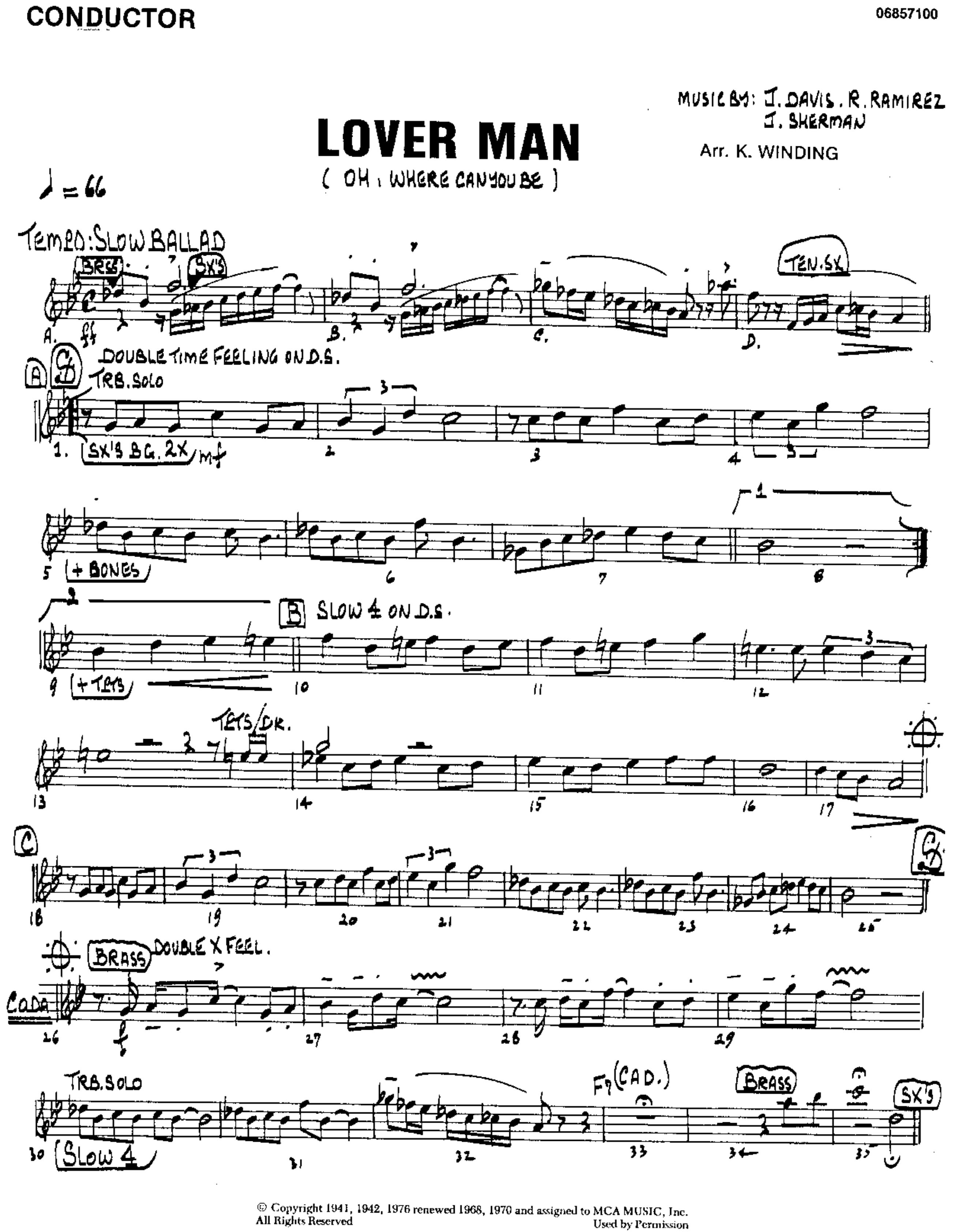
Lover Man (K.Winding)
Composed by Jimmy Davis
Arranged by K.Winding
- Ensemble: Big Band
- Style: Jazz Standard
- Pages: 20
- Instruments (20): Conductor, Trombone Solo, Alto Sax 1, Alto Sax 2, Tenor Sax 1, Tenor Sax 2, Baritone Sax, Trumpet 1, Trumpet 2, Trumpet 3, Trumpet 4, Trumpet 5, Trombone 1, Trombone 2, Trombone 3, Trombone 4, Trombone 5, Piano, Bass, Drums
- Difficulty: easy
- Content: Individual Parts
- Format: PDF Download (Instant)
- Price: $24.99
Composed in 1941 by Jimmy Davis, James Sherman, and Roger Ramirez, "Lover Man (Oh Where Can You Be?)" occupies a revered space in the American songbook, immortalized eternally by Billie Holiday’s haunting 1944 recording. This quintessential jazz standard bridges the late swing era and the dawn of modern bebop, capturing a mood of profound nocturnal yearning and melancholic vulnerability. While countless vocalists and small groups have interpreted its yearning melody, arranging it for a full jazz big band introduces a rich canvas of dynamic contrast, transforming an intimate lament into a sweeping orchestral statement without losing its emotional core. Kai Winding’s distinctive treatment of this material leverages his legendary mastery of the trombone, shaping an arrangement that is deeply lyrical yet harmonically sophisticated. Set as a lush, introspective ballad with a lingering, expressive pulse, the chart avoids static orchestration in favor of flowing counterlines and rich, modern chord extensions. Winding utilizes classic cool-school voicings, blending the saxophone section with warm trombone pads to create a velvety texture that mirrors the smoky atmosphere of a 1950s jazz club. The mood shifts seamlessly from hushed, delicate underscoring to soaring, emotionally charged ensemble swells that demand absolute control over intonation and breath support. At the heart of this 19-instrument configuration is a prominent Trombone Solo, a nod to Winding's own virtuosic performance style, flanked by a standard 5-sax, 4-trumpet, 4-trombone, and 4-rhythm section complement. The melody is introduced with tasteful economy before the arrangement opens up into lush soli sections that test the ensemble's balance and blend. While the technical demands are rooted less in blazing velocity and more in tone production, endurance, and rubato phrasing, the solo trombone chair requires a player capable of nuanced, vocal-like expression. The harmonic landscape features sophisticated altered dominants and chromatic voice-leading that will captivate advanced listeners and provide deep educational value for the performers. Advanced high school ensembles with mature lead players, collegiate jazz orchestras, and professional big bands will find this arrangement an ideal vehicle for developing ballad-playing maturity. Because modern big band literature often prioritizes high-energy swing or complex fusion, this chart offers a vital curriculum counterweight: teaching musicians how to play softly, listen across sections, and sustain emotional tension over slow tempos. It stands out as a masterclass in economy of means, proving that a big band can pack an immense emotional punch through sheer harmonic beauty and sensitive dynamic shading. Navigating this slow ballad successfully requires exceptional breath support, pristine intonation, and a unified concept of time from the entire ensemble. The conductor should establish a relaxed, pulsating feel that avoids a rigid or dragging pulse; encourage the rhythm section to play with a subtle, heartbeat-like subdivision rather than a heavy downbeat. The primary technical challenge lies in maintaining a warm, centered tone at very soft dynamic levels, particularly during exposed chordal passages in the brass. Section leaders must meticulously balance the voicing stacks so that no single instrument sticks out of the harmonic blend. The featured trombone soloist should approach the changes with a vocal lyricism, prioritizing melodic contour over flashy ornamentation. Rehearsal time should be heavily invested in tuning the altered chords and matching vibrato widths across the saxophone and trombone sections. Encourage the rhythm section—especially the pianist and guitarist—to voice chords sparsely, leaving plenty of sonic space for the rich orchestrations to breathe. Q: What instruments and parts are included in this arrangement? A: This chart is scored for a standard 19-instrument big band, consisting of a Trombone Soloist, 2 Alto Saxophones, 2 Tenor Saxophones, Baritone Saxophone, 4 Trumpets, 4 Trombones, Piano, Guitar, Bass, and Drums, alongside a complete conductor score and 20 individual pages of parts. Q: What is the difficulty level of this chart? A: This arrangement is graded as advanced, primarily suited for collegiate, professional, and top-tier high school jazz ensembles due to its demands on intonation, dynamic control, and subtle ballad phrasing. Q: What is the historical style and context of this piece? A: Originally penned as a 1941 vocal vehicle famously recorded by Billie Holiday, this arrangement reframes the classic standard through a sophisticated, cool-jazz lens inspired by the arranging and trombone stylings of Kai Winding. Q: What makes this particular arrangement unique? A: It centers around a featured trombone solo and utilizes lush, modern chord extensions and delicate section blending, elevating a traditional vocal lament into a sophisticated instrumental tone poem for big band. Q: What is the performance duration and tempo feel? A: The piece is structured as a slow, expressive ballad with a flexible, breathing tempo feel, typically running between 4 and 5 minutes depending on the length of the improvised solo sections and rubato phrasing.
Questions and answers
- What is included in the Lover Man (K.Winding) PDF?
- The verified current file contains a conductor score and individual parts across 20 pages.
- How many instruments or parts are listed for Lover Man (K.Winding)?
- The verified instrumentation list contains 20 entries for this Big Band arrangement.
- Who is credited for Lover Man (K.Winding)?
- Composer: Jimmy Davis. Arranger: K.Winding.
- What difficulty is listed for Lover Man (K.Winding)?
- The verified difficulty level is easy.
- What style is listed for Lover Man (K.Winding)?
- The catalog lists the style as Jazz Standard.
- Can I preview Lover Man (K.Winding) before buying?
- Yes. The product page provides a preview generated from the current PDF file.
- How is Lover Man (K.Winding) delivered?
- After successful payment, the digital PDF is made available for download. The displayed price is $24.99.
Musicians Also Search For
Lover Man K.Winding PDF • Lover Man K.Winding sheet music • Lover Man arranged by K.Winding • K.Winding big band charts • K.Winding jazz arrangements PDF • Lover Man Jimmy Davis sheet music • Lover Man Jimmy Davis big band arrangements • Jimmy Davis big band charts • Lover Man big band arrangements • Lover Man big band PDF download • Lover Man jazz sheet music • big band sheet music download • Lover Man conductor score PDF • Lover Man individual parts download • Lover Man sheet music PDF • Lover Man Jazz Standard charts • Jazz Standard big band arrangements • buy Lover Man sheet music • download Lover Man PDF • Lover Man jazz charts • best K.Winding big band arrangements • Jimmy Davis arranged by K.Winding • Lover Man printable sheet music • big band repertoire PDF