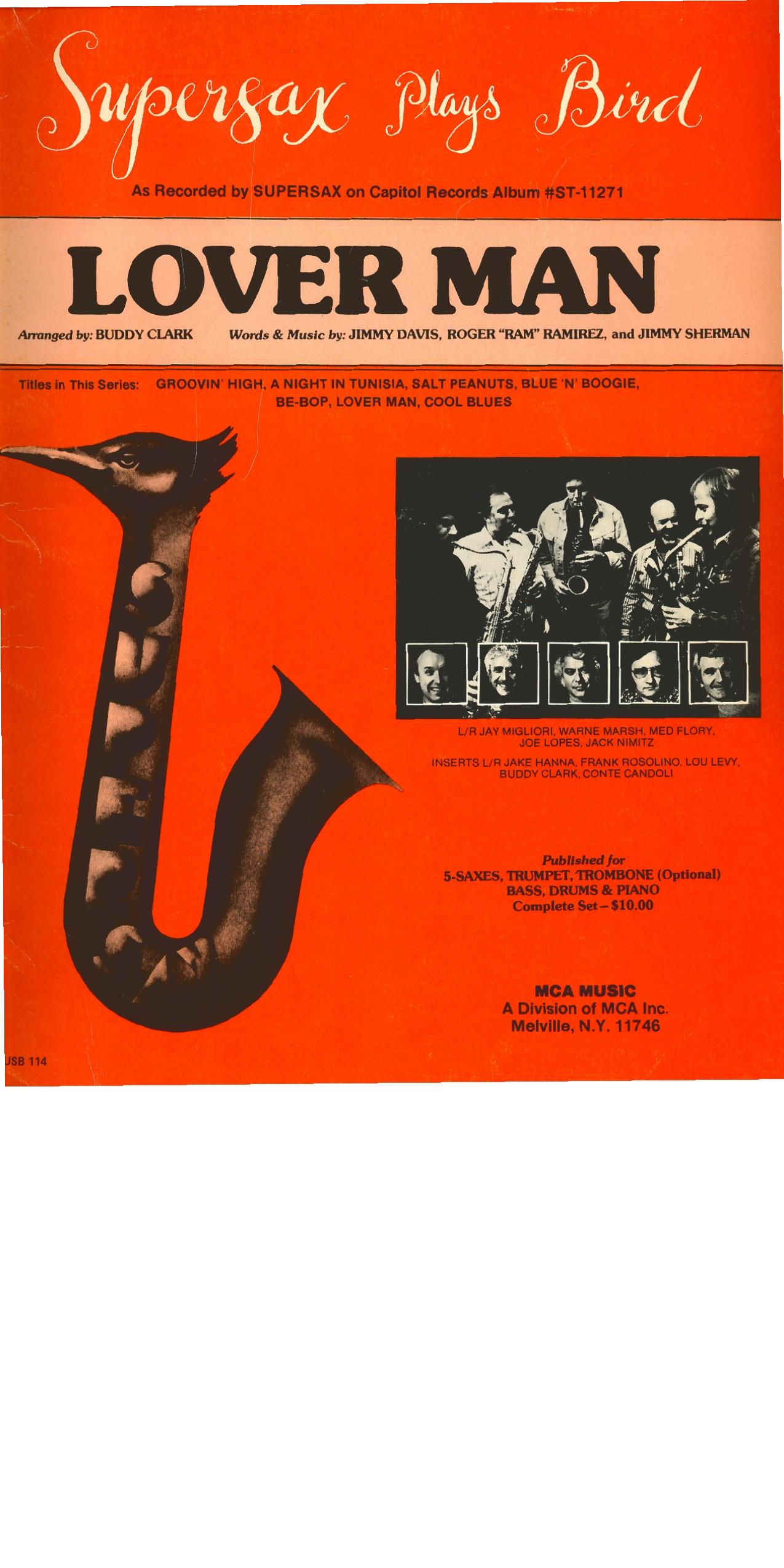
Lover Man (B.Clark)
Composed by Jimmy Davis, Ram Ramirez, James Sherman
Arranged by Buddy Clark
- Ensemble: Small Ensemble
- Style: Jazz Standard
- Pages: 20
- Instruments (10): Piano, Bass, Drums, 1st Eb Alto Saxophone, 2nd Eb Alto Saxophone, 1st Bb Tenor Saxophone, 2nd Bb Tenor Saxophone, Eb Baritone Saxophone, Bb Trumpet, Trombone (Optional)
- Difficulty: easy
- Content: Individual Parts
- Format: PDF Download (Instant)
- Price: $12.99
"Lover Man (Oh, Where Can You Be?)" stands as a cornerstone of the jazz ballad repertoire, a poignant lament born in 1941. This timeless standard gained immortal status through the definitive 1944 recording by Billie Holiday, whose deeply expressive vocal interpretation cemented its place in jazz history. Emerging from the swing era but foreshadowing the harmonic sophistication of bebop, "Lover Man" is characterized by its lush, often melancholic melody and rich chord changes, making it a favorite vehicle for improvisation and emotional storytelling. Its enduring appeal lies in its universal theme of longing and its capacity to showcase a performer's lyrical prowess and harmonic understanding. Buddy Clark's arrangement of "Lover Man" for small ensemble masterfully captures the song's inherent romanticism while imbuing it with his signature harmonic richness and intelligent voicing. Clark approaches this piece as a medium-slow swing ballad in the key of F Major, maintaining the original's tender, introspective mood but allowing for a gentle, understated rhythmic drive. His distinctive touch is evident in the warm, close voicings that create a sophisticated harmonic tapestry, particularly in the ensemble sections. The arrangement opens with a beautifully voiced, harmonized statement of the melody, immediately establishing an intimate and expressive atmosphere. Clark avoids overt flashiness, instead focusing on crafting a cohesive and emotionally resonant performance through thoughtful orchestration and dynamic control. The arrangement features the melody carried primarily by the lead instrument (e.g., trumpet or alto saxophone), often supported by the other horns in a lush, harmonized texture. There are ample opportunities for featured solos, typically over the standard AABA form, allowing individual musicians to explore the rich harmonic landscape. Clark's charts are known for their clarity, making the often-complex harmonies accessible while still challenging musicians to play with precision and blend. Technical challenges include maintaining a consistent, relaxed medium-slow swing feel, executing precise dynamics, and navigating the subtle harmonic shifts. The reward lies in performing a truly beautiful piece of music that allows for deep emotional expression and showcases the ensemble's ability to play with sensitivity and nuance. This arrangement is particularly well-suited for college, community, and professional small jazz ensembles seeking a sophisticated yet accessible ballad that highlights musicality and ensemble blend. This arrangement of "Lover Man" requires a sensitive and cohesive approach to achieve its full emotional impact. The primary challenge lies in maintaining a consistent, relaxed medium-slow swing feel (quarter note around 80-90 bpm) without dragging or losing momentum. Emphasize a light, airy swing eighth-note feel from the rhythm section, avoiding heavy accents. Horn players should focus on precise intonation, especially in the close voicings, and strive for a warm, blended sound throughout. Dynamics are crucial; observe all markings carefully, paying particular attention to crescendos and diminuendos that shape the melodic lines. Encourage soloists to approach their improvisations with lyrical phrasing and harmonic awareness, drawing inspiration from the original's melancholic beauty. Rehearse the ensemble voicings slowly to ensure balance and clarity, especially in the harmonized melody sections. No special techniques like plunger mutes or falls are explicitly required, allowing the focus to remain on pure tone and musical expression. Q: What instruments are included in this "Lover Man (B.Clark)" arrangement? A: This small ensemble arrangement typically includes parts for lead trumpet, alto saxophone, tenor saxophone, trombone, piano, bass, and drums, providing a classic jazz combo instrumentation. Q: What is the difficulty level of this arrangement? A: This arrangement is rated as intermediate to advanced. While technically accessible, it requires strong musicianship, good intonation, and a sophisticated understanding of jazz ballad phrasing and ensemble blend. Q: What musical style and historical context does this arrangement represent? A: This arrangement is a jazz standard ballad, originally composed in 1941 and famously recorded by Billie Holiday. It embodies the lyrical and harmonically rich characteristics of the swing era, with touches of pre-bebop sophistication. Q: What makes Buddy Clark's arrangement of "Lover Man" unique? A: Buddy Clark's treatment is distinguished by its lush, close voicings, intelligent harmonic choices, and a focus on maintaining the song's inherent emotional depth and romanticism through a medium-slow swing feel. Q: What is the typical performance duration and tempo for this piece? A: The typical performance duration for this arrangement is approximately 3.5 to 4.5 minutes, played at a medium-slow swing tempo, generally around 80-90 beats per minute.
Questions and answers
- What is included in the Lover Man (B.Clark) PDF?
- The verified current file contains individual parts across 20 pages.
- How many instruments or parts are listed for Lover Man (B.Clark)?
- The verified instrumentation list contains 10 entries for this Small Ensemble arrangement.
- Who is credited for Lover Man (B.Clark)?
- Composer: Jimmy Davis, Ram Ramirez, James Sherman. Arranger: Buddy Clark.
- What difficulty is listed for Lover Man (B.Clark)?
- The verified difficulty level is easy.
- What style is listed for Lover Man (B.Clark)?
- The catalog lists the style as Jazz Standard.
- Can I preview Lover Man (B.Clark) before buying?
- Yes. The product page provides a preview generated from the current PDF file.
- How is Lover Man (B.Clark) delivered?
- After successful payment, the digital PDF is made available for download. The displayed price is $12.99.
Musicians Also Search For
Lover Man Buddy Clark PDF • Lover Man Buddy Clark sheet music • Lover Man arranged by Buddy Clark • Buddy Clark small ensemble charts • Buddy Clark jazz arrangements PDF • Lover Man Jimmy Davis, Ram Ramirez, James Sherman sheet music • Lover Man Jimmy Davis, Ram Ramirez, James Sherman small ensemble arrangements • Jimmy Davis, Ram Ramirez, James Sherman small ensemble charts • Lover Man small ensemble arrangements • Lover Man small ensemble PDF download • Lover Man jazz sheet music • small ensemble sheet music download • Lover Man individual parts download • Lover Man sheet music PDF • Lover Man Jazz Standard charts • Jazz Standard small ensemble arrangements • buy Lover Man sheet music • download Lover Man PDF • Lover Man jazz charts • best Buddy Clark small ensemble arrangements • Jimmy Davis, Ram Ramirez, James Sherman arranged by Buddy Clark • Lover Man printable sheet music • small ensemble repertoire PDF