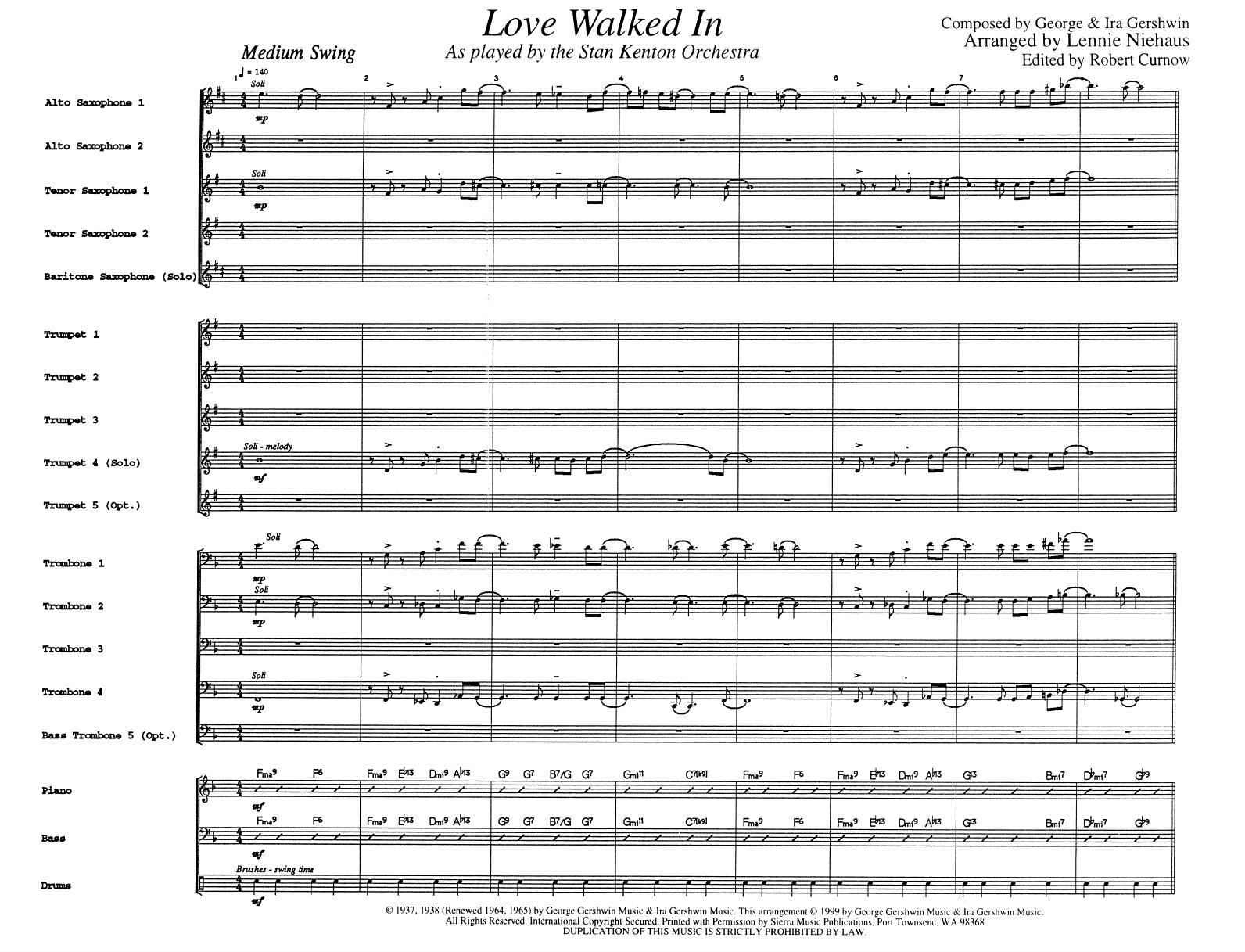
Love Walked In (L.Niehaus)
Composed by George Gershwin
Arranged by Lennie Niehaus
- Ensemble: Big Band
- Pages: 14
- Instruments (18): Alto Saxophone 1, Alto Saxophone 2, Tenor Saxophone 1, Tenor Saxophone 2, Baritone Saxophone, Trumpet 1, Trumpet 2, Trumpet 3, Trumpet 4, Trumpet 5, Trombone 1, Trombone 2, Trombone 3, Trombone 4, Bass Trombone 5, Piano, Bass, Drums
- Difficulty: easy
- Content: Individual Parts
- Format: PDF Download (Instant)
- Price: $24.99
George Gershwin’s timeless melody "Love Walked In," originally introduced in the 1938 musical film *The Goldwyn Follies* and quickly embraced as a cornerstone of the Great American Songbook, receives an exquisite, West Coast-inflected transformation in this definitive big band setting. As a jazz standard, the tune has been interpreted by everyone from Ella Fitzgerald to Art Blakey, celebrated for its soaring AABA melodic architecture and lush harmonic progression. Lennie Niehaus—a towering figure in West Coast jazz renowned for his work with the Stan Kenton Orchestra and his prolific writing for both jazz ensembles and film—infuses the composition with his signature sophistication, clarity, and linear counterpoint, turning a classic vocal ballad into an engaging instrumental showcase. Clocking in with a buoyant, medium-swing groove, this arrangement establishes an atmosphere of effortless cool and understated elegance. Niehaus avoids heavy, bombastic scoring in favor of transparent, harmonically rich voicings that allow the ensemble's sections to converse with conversational agility. The mood is sophisticated and optimistic, characterized by breezy saxophone solis and crisp brass interplay that evokes the refined climate of 1950s modernist jazz. The underlying rhythm section drives the chart with a steady, buoyant walking bassline and light ride-cymbal-dominated swing, maintaining forward momentum without ever rushing the relaxed pocket essential to the West Coast aesthetic. Niehaus’s arranging genius shines through the meticulous balancing of texture and register, utilizing tight reed voicings and subtle chromatic passing tones that expand Gershwin’s original harmonies into modern jazz territory. The saxophone section takes a prominent role, carrying the primary thematic material through intricately crafted unison and harmonized lines that demand clean articulation and precise intonation. Featured solo space allows a designated horn player to stretch out over standard changes, supported by clever background figures from the brass that build dramatic tension naturally. The ensemble will find the chart deeply rewarding due to its intelligent voice-leading; every part has a linear integrity that makes the inner voices feel like independent melodic counterlines rather than mere padding. Advanced high school ensembles with strong section players, college jazz orchestras, and professional community big bands will find this arrangement to be an ideal vehicle for developing stylistic refinement and ensemble listening skills. While it does not rely on ultra-high brass ranges or breakneck tempos to make an impact, its success hinges on uniform articulation, stylistic unity, and a light, swinging eighth-note feel. Directors will appreciate how the chart teaches students the value of restraint, balance, and dynamic shading, making it an exceptional programming choice for both formal concerts and festival stages. Success with this Lennie Niehaus chart depends heavily on maintaining a relaxed, buoyant medium-swing feel rather than pushing the tempo. The rhythm section must lock into an unhurried, driving pocket; the drummer should emphasize a crisp, feather-light ride cymbal pattern with a gentle chick on beats two and four, avoiding heavy hi-hat stomps that can bog down the West Coast lightness. Horn players must pay strict attention to short-long articulation markings, ensuring that eighth notes are swung naturally in the mid-century modern style without over-exaggerating triplets. Technically, the primary challenge lies in the inner-voice balance within the saxophone and trombone sections, as Niehaus employs close, linear harmonies that require immaculate intonation to bloom properly. Brass players should keep vibrato controlled and purposeful, utilizing clean, punchy attacks on background figures to support soloists without overwhelming them. Rehearsal time should initially be split between sectional work—focusing on blend and uniform phrasing—and full-ensemble integration to ensure the dynamic interplay between the rhythm section and horns remains transparent and articulate. Q: What instruments and parts are included in this big band arrangement? A: The 14-page arrangement is scored for a standard 16-instrument big band instrumentation, comprising two alto saxophones, two tenor saxophones, baritone saxophone, standard brass sections, and a complete rhythm section. Q: What is the difficulty level of this arrangement? A: This chart is graded as intermediate-to-advanced (suitable for advanced high school, college, and professional community big bands), requiring strong ensemble reading, stylistic maturity, and precise section blending rather than extreme technical pyrotechnics. Q: What is the style and historical context of this piece? A: Composed originally by George Gershwin in 1938, this piece is arranged in a classic West Coast medium-swing style by veteran jazz saxophonist and arranger Lennie Niehaus, reflecting the refined, harmonically sophisticated aesthetic of 1950s modern jazz. Q: What makes this specific Lennie Niehaus arrangement unique? A: It stands out for its transparent, linear voice-leading, clever counterpoint, and polished ensemble interplay, transforming a traditional songbook ballad into a sophisticated instrumental showcase that prioritizes balance and cool-jazz elegance over loud, heavy shout choruses. Q: What is the recommended performance tempo and duration? A: The arrangement is set to a comfortable, flowing medium-swing tempo that typically yields a performance duration of approximately 3 to 4 minutes, depending on the length of the improvised solos.
Questions and answers
- What is included in the Love Walked In (L.Niehaus) PDF?
- The verified current file contains a conductor score across 14 pages.
- How many instruments or parts are listed for Love Walked In (L.Niehaus)?
- The verified instrumentation list contains 18 entries for this Big Band arrangement.
- Who is credited for Love Walked In (L.Niehaus)?
- Composer: George Gershwin. Arranger: Lennie Niehaus.
- What difficulty is listed for Love Walked In (L.Niehaus)?
- The verified difficulty level is easy.
- Can I preview Love Walked In (L.Niehaus) before buying?
- Yes. The product page provides a preview generated from the current PDF file.
- How is Love Walked In (L.Niehaus) delivered?
- After successful payment, the digital PDF is made available for download. The displayed price is $24.99.
Musicians Also Search For
Love Walked In Lennie Niehaus PDF • Love Walked In Lennie Niehaus sheet music • Love Walked In arranged by Lennie Niehaus • Lennie Niehaus big band charts • Lennie Niehaus jazz arrangements PDF • Love Walked In George Gershwin sheet music • Love Walked In George Gershwin big band arrangements • George Gershwin big band charts • Love Walked In big band arrangements • Love Walked In big band PDF download • Love Walked In jazz sheet music • big band sheet music download • Love Walked In conductor score PDF • Love Walked In sheet music PDF • buy Love Walked In sheet music • download Love Walked In PDF • Love Walked In jazz charts • best Lennie Niehaus big band arrangements • George Gershwin arranged by Lennie Niehaus • Love Walked In printable sheet music • big band repertoire PDF