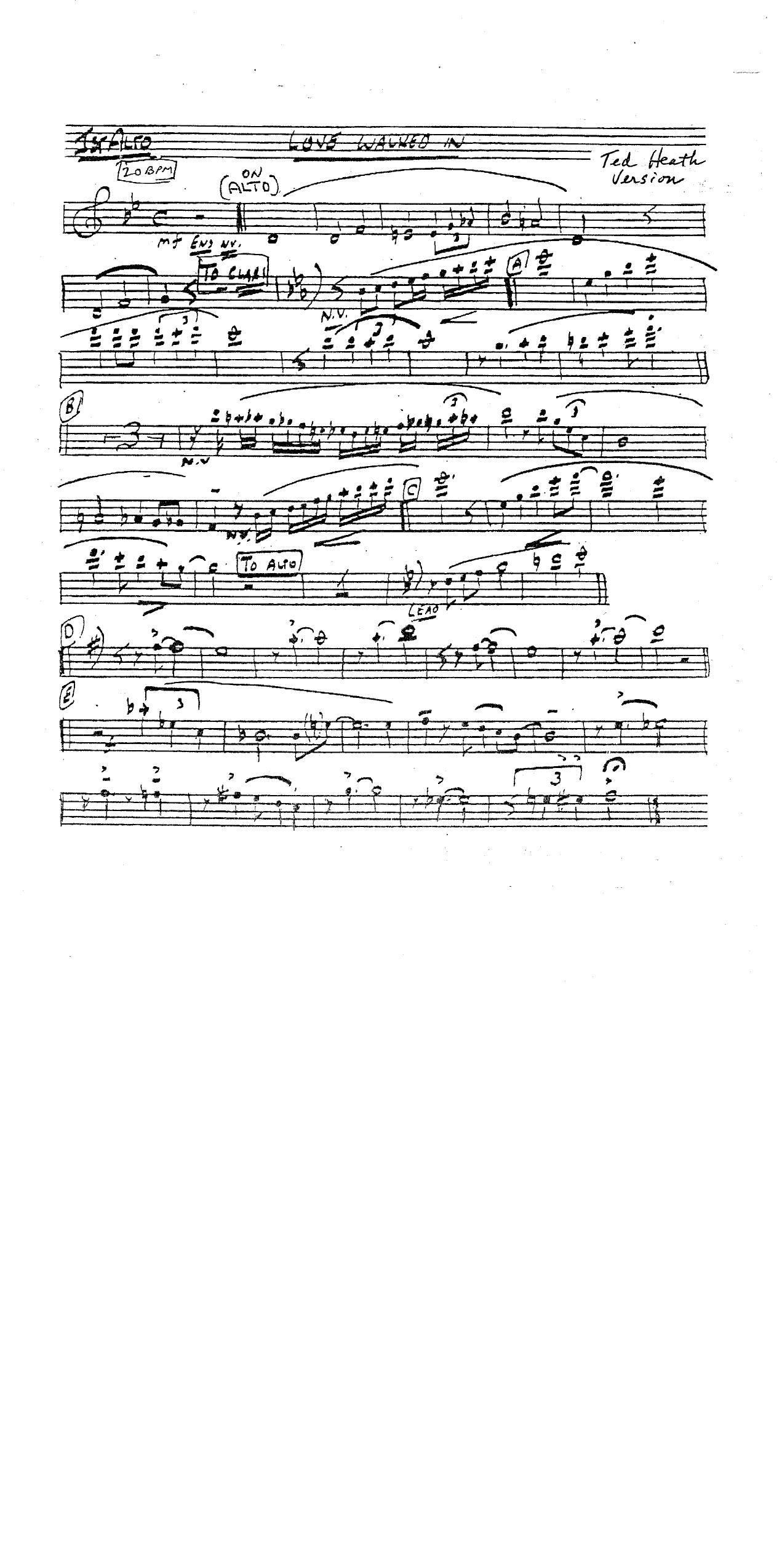
Love Walked In (J.Farley) (Ted Heath)
Composed by George Gershwin
Arranged by John Farley
- Ensemble: Big Band
- Pages: 17
- Instruments (17): 1st Alto Saxophone, 2nd Alto Saxophone, 1st Tenor Saxophone, 2nd Tenor Saxophone, Baritone Saxophone, 1st Trumpet, 2nd Trumpet, 3rd Trumpet, 4th Trumpet, 1st Trombone, 2nd Trombone, 3rd Trombone, 4th Trombone, Guitar, Piano, Bass, Drums
- Difficulty: easy
- Content: Individual Parts
- Format: PDF Download (Instant)
- Price: $24.99
George Gershwin’s timeless melody "Love Walked In," introduced in the 1938 film *The Goldwyn Follies*, stands as one of the great romantic contributions to the Great American Songbook. Later embraced by icons like Ella Fitzgerald, Chet Baker, and Art Blakey, the tune's soaring AABA lyrical contour and sophisticated harmonic framework made it an instant favorite for jazz interpreters. In the British big band tradition, the Ted Heath Orchestra championed a polished, high-octane yet deeply swinging sound that rivaled the finest American orchestras of the post-war era. Ted Heath’s signature approach relied on lush brass voicings, precision reed solis, and an undeniable rhythmic drive that elevated standard arrangements into masterclasses of British jazz sophistication. John Farley’s masterful adaptation for a 9-instrument big band distills the grandeur of the full Ted Heath library into a flexible, punchy, and texturally rich chamber-jazz format. Anchored by a buoyant, driving medium swing feel in 4/4 time, this arrangement balances sophisticated harmonic extensions with an infectious, swinging momentum. The mood shifts effortlessly from warm, romantic nostalgia during the head statements to an effervescent, high-energy swing that evokes the golden age of late-1940s and 1950s dance halls and concert stages. Farley captures the characteristic Heath brass bite while maintaining a transparent texture that allows every instrumental voice to shine independently within the 9-piece instrumentation. Farley’s arranging strategy utilizes tight, interlocking horn voicings reminiscent of traditional West Coast writing, paired with classic swing-era block chords for the saxophones. The arrangement features the alto and tenor saxophones carrying the primary melodic weight, often doubling in sweet, breathy unisons before expanding into rich four-part reed harmonies. A standout moment in the chart is a meticulously crafted ensemble soli that showcases the dynamic interplay between the brass and reeds, building naturally toward a spirited shout chorus. Technical challenges center around maintaining a consistent, relaxed swing eighth-note subdivision at a moderate-to-up tempo, clean articulation on syncopated figures, and balancing the inner voices so that the counter-melodies in the trombone and baritone sax remain audible beneath the lead trumpet. Advanced high school, collegiate, and professional freelance big bands or jazz nonets/decets will find this arrangement an exceptional vehicle for showcasing stylistic versatility and section blend. Because it condenses the massive, wall-of-sound aesthetic of the Ted Heath Orchestra into a streamlined 9-instrument configuration (featuring Alto Sax, Tenor Sax, Baritone Sax, Trumpet, Trombone, and rhythm section support), it requires skilled players who can project individually without a massive section backing them up. It offers a rewarding rehearsal experience that hones listening skills, section unity, and classic swing phrasing, making it a sophisticated choice for festival performance or concert programming. Achieving an authentic Ted Heath-inspired sound with this 9-instrument ensemble requires meticulous attention to articulation, balance, and stylistic unity. The tempo should be set at a comfortable medium swing (approx. quarter note = 120–126 BPM), ensuring the rhythm section lays down a feather-light, driving ride cymbal pulse rather than a heavy, stomping beat. Horn players must pay close attention to dynamic markings, particularly during the transition from the lush, rubato-flavored intro into the strict tempo swing groove. Key technical challenges include clean execution of short, crisp staccato accents on the off-beats and precise intonation on Farley's extended chord voicings in the brass. Trumpets should use a warm, focused tone without excessive edge, blending seamlessly with the upper register of the alto saxophone during unison lines. Trombone and baritone sax players must anchor the bottom end with a rounded, warm acoustic timbre, treating their counter-lines as conversational elements rather than background filler. Rehearsals should begin section-by-section to lock in the articulation of the complex rhythmic unisons before integrating the rhythm section. Emphasize the natural push of the swing eighth notes, avoiding any tendency to square out the phrasing. Q: What instruments and parts are included in this arrangement? A: This arrangement is scored for a 9-instrument jazz ensemble, featuring Alto Saxophone, Tenor Saxophone, Baritone Saxophone, Trumpet, Trombone, and a full rhythm section (Piano, Bass, Drums, and Guitar), spanning a comprehensive 17-page score and parts set. Q: What is the difficulty level of this chart? A: It is geared toward advanced high school, collegiate, and professional smaller big bands or jazz nonets, requiring strong sight-reading, solid section blend, and facility with medium-tempo swing phrasing. Q: What is the musical style and historical context of the piece? A: Written in the style of the legendary British Ted Heath Orchestra, this chart takes George Gershwin’s 1938 standard "Love Walked In" and reimagines it through a sophisticated, post-war British big band lens. Q: What makes John Farley's arrangement unique? A: Farley successfully condenses the lush, massive wall-of-sound brass and reed textures of a full 17-piece big band into a nimble 9-instrument format without sacrificing harmonic depth or rhythmic drive. Q: What is the performance duration and tempo of this arrangement? A: The arrangement runs approximately 3.5 to 4 minutes in duration and is designed to be performed at a buoyant, driving medium swing tempo around 120–126 BPM.
Questions and answers
- What is included in the Love Walked In (J.Farley) (Ted Heath) PDF?
- The verified current file contains individual parts across 17 pages.
- How many instruments or parts are listed for Love Walked In (J.Farley) (Ted Heath)?
- The verified instrumentation list contains 17 entries for this Big Band arrangement.
- Who is credited for Love Walked In (J.Farley) (Ted Heath)?
- Composer: George Gershwin. Arranger: John Farley.
- What difficulty is listed for Love Walked In (J.Farley) (Ted Heath)?
- The verified difficulty level is easy.
- Can I preview Love Walked In (J.Farley) (Ted Heath) before buying?
- Yes. The product page provides a preview generated from the current PDF file.
- How is Love Walked In (J.Farley) (Ted Heath) delivered?
- After successful payment, the digital PDF is made available for download. The displayed price is $24.99.
Musicians Also Search For
Love Walked In John Farley PDF • Love Walked In John Farley sheet music • Love Walked In arranged by John Farley • John Farley big band charts • John Farley jazz arrangements PDF • Love Walked In George Gershwin sheet music • Love Walked In George Gershwin big band arrangements • George Gershwin big band charts • Love Walked In big band arrangements • Love Walked In big band PDF download • Love Walked In jazz sheet music • big band sheet music download • Love Walked In individual parts download • Love Walked In sheet music PDF • buy Love Walked In sheet music • download Love Walked In PDF • Love Walked In jazz charts • best John Farley big band arrangements • George Gershwin arranged by John Farley • Love Walked In printable sheet music • big band repertoire PDF