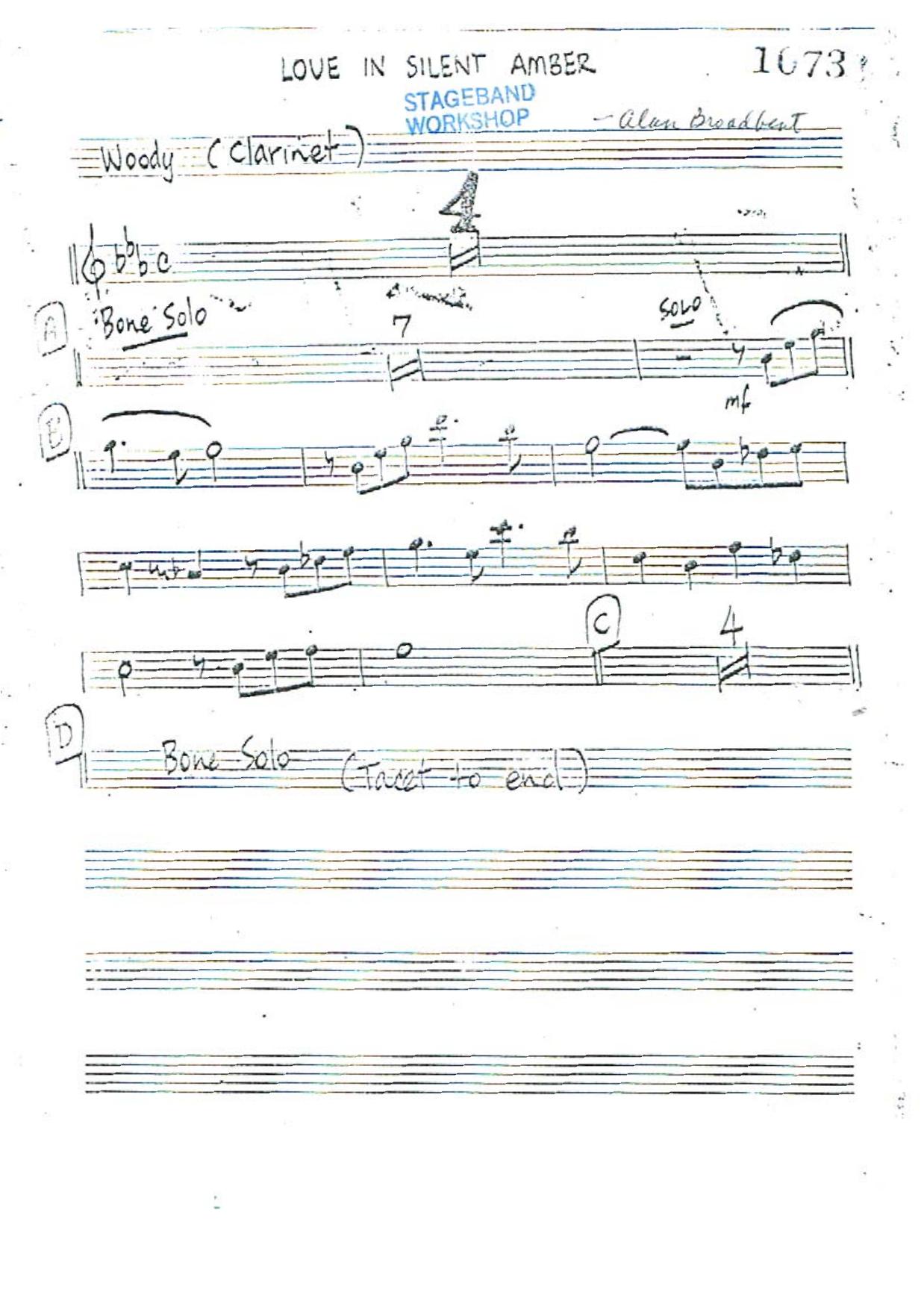
Love In Silent Amber (A.Broadbent) sheet music preview

Love In Silent Amber (A.Broadbent)

Composed by Alan Broadbent

Arranged by Woody Herman

  • Ensemble: Big Band
  • Pages: 31
  • Instruments (16): Clarinet, Tenor Saxophone 1, Tenor Saxophone 2, Tenor Saxophone 3, Baritone Saxophone, Trumpet 1, Trumpet 2, Trumpet 3, Trumpet 4, Solo Trombone, Trombone 2, Trombone 3 (Bass), Piano, Guitar, Bass, Drums
  • Difficulty: medium
  • Content: Individual Parts
  • Format: PDF Download (Instant)
  • Price: $24.99

Alan Broadbent’s evocative composition "Love In Silent Amber" receives a masterclass in ensemble color through this sophisticated big band adaptation by the legendary Woody Herman Orchestra. Originally rooted in the rich soil of modern acoustic jazz and cinematic lyricism, Broadbent’s writing has long been celebrated for its lush harmonic vocabulary and introspective depth. When filtered through the lens of the Woody Herman library, the work transitions from an intimate chamber-jazz statement into a sweeping orchestral landscape that bridges post-bop sophistication with the expressive tradition of the great big band balladeers. The musical character is defined by a lingering, rubato-leaning ballad feel that gradually unfolds into a spacious, flowing medium-slow tempo. The mood is deeply contemplative, melancholic, and intensely romantic, built upon shimmering extended tertian harmonies, subtle chromatic mediant shifts, and a pervasive sense of nocturnal nostalgia. Rather than relying on heavy-handed volume, the emotional weight of the chart is carried by meticulous dynamic shading, transparent woodwind textures, and a patient, narrative-driven pacing that commands the absolute attention of both the ensemble and the audience. Woody Herman’s arranging approach honors Broadbent’s intricate harmonic architecture while utilizing classic big band coloristic devices. Rich, closed-position saxophone voicings blend seamlessly with warm, muted brass entries, creating a velvety sonic blanket reminiscent of Herman's finest ballad recordings. The arrangement avoids predictable scoring formulas, instead favoring counterpoint and shifting tonal centers where individual horn lines weave organically around the core melody. The tenor saxophone and trumpet sections frequently share melodic duties, treated with a fluid, vocal-like phrasing that demands exceptional breath control and intonation. From a performance standpoint, the primary technical challenges lie not in digital dexterity, but in ensemble blend, balance, and sustained stylistic cohesion. The rhythm section functions as a delicate textural cushion, where the pianist must voice Broadbent’s sophisticated chord extensions with a feather-light touch, and the drummer utilizes brushwork that mimics the whisper of a late-night breeze. A featured, highly expressive improvised solo—typically designated for tenor saxophone or flugelhorn—serves as the emotional epicenter of the chart, requiring a player with a mature command of space, tone, and lyrical development. Advanced college ensembles, top-tier high school jazz orchestras, and professional repertory bands will find this arrangement an invaluable vehicle for developing ensemble maturity. Because it bypasses traditional high-energy shout-chorus clichés in favor of subtle harmonic tension and resolution, it offers a refreshing pedagogical and artistic counterweight to standard swing-era repertoire, rewarding groups that possess refined listening skills and a deep appreciation for modern jazz nuance. Conductors approaching "Love In Silent Amber" must prioritize vertical intonation and horizontal line-connection above all else. Establish a relaxed, flowing pulse early on, ensuring that the eighth-note subdivisions remain liquid rather than rigid or mechanical. The tempo should breathe naturally, particularly during transitional rubato phrases where the ensemble must follow the soloist or conductor’s lead like a flexible chamber orchestra. Trumpets and trombones should utilize cup mutes or harmon mutes (stem half-in) where indicated to achieve that quintessential smoky, atmospheric timbre, ensuring that muted passages never sound thin or forced. Rehearsal strategy should begin by isolating the chordal voicings within the saxophones and brass separately to lock in the complex altered dominants and maj9/13 sonorities before integrating the rhythm section. Pay close attention to dynamic crescendos and decrescendos; the emotional peaks of this arrangement are achieved through controlled contrast rather than sheer volume. Encourage the rhythm section to treat the accompaniment as a continuous, shimmering texture, keeping cymbals dark and bass lines deep, warm, and economically stated. Q: What specific instrumentation and parts are included in this arrangement? A: This chart is scored for a standard modern big band configuration featuring 8 specific instruments/sections: Alto Saxophone 1-2, Tenor Saxophone 1-2, Baritone Saxophone, Trumpet 1-4, Trombone 1-3, Bass Trombone, and a full rhythm section comprising piano, guitar, acoustic bass, and drums, spanning a comprehensive 31-page score and parts set. Q: What is the difficulty level of this Woody Herman arrangement? A: It is graded as advanced (collegiate or professional level), primarily due to its sophisticated harmonic language, requirement for mature breath support, and the necessity for exceptional intonation and balance rather than extreme technical velocity. Q: What is the stylistic and historical context of this piece? A: The arrangement merges Alan Broadbent’s modern, cinematic jazz composition style with the refined, expressive ballad tradition of the Woody Herman Orchestra, offering a rich post-bop aesthetic tailored for a reduced or standard 8-instrument-section big band framework. Q: What makes this specific arrangement unique within a big band library? A: Unlike high-octane swing charts or blues-heavy arrangements, this piece relies on lush extended harmonies, shifting chromatic voicings, and an introspective, narrative-driven structure that showcases an ensemble's capacity for subtlety, mood, and color. Q: What is the approximate performance duration and tempo feel of the piece? A: The arrangement typically runs between 5 to 6 minutes in duration, performed at a spacious, flowing slow-to-medium ballad tempo with an emphasis on rubato flexibility and a relaxed, breathing pulse.

Questions and answers

What is included in the Love In Silent Amber (A.Broadbent) PDF?
The verified current file contains individual parts across 31 pages.
How many instruments or parts are listed for Love In Silent Amber (A.Broadbent)?
The verified instrumentation list contains 16 entries for this Big Band arrangement.
Who is credited for Love In Silent Amber (A.Broadbent)?
Composer: Alan Broadbent. Arranger: Woody Herman.
What difficulty is listed for Love In Silent Amber (A.Broadbent)?
The verified difficulty level is medium.
Can I preview Love In Silent Amber (A.Broadbent) before buying?
Yes. The product page provides a preview generated from the current PDF file.
How is Love In Silent Amber (A.Broadbent) delivered?
After successful payment, the digital PDF is made available for download. The displayed price is $24.99.

Musicians Also Search For

Love In Silent Amber Woody Herman PDFLove In Silent Amber Woody Herman sheet musicLove In Silent Amber arranged by Woody HermanWoody Herman big band chartsWoody Herman jazz arrangements PDFLove In Silent Amber Alan Broadbent sheet musicLove In Silent Amber Alan Broadbent big band arrangementsAlan Broadbent big band chartsLove In Silent Amber big band arrangementsLove In Silent Amber big band PDF downloadLove In Silent Amber jazz sheet musicbig band sheet music downloadLove In Silent Amber individual parts downloadLove In Silent Amber sheet music PDFbuy Love In Silent Amber sheet musicdownload Love In Silent Amber PDFLove In Silent Amber jazz chartsbest Woody Herman big band arrangementsAlan Broadbent arranged by Woody HermanLove In Silent Amber printable sheet musicbig band repertoire PDF

All arrangements by Woody Herman All Alan Broadbent sheet music