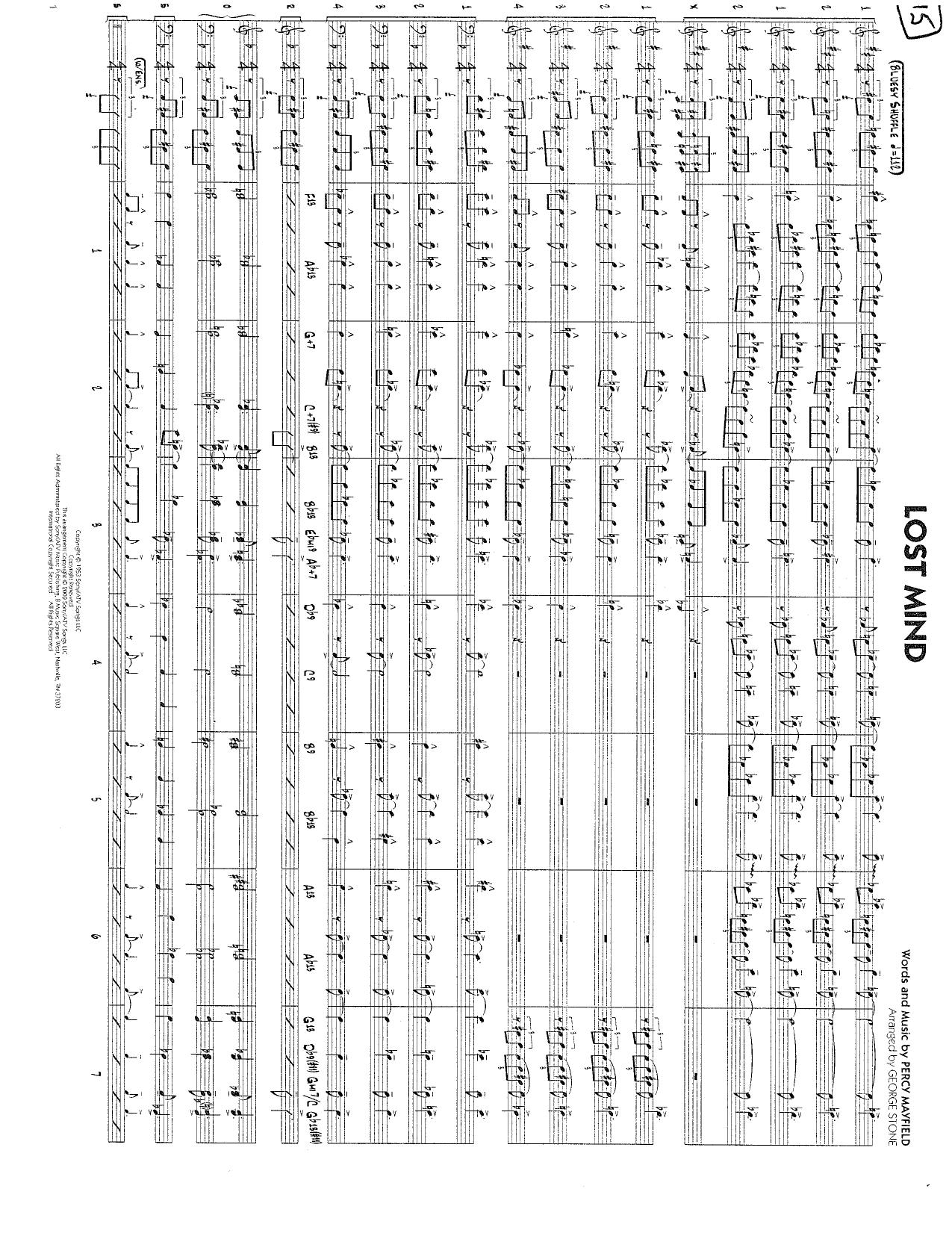
Lost Mind (G.Stone)
Composed by George Stone
Arranged by George Stone
- Ensemble: Big Band
- Pages: 46
- Instruments (17): Alto Sax 1, Alto Sax 2, Tenor Sax 1, Tenor Sax 2, Baritone Sax, Trumpet 1, Trumpet 2, Trumpet 3, Trumpet 4, Trombone 1, Trombone 2, Trombone 3, Trombone 4, Guitar, Piano, Bass, Drums
- Difficulty: medium
- Content: Individual Parts
- Format: PDF Download (Instant)
- Price: $24.99
George Stone’s sophisticated contemporary jazz original "Lost Mind" stands as a masterclass in modern big band writing, showcasing the intricate harmonic vocabulary and textural depth that have defined Stone’s prominent career as a West Coast composer and arranger. Rooted in the rich lineage of contemporary West Coast jazz orchestration—where lush, impressionistic chord clusters meet driving, muscular rhythmic momentum—this composition bridges the gap between traditional post-bop harmonic exploration and modern cinematic scope. While drawing inspiration from the sophisticated voicings pioneered by arrangers like Bob Mintzer, Bill Holman, and Dave Richards, Stone carves out a distinct sonic identity that prioritizes linear counterpoint, shifting metric feels, and a deeply evocative atmospheric narrative. "Lost Mind" unfolds at a smoldering, hypnotic medium-slow swing tempo (approx. quarter note = 104 BPM), establishing a moody, introspective atmosphere from the downbeat. The harmonic landscape is rich with extended and altered dominants, minor-major seventh sonorities, and chromatic voice-leading that evokes a sense of nocturnal mystery and psychological suspense. The piece opens with a delicate, atmospheric intro featuring sparse piano voicings and subtle mallet percussion before the low brass and saxophones enter with a haunting, serpentine motif. As the arrangement builds in density, Stone deploys a masterclass in dynamic contrast, steering the ensemble through brooding, dense textural blocks that suddenly open up into soaring, harmonically adventurous brass counterlines. Stone’s structural architecture for "Lost Mind" places heavy demands on ensemble blend, intonation, and rhythmic precision. The melodic weight is shared fluidly across the woodwind and brass sections, featuring a lushly voiced saxophone soli that requires absolute unanimity in phrasing, vibrato control, and dynamic shading. The arrangement includes open solo sections—customizable for piano, trumpet, or tenor saxophone—backed by crisp, interactive backgrounds that challenge the rhythm section to maintain a buoyant, forward-driving groove beneath complex, shifting harmonic changes. A towering, multi-tiered shout chorus serves as the emotional climax of the chart, utilizing vertical stacking and angular intervallic leaps to generate immense pressure before dissolving back into the quiet, haunting introspection of the opening theme. Advanced college ensembles, elite high school jazz bands, and professional community big bands will find "Lost Mind" to be an exceptionally rewarding centerpiece for festival programs or formal concert sets. Because of its reliance on nuanced dynamic control, mature stylistic awareness, and advanced sight-reading capabilities—particularly regarding complex rhythmic unisons and tight interval tuning in the saxophones and trombones—it demands an ensemble comfortable with contemporary big band idioms. Conductor and players alike will appreciate how the 46-page conductor score and meticulously edited 17-instrument parts provide a clear roadmap to bringing Stone’s brilliant architectural vision to life. Navigating "Lost Mind" successfully requires meticulous attention to dynamic shading and section balance, particularly when executing George Stone’s dense, contemporary chord clusters. The primary technical challenge lies in the precise tuning of altered extensions within the brass and saxophones; players must actively listen across sections to lock in the micro-tonal shifts inherent in Stone's modern harmonic language. The tempo must remain anchored by a steady, unhurried medium-swing groove—avoid rushing the triplets in the bridge or letting the ballad-like sections drag. Rhythm section players should approach their accompaniment with a high degree of interactive sensitivity, utilizing rootless voicings on the piano and an elastic, conversational bass line that supports the melody without cluttering the texture. No specialized plunger or cup mutes are strictly required, allowing the natural warmth of the horns to project the dark, velvety mood. Rehearsal should begin by isolating the complex unison rhythmic figures between the rhythm section and horns, ensuring that every syncopation locks in tightly before layering in the dynamic swells and emotional climaxes. Q: What specific instruments and parts are included in this arrangement? A: The chart is scored for a standard 17-instrument big band lineup, consisting of 2 alto saxophones, 2 tenor saxophones, 1 baritone saxophone, 4 trumpets, 4 trombones, guitar, piano, bass, and drums, supported by a comprehensive 46-page conductor score. Q: What is the difficulty level of this chart? A: This arrangement is graded as advanced, making it best suited for collegiate music programs, elite high school jazz orchestras, and professional community big bands with strong section players and experienced soloists. Q: What musical style and historical era does "Lost Mind" represent? A: Composed by George Stone, the piece exemplifies contemporary West Coast modern big band jazz, bridging post-bop harmonic sophistication with cinematic, mood-driven orchestration. Q: What makes this particular arrangement by George Stone unique? A: Its uniqueness lies in Stone’s signature impressionistic voicings, intricate linear counterpoint, and a striking structural design that builds from a hushed, mysterious intro into a towering, harmonically adventurous shout chorus. Q: What is the recommended performance duration and tempo feel? A: The piece is set at a smoldering, hypnotic medium-swing tempo (around 104 BPM) and typically runs between 5 to 6 minutes in performance, depending on the number of solo choruses taken.
Questions and answers
- What is included in the Lost Mind (G.Stone) PDF?
- The verified current file contains a conductor score and individual parts across 46 pages.
- How many instruments or parts are listed for Lost Mind (G.Stone)?
- The verified instrumentation list contains 17 entries for this Big Band arrangement.
- Who is credited for Lost Mind (G.Stone)?
- Composer: George Stone. Arranger: George Stone.
- What difficulty is listed for Lost Mind (G.Stone)?
- The verified difficulty level is medium.
- Can I preview Lost Mind (G.Stone) before buying?
- Yes. The product page provides a preview generated from the current PDF file.
- How is Lost Mind (G.Stone) delivered?
- After successful payment, the digital PDF is made available for download. The displayed price is $24.99.
Musicians Also Search For
Lost Mind George Stone PDF • Lost Mind George Stone sheet music • Lost Mind arranged by George Stone • George Stone big band charts • George Stone jazz arrangements PDF • Lost Mind George Stone big band arrangements • Lost Mind big band arrangements • Lost Mind big band PDF download • Lost Mind jazz sheet music • big band sheet music download • Lost Mind conductor score PDF • Lost Mind individual parts download • Lost Mind sheet music PDF • buy Lost Mind sheet music • download Lost Mind PDF • Lost Mind jazz charts • best George Stone big band arrangements • Lost Mind printable sheet music • big band repertoire PDF