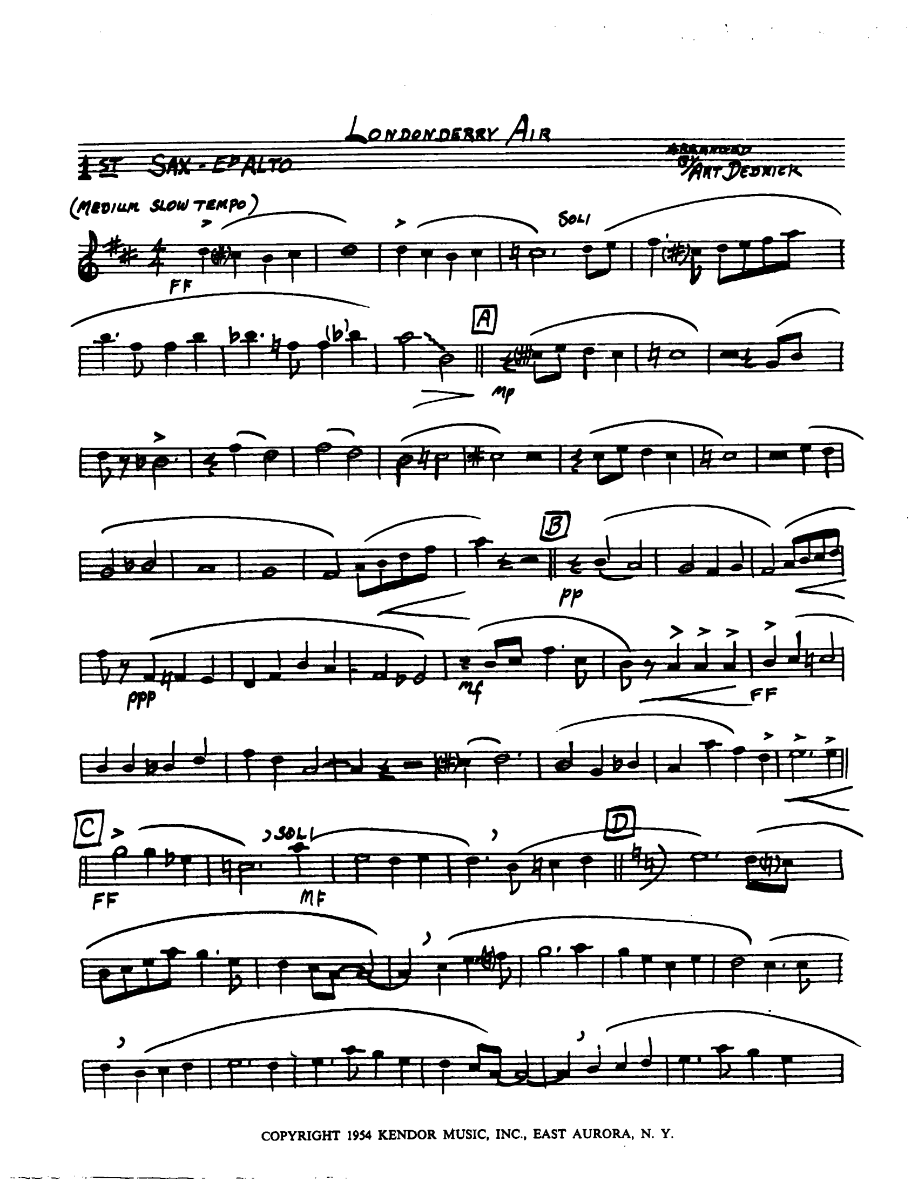
Londonderry Air (A.Dedrick)
Composed by Traditional
Arranged by Art Dedrick
- Ensemble: Big Band
- Style: Jazz Standard
- Pages: 26
- Instruments (19): 1st Sax Eb Alto, 3rd Sax Eb Alto, 2nd Sax Bb Tenor, 4th Sax Bb Tenor, 5th Sax (Baritone Eb), 1st Trumpet Bb, 2nd Bb Trumpet, 3rd Bb Trumpet, 4th Bb Trumpet, 1st Trombone, 2nd Trombone, 3rd Trombone, 4th Trombone, Piano, String Bass, Drums, Vibes, Guitar, Bb Bass Tuba
- Difficulty: medium
- Content: Individual Parts
- Format: PDF Download (Instant)
- Price: $24.99
The timeless melody of "Londonderry Air," universally recognized as "Danny Boy," finds a sophisticated and compelling new voice in Art Dedrick's masterful big band arrangement. This traditional Irish air, whose origins date back to the 19th century, gained widespread popularity in the early 20th century, becoming a beloved folk song and a staple in various musical genres. While not a jazz standard in the conventional sense, its poignant, lyrical quality has long attracted jazz artists who appreciate its harmonic depth and expressive potential. Dedrick's treatment elevates this classic, transforming it into a lush, reflective jazz ballad that showcases the full expressive range of the modern big band. Dedrick’s arrangement unfolds as a slow, deliberate ballad in a 4/4 meter, likely in a key such as Eb or F major to maximize the brass and saxophone voicings. The mood is one of profound introspection and tender melancholy, building to moments of soaring beauty. The piece opens with a delicate, almost ethereal texture, often featuring the saxophone section in rich, sustained harmonies, establishing the iconic melody with reverence. Dedrick, known for his meticulous scoring and ability to create rich, warm sonorities, employs his signature techniques throughout. Expect expertly crafted soli passages where sections blend seamlessly, often utilizing close voicings and extended harmonies that add a contemporary jazz sheen without sacrificing the melody's inherent emotion. The arrangement avoids overt swing or bebop gestures, instead focusing on a deeply felt, rubato-infused ballad style. Performance of this arrangement offers significant rewards for a discerning ensemble. The melody is initially presented by the lead alto saxophone or trumpet, often with a harmonized backdrop from the rest of the section, before being passed to other sections, such as the full saxophone choir or the brass. While there are no extended improvised solos in the traditional sense, the arrangement itself functions as a beautifully composed solo for the entire ensemble. Technical challenges lie primarily in achieving precise intonation within the dense voicings, maintaining a consistent, expressive legato across all parts, and executing the delicate dynamic shifts required to convey the piece's emotional arc. The brass section will need excellent breath control for sustained phrases, and the rhythm section must provide a supportive, understated foundation without overpowering the melodic lines. This arrangement is ideally suited for advanced high school, collegiate, community, or professional big bands. Its demands for musical maturity, blend, and intonation make it an excellent vehicle for teaching expressive playing and ensemble cohesion. Bands looking to expand their repertoire beyond typical swing charts will find this a refreshing and deeply satisfying piece to perform, offering audiences a moment of serene beauty and emotional resonance. Conductors should emphasize a unified, expressive legato throughout the ensemble, particularly in the saxophone and brass sections. Intonation is paramount, especially within the close voicings and sustained chords; dedicated tuning time for each section is recommended. The tempo should be a slow, flowing ballad, allowing ample space for the melody to breathe and for the harmonies to resonate. Encourage musicians to listen across sections to achieve a seamless blend. Dynamic contrasts are crucial for shaping the emotional narrative; practice the crescendo and diminuendo markings carefully to avoid abrupt changes. There are no special techniques like plunger mutes or falls, focusing instead on pure tone and articulation. The rhythm section should provide a sensitive, supportive foundation, with the bass and drums maintaining a gentle pulse without pushing the tempo. Rehearsal should focus on the ensemble's collective sound and musicality, ensuring every phrase contributes to the overall lyrical beauty. Q: What instruments are included in this arrangement? A: This arrangement is scored for a standard 17-piece big band, including Alto Saxophone 1, Alto Saxophone 2, Tenor Saxophone 1, Tenor Saxophone 2, Baritone Saxophone, Trumpet 1, Trumpet 2, Trumpet 3, Trumpet 4, Trombone 1, Trombone 2, Trombone 3, Trombone 4, Piano, Bass, Drums, and Guitar. Q: What is the difficulty level of Art Dedrick's "Londonderry Air" arrangement? A: This arrangement is rated as advanced, suitable for high school, collegiate, community, and professional big bands. Its challenges lie in achieving precise intonation, maintaining a consistent legato, and executing subtle dynamic control within complex voicings. Q: What is the musical style and historical context of this piece? A: This is a jazz big band ballad arrangement of "Londonderry Air," a traditional Irish air from the 19th century. While the original is a folk melody, Dedrick's arrangement transforms it into a lush, reflective jazz piece, showcasing the melodic and harmonic potential that has attracted many jazz artists. Q: What makes this Art Dedrick arrangement unique compared to other versions of "Londonderry Air"? A: Dedrick's signature lies in his masterful use of rich, extended harmonies, meticulously crafted soli sections, and a focus on creating a deeply expressive, lyrical ballad. His arrangement emphasizes ensemble blend and musicality over improvisation, presenting the piece as a beautifully composed statement for the entire big band. Q: What is the typical performance duration and tempo for this arrangement? A: As a slow ballad, the typical performance duration for this arrangement is approximately 4-5 minutes, depending on the conductor's interpretation. The tempo is a slow 4/4, emphasizing a sustained, flowing feel rather than a strict metronomic pulse.
Questions and answers
- What is included in the Londonderry Air (A.Dedrick) PDF?
- The verified current file contains individual parts across 26 pages.
- How many instruments or parts are listed for Londonderry Air (A.Dedrick)?
- The verified instrumentation list contains 19 entries for this Big Band arrangement.
- Who is credited for Londonderry Air (A.Dedrick)?
- Composer: Traditional. Arranger: Art Dedrick.
- What difficulty is listed for Londonderry Air (A.Dedrick)?
- The verified difficulty level is medium.
- What style is listed for Londonderry Air (A.Dedrick)?
- The catalog lists the style as Jazz Standard.
- Can I preview Londonderry Air (A.Dedrick) before buying?
- Yes. The product page provides a preview generated from the current PDF file.
- How is Londonderry Air (A.Dedrick) delivered?
- After successful payment, the digital PDF is made available for download. The displayed price is $24.99.
Musicians Also Search For
Londonderry Air Art Dedrick PDF • Londonderry Air Art Dedrick sheet music • Londonderry Air arranged by Art Dedrick • Art Dedrick big band charts • Art Dedrick jazz arrangements PDF • Londonderry Air Traditional sheet music • Londonderry Air Traditional big band arrangements • Traditional big band charts • Londonderry Air big band arrangements • Londonderry Air big band PDF download • Londonderry Air jazz sheet music • big band sheet music download • Londonderry Air individual parts download • Londonderry Air sheet music PDF • Londonderry Air Jazz Standard charts • Jazz Standard big band arrangements • buy Londonderry Air sheet music • download Londonderry Air PDF • Londonderry Air jazz charts • best Art Dedrick big band arrangements • Traditional arranged by Art Dedrick • Londonderry Air printable sheet music • big band repertoire PDF