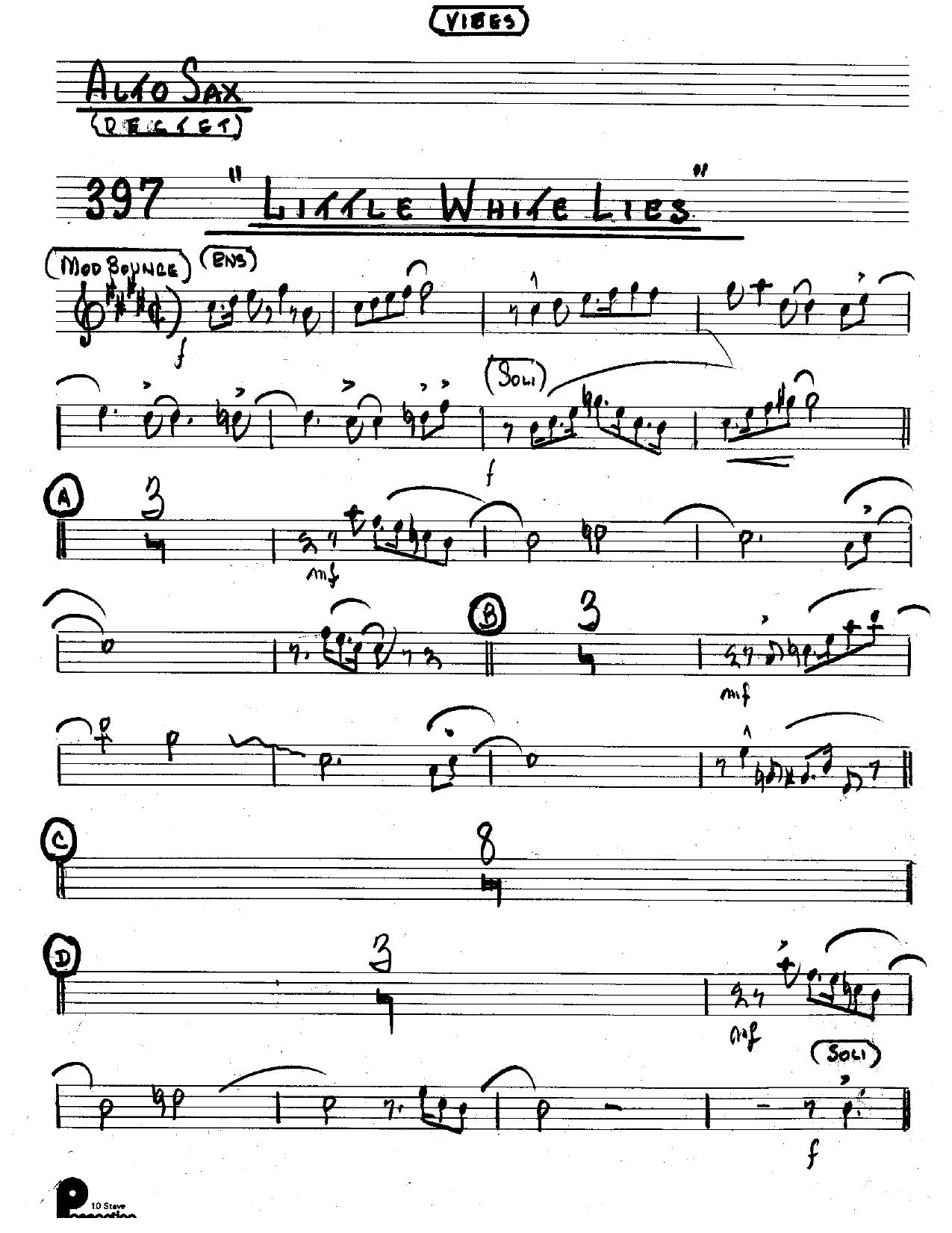
Little White Lies (Kenton Dectet #397)
Composed by Walter Donaldson
Arranged by Kenton Dectet #397
- Ensemble: Small Ensemble
- Style: Jazz Standard
- Pages: 37
- Instruments (11): Alto Sax, Tenor Sax, Baritone Sax, Trumpet 1, Trumpet 2, Trombone, Drums, Bass, Piano, Vocalist, Vibes
- Difficulty: easy
- Content: Individual Parts
- Format: PDF Download (Instant)
- Price: $12.99
"Little White Lies," penned by Walter Donaldson in 1930, emerged from the vibrant Tin Pan Alley era, quickly becoming a beloved standard of American popular song. Its melancholic yet captivating melody resonated deeply during the Great Depression, offering a poignant reflection on deception and heartbreak. While first popularized by artists like Ted Lewis and His Band, it was later embraced by jazz luminaries, cementing its place in the jazz canon. Bing Crosby's 1930 recording was particularly influential, showcasing the tune's enduring lyrical and melodic appeal. The song's harmonic sophistication, characterized by its elegant chord changes and expressive melodic contours, made it a natural fit for jazz interpretation, allowing improvisers ample space for creative exploration while retaining its inherent emotional depth. This Kenton Dectet #397 arrangement reimagines "Little White Lies" as a sophisticated, medium-swing excursion, set in the inviting key of F major. The mood is one of bittersweet reflection, evolving from a tender, almost introspective opening to a more assertive, yet always tasteful, swing feel. The arrangement masterfully balances the tune's inherent pathos with the kinetic energy of a classic jazz small ensemble. Kenton Dectet #397's signature approach is evident in the rich, often close-voiced harmonies, creating a lush soundscape that belies the ensemble's size. Expect intricate counterpoint, particularly in the ensemble passages, and a meticulous attention to dynamic shading that builds and releases tension with expert precision. The arrangement opens with a lyrical trumpet statement of the melody, supported by warm, sustained voicings from the reeds and rhythm section, immediately establishing the piece's reflective character. This leads into a beautifully crafted saxophone soli, showcasing the arranger's knack for weaving complex lines into a cohesive whole. Featured solos are provided for both trumpet and tenor saxophone, offering opportunities for expressive improvisation over the tune's classic changes. The technical challenges lie primarily in maintaining precise ensemble blend and balance, navigating the nuanced dynamic shifts, and executing the intricate rhythmic figures with a unified swing feel. The rewarding aspect is the opportunity to perform a truly classic tune with a fresh, sophisticated interpretation, allowing each musician to contribute to a collective, emotionally resonant performance. This arrangement culminates in a tastefully orchestrated shout chorus that builds to a satisfying climax before a gentle, fading coda. This arrangement is ideally suited for college-level jazz ensembles, advanced community bands, or professional small groups seeking a challenging yet deeply rewarding addition to their repertoire. Its sophisticated harmonic language and demands for precise ensemble work make it an excellent vehicle for developing musical maturity and stylistic authenticity. The detailed voicings and intricate interplay require attentive listening and a strong command of jazz articulation, making it a valuable educational tool and a captivating performance piece. Conductors should emphasize a consistent, relaxed medium-swing feel throughout, avoiding any tendency to rush or drag. The opening trumpet melody requires a warm, sustained tone with expressive phrasing. Pay close attention to the dynamic markings, particularly the subtle swells and diminuendos that shape the emotional arc of the piece. The saxophone soli demands meticulous balance and intonation to achieve the intended rich, blended sound; encourage players to listen across the section. Rhythm section players should lock into a cohesive groove, with the bass providing a strong foundation and the drums offering tasteful, swinging accompaniment without overpowering the melodic lines. Articulation is key: ensure all swing eighth notes are executed with appropriate jazz inflection. Rehearsal time should be dedicated to isolating and balancing the ensemble voicings, particularly in the shout chorus, to ensure clarity and impact. Q: What instruments are included in this arrangement of "Little White Lies (Kenton Dectet #397)"? A: This small ensemble arrangement includes parts for Trumpet, Alto Saxophone, Tenor Saxophone, Trombone, Piano, Bass, and Drums, providing a classic jazz dectet instrumentation. Q: What is the difficulty level of this arrangement? A: This arrangement is considered advanced intermediate to advanced, suitable for college-level jazz ensembles, advanced community bands, or professional small groups due to its sophisticated harmonies, intricate voicings, and demands for precise ensemble execution. Q: What is the musical style and historical context of "Little White Lies"? A: "Little White Lies" is a jazz standard from the Tin Pan Alley era, originally composed by Walter Donaldson in 1930. This arrangement presents it in a medium-swing jazz style, reflecting its enduring popularity in the jazz canon. Q: What makes this Kenton Dectet #397 arrangement unique compared to other versions of "Little White Lies"? A: This arrangement is distinguished by Kenton Dectet #397's signature approach, featuring rich, often close-voiced harmonies, intricate counterpoint, and a masterful balance of the tune's melancholic character with a vibrant medium-swing feel, culminating in a sophisticated shout chorus. Q: What is the approximate performance duration and recommended tempo for this arrangement? A: The approximate performance duration for this arrangement is 3:30 to 4:00 minutes. It is set at a medium-swing tempo, ideally around quarter note = 120-130 BPM, allowing for expressive phrasing and a relaxed, grooving feel.
Questions and answers
- What is included in the Little White Lies (Kenton Dectet #397) PDF?
- The verified current file contains individual parts across 37 pages.
- How many instruments or parts are listed for Little White Lies (Kenton Dectet #397)?
- The verified instrumentation list contains 11 entries for this Small Ensemble arrangement.
- Who is credited for Little White Lies (Kenton Dectet #397)?
- Composer: Walter Donaldson. Arranger: Kenton Dectet #397.
- What difficulty is listed for Little White Lies (Kenton Dectet #397)?
- The verified difficulty level is easy.
- What style is listed for Little White Lies (Kenton Dectet #397)?
- The catalog lists the style as Jazz Standard.
- Can I preview Little White Lies (Kenton Dectet #397) before buying?
- Yes. The product page provides a preview generated from the current PDF file.
- How is Little White Lies (Kenton Dectet #397) delivered?
- After successful payment, the digital PDF is made available for download. The displayed price is $12.99.
Musicians Also Search For
Little White Lies Kenton Dectet #397 PDF • Little White Lies Kenton Dectet #397 sheet music • Little White Lies arranged by Kenton Dectet #397 • Kenton Dectet #397 small ensemble charts • Kenton Dectet #397 jazz arrangements PDF • Little White Lies Walter Donaldson sheet music • Little White Lies Walter Donaldson small ensemble arrangements • Walter Donaldson small ensemble charts • Little White Lies small ensemble arrangements • Little White Lies small ensemble PDF download • Little White Lies jazz sheet music • small ensemble sheet music download • Little White Lies individual parts download • Little White Lies sheet music PDF • Little White Lies Jazz Standard charts • Jazz Standard small ensemble arrangements • buy Little White Lies sheet music • download Little White Lies PDF • Little White Lies jazz charts • best Kenton Dectet #397 small ensemble arrangements • Walter Donaldson arranged by Kenton Dectet #397 • Little White Lies printable sheet music • small ensemble repertoire PDF