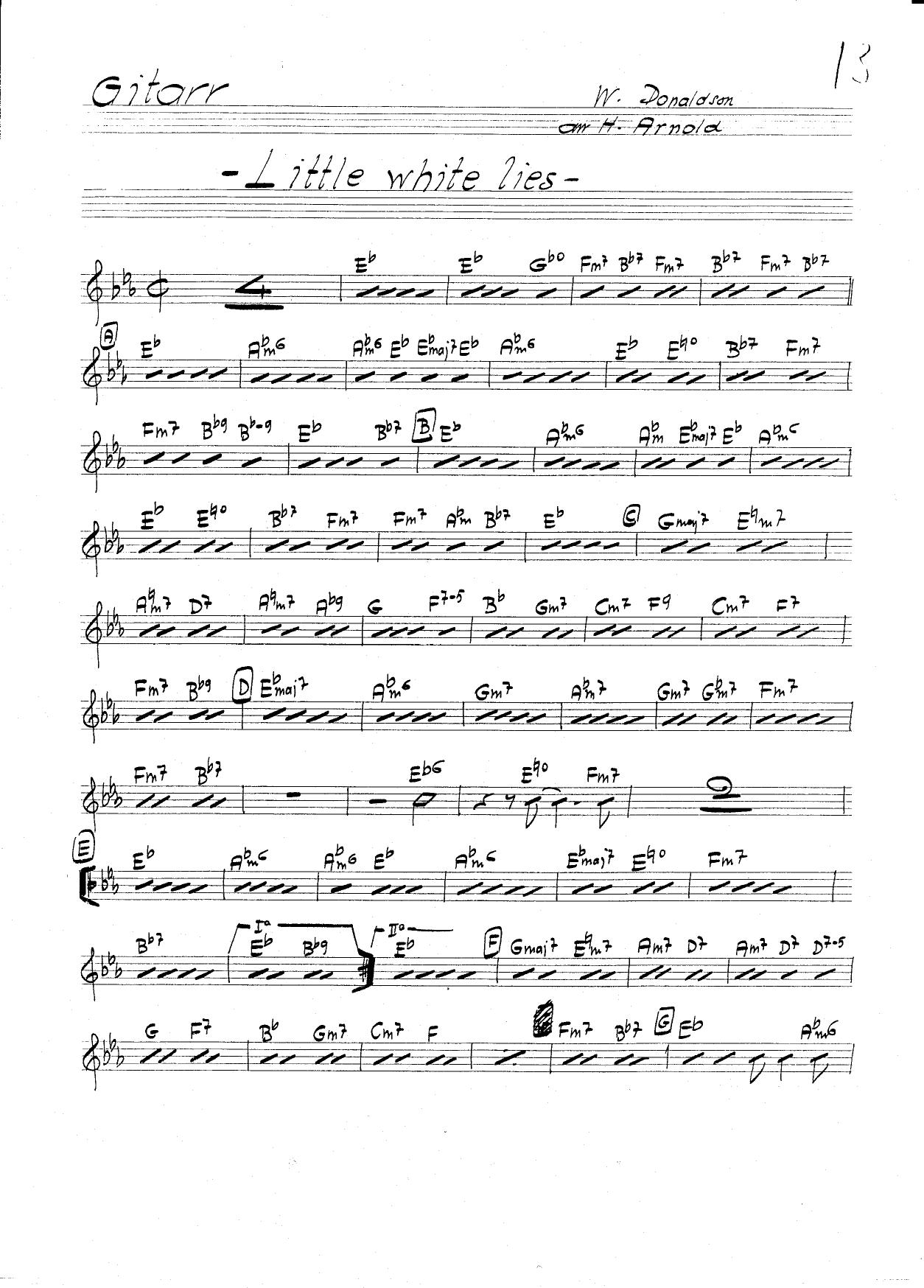
Little White Lies (H.Arnold)
Composed by Walter Donaldson
Arranged by H.Arnold
- Ensemble: Big Band
- Style: Jazz Standard
- Pages: 21
- Instruments (17): Gitarr, Piano, Bas, Trummor, Alt. Sax. I, Alt. Sax. II, Tenor Sax. I, Tenor Sax. II, Bar. Sax., Trombone I, Trombone II, 3e Trombone, 4e Trombone, Trumpet I, Trumpet II, Trumpet III, Trumpet IV
- Difficulty: easy
- Content: Individual Parts
- Format: PDF Download (Instant)
- Price: $24.99
Walter Donaldson’s timeless 1930 composition "Little White Lies" occupies a cherished space in the Great American Songbook, having transitioned from a popular Tin Pan Alley tune into a resilient vehicle for jazz improvisation. Immortalized by legendary interpreters ranging from early swing orchestras to vocal icons like Ella Fitzgerald and Dinah Washington, the tune thrives on its deceptively simple, major-mode melancholy and infectious harmonic progression. This particular big band adaptation honors that rich lineage while distilling the sonic architecture down to a tightly knit, high-impact framework. It captures the sophisticated bounce of the late-swing era, marrying nostalgic warmth with the driving rhythmic momentum characteristic of mid-century jazz club performances. From the opening measure, H.Arnold’s arrangement establishes a buoyant, medium-up swing groove in 4/4 time that immediately engages both performers and listeners. The chart balances lush, harmonically rich ensemble voicings with driving rhythm-section interplay, evoking the sophisticated atmosphere of 1950s East Coast jazz rooms. The mood shifts fluidly between playful, conversational head statements and soaring, brass-heavy interludes, creating a dynamic emotional arc that avoids monotony. The underlying harmony utilizes extended upper-structure chords and subtle chromatic voice-leading, giving the classic changes a modern, sophisticated sheen without alienating traditionalists. H.Arnold approaches the score with an acute understanding of sectional balance and textural contrast, ensuring that the arrangement sounds full and professional despite its streamlined orchestration. The chart opens with a crisp, rhythm-driven intro that sets a confident tempo before handing the primary melody to the horns with clever counter-melodic commentary from the rhythm section. Notable moments include a harmonically adventurous developmental bridge that temporarily shifts color before resolving triumphantly back to the home key, and a tightly wound shout chorus that builds linear tension through syncopated cross-rhythms. The arrangement leaves ample space for improvised solo sections over standard form changes, allowing featured instrumentalists to stretch out and showcase their personal voice. Advanced high school ensembles, collegiate jazz orchestras, and professional freelance big bands will find this chart to be an exceptionally rewarding addition to their repertoire. Because the arrangement is tailored for a dynamic 4-instrument rhythm section (Guitar, Piano, Bass, and Drum Set) working alongside standard or flexible horn configurations across its comprehensive 21-page score, it demands strong internal time and attentive listening. Rhythm section players must lock in a steady, unhurried macro-swing feel, while soloists and section leaders will appreciate the intelligent pacing and idiomatic writing that make the chart a guaranteed crowd-pleaser in concert settings. Success with H.Arnold’s chart hinges on maintaining an authentic, relaxed medium-swing feel without letting the tempo drag or rush. The rhythm section serves as the anchor; the drummer should prioritize a crisp, feather-light ride cymbal pattern with a distinct "spang-a-lang" articulation, dropping subtle comping accents on beats two and four. Pianists and guitarists must avoid over-playing, opting instead for sparse, transparent shell voicings that complement the horn section's harmonic density rather than crowding it. Watch out for the dynamic shifts leading into the bridge; ensure that the ensemble executes sudden piano-to-forte contrasts cleanly without sacrificing intonation. Horn players should focus on uniform articulation—using standard jazz articulations where eighth notes are swung naturally, with accents placed strictly on the upbeat of two and four. Rehearsals should begin slowly at a reduced tempo to lock in the ensemble blend during the chromatic passing chords, gradually working up to the performance tempo while preserving rhythmic precision in the syncopated shout chorus. Q: What instruments and parts are included in this arrangement? A: This 21-page arrangement is specifically scored for a core rhythm section comprising Guitar, Piano, Bass, and Drum Set, integrated seamlessly with standard big band horn instrumentation. Q: What is the difficulty level of this chart? A: This arrangement is graded as intermediate-advanced (suitable for advanced high school, collegiate, and professional big bands) due to its demand for strong swing time, reading proficiency, and stylistic maturity. Q: What is the historical style and context of the piece? A: Based on Walter Donaldson’s 1930 standard, this chart embraces a classic mid-century swing and mainstream jazz aesthetic, blending Tin Pan Alley melodic charm with sophisticated post-swing harmonies. Q: What makes H.Arnold’s arrangement unique? A: The chart stands out for its clever use of counter-melodies, sophisticated upper-structure chord voicings, and a tightly constructed shout chorus that maximizes impact while maintaining transparent textures. Q: What is the performance duration and recommended tempo? A: The arrangement is designed for a performance time of approximately 3 to 4 minutes, anchored by a steady, driving medium-swing tempo (around quarter note = 120–132 BPM).
Questions and answers
- What is included in the Little White Lies (H.Arnold) PDF?
- The verified current file contains individual parts across 21 pages.
- How many instruments or parts are listed for Little White Lies (H.Arnold)?
- The verified instrumentation list contains 17 entries for this Big Band arrangement.
- Who is credited for Little White Lies (H.Arnold)?
- Composer: Walter Donaldson. Arranger: H.Arnold.
- What difficulty is listed for Little White Lies (H.Arnold)?
- The verified difficulty level is easy.
- What style is listed for Little White Lies (H.Arnold)?
- The catalog lists the style as Jazz Standard.
- Can I preview Little White Lies (H.Arnold) before buying?
- Yes. The product page provides a preview generated from the current PDF file.
- How is Little White Lies (H.Arnold) delivered?
- After successful payment, the digital PDF is made available for download. The displayed price is $24.99.
Musicians Also Search For
Little White Lies H.Arnold PDF • Little White Lies H.Arnold sheet music • Little White Lies arranged by H.Arnold • H.Arnold big band charts • H.Arnold jazz arrangements PDF • Little White Lies Walter Donaldson sheet music • Little White Lies Walter Donaldson big band arrangements • Walter Donaldson big band charts • Little White Lies big band arrangements • Little White Lies big band PDF download • Little White Lies jazz sheet music • big band sheet music download • Little White Lies individual parts download • Little White Lies sheet music PDF • Little White Lies Jazz Standard charts • Jazz Standard big band arrangements • buy Little White Lies sheet music • download Little White Lies PDF • Little White Lies jazz charts • best H.Arnold big band arrangements • Walter Donaldson arranged by H.Arnold • Little White Lies printable sheet music • big band repertoire PDF