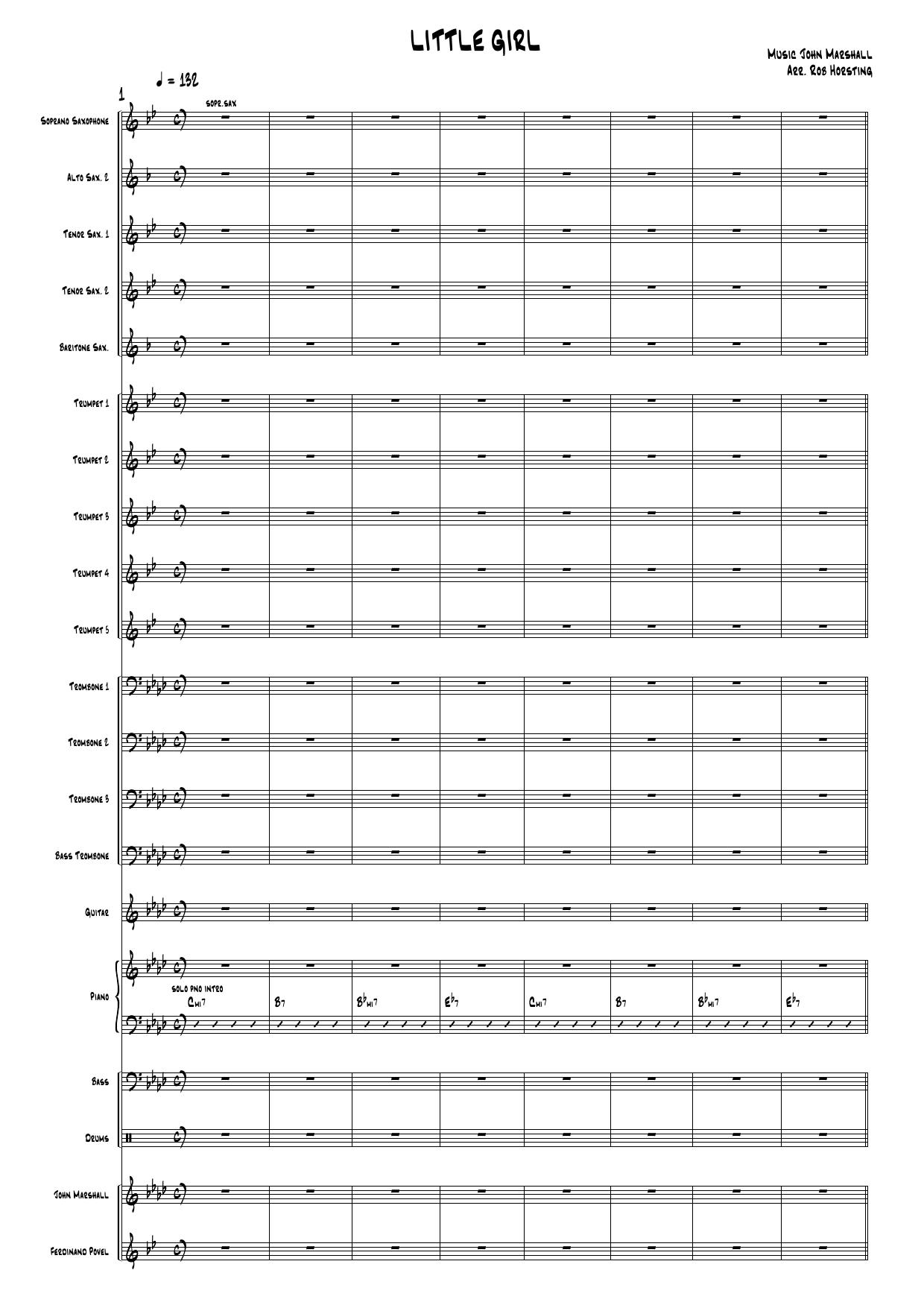
Little Girl (R.Horsting)
Composed by R. Horsting
Arranged by R.Horsting
- Ensemble: Big Band
- Style: Jazz Standard
- Pages: 31
- Instruments (20): Soprano Saxophone, Alto Saxophone 2, Tenor Saxophone 1, Tenor Saxophone 2, Baritone Saxophone, Trumpet 1, Trumpet 2, Trumpet 3, Trumpet 4, Trumpet 5, Trombone 1, Trombone 2, Trombone 3, Bass Trombone, Guitar, Piano, Bass, Drums, Vocal Soloist (John Marshall), Vocal Soloist (Ferdinand Povel)
- Difficulty: medium
- Content: Individual Parts
- Format: PDF Download (Instant)
- Price: $24.99
Imbued with the sophisticated harmonic palette of modern big band writing, "Little Girl," composed and arranged by R. Horsting, breathes fresh life into the timeless jazz standard tradition. While the title echoes the nostalgic charm of classic 1930s Tin Pan Alley songwriting popularized by early jazz icons, Horsting’s contemporary treatment pivots away from dated pastiche, recontextualizing the material through a lens of post-bop harmonic sophistication and rich, layered ensemble textures. The composition bridges the gap between swinging tradition and modern harmonic exploration, offering an expansive sonic landscape that demands both rhythmic precision and expressive nuance from every section of the orchestra. Balancing driving momentum with moments of lush introspection, the arrangement settles comfortably into a buoyant, infectious medium-swing groove. The underlying rhythmic framework alternates between crisp, understated ride-cymbal pulsations and robust, interactive horn punctuations that propel the form forward. Horsting masterfully exploits the dynamic contrast of the 18-piece ensemble, moving fluidly from whisper-soft, harmonized sax solis to towering, brass-heavy shout choruses that overflow with altered dominants and vibrant chromatic mediants. The emotional trajectory shifts gracefully from playful optimism to moments of cinematic grandeur, evoking the sophisticated atmosphere of a late-night metropolitan jazz club. Horsting’s arranging fingerprint is immediately recognizable in the meticulous voice-leading and innovative chord substitutions underpinning the melodies. Rather than relying on predictable block-voicing, the chart utilizes open-position harmonies and clever counterpoint, particularly within the saxophone section—which features a dynamic deployment of soprano saxophone alongside traditional alto, tenor, and baritone voices. The woodwind doubling adds a distinct coloration reminiscent of contemporary European jazz composition. Melodic duties are shared democratically across the ensemble, passing fluidly from a sultry tenor saxophone feature to full-ensemble tutti bursts. Open solo sections provide designated featured artists ample space to stretch out over contemporary changes, supported by an alert rhythm section that must navigate shifting harmonic plateaus. Advanced high school ensembles with strong section leaders, as well as collegiate, community, and professional big bands, will find this chart to be an exceptionally rewarding addition to their repertoire. While the rhythmic figures require a high degree of articulation alignment—especially during syncopated ensemble hits—the payoff is an arresting, professional-grade performance piece that consistently captivates audiences and challenges players to elevate their collective listening and stylistic flexibility. Navigating R. Horsting’s arrangement of "Little Girl" successfully requires meticulous attention to articulation uniformity, particularly within the saxes and brass. The medium-swing tempo must remain rock-solid; avoid rushing during unaccompanied ensemble breaks or dynamic swells. Directors should pay close attention to the balance during the dense harmonic voicings in the middle section—inner voices must project without covering the primary melodic line, which often shifts between the tenor saxophone and lead trumpet. Rhythm section players are encouraged to treat the chord symbols as a roadmap rather than a rigid constraint, utilizing modern voicings that complement Horsting's extended harmonies. The drummer should maintain a transparent, driving swing feel, using light cymbal work to support the horns during quieter soli sections while providing robust, crisp punctuation during the aggressive shout chorus. Brass players should approach mutes (where applicable) with an eye toward blending rather than piercing brightness, ensuring the rich, modern chord clusters bloom naturally across the ensemble. Q: What instruments and parts are included in this big band arrangement? A: The complete 18-instrument instrumentation features Soprano Saxophone, Alto Saxophone 2, Tenor Saxophone 1, Tenor Saxophone 2, Baritone Saxophone, standard brass designations, and a full rhythm section across 31 total pages of music. Q: What is the difficulty level of this arrangement? A: This chart is best suited for advanced high school, collegiate, and professional big bands due to its complex extended harmonies, syncopated ensemble figures, and demands for mature stylistic integration. Q: What is the musical style and historical context of the piece? A: Composed in the style of a modern jazz standard, the arrangement updates the classic 1930s aesthetic with contemporary post-bop harmonies, sophisticated voice-leading, and a buoyant medium-swing feel. Q: What makes R. Horsting’s arrangement unique? A: The chart stands out through its innovative use of a soprano saxophone within the standard reed section, open-position chord voicings, and an intricate balance between lush, introspective textures and powerhouse brass shout choruses. Q: What is the approximate performance duration and tempo guideline? A: While performance time varies slightly based on the length of improvised solo choruses, the arrangement is designed around a comfortable, driving medium-swing tempo that typically clocks in at roughly 4 to 5 minutes.
Questions and answers
- What is included in the Little Girl (R.Horsting) PDF?
- The verified current file contains a conductor score across 31 pages.
- How many instruments or parts are listed for Little Girl (R.Horsting)?
- The verified instrumentation list contains 20 entries for this Big Band arrangement.
- Who is credited for Little Girl (R.Horsting)?
- Composer: R. Horsting. Arranger: R.Horsting.
- What difficulty is listed for Little Girl (R.Horsting)?
- The verified difficulty level is medium.
- What style is listed for Little Girl (R.Horsting)?
- The catalog lists the style as Jazz Standard.
- Can I preview Little Girl (R.Horsting) before buying?
- Yes. The product page provides a preview generated from the current PDF file.
- How is Little Girl (R.Horsting) delivered?
- After successful payment, the digital PDF is made available for download. The displayed price is $24.99.
Musicians Also Search For
Little Girl R.Horsting PDF • Little Girl R.Horsting sheet music • Little Girl arranged by R.Horsting • R.Horsting big band charts • R.Horsting jazz arrangements PDF • Little Girl R. Horsting sheet music • Little Girl R. Horsting big band arrangements • R. Horsting big band charts • Little Girl big band arrangements • Little Girl big band PDF download • Little Girl jazz sheet music • big band sheet music download • Little Girl conductor score PDF • Little Girl sheet music PDF • Little Girl Jazz Standard charts • Jazz Standard big band arrangements • buy Little Girl sheet music • download Little Girl PDF • Little Girl jazz charts • best R.Horsting big band arrangements • R. Horsting arranged by R.Horsting • Little Girl printable sheet music • big band repertoire PDF