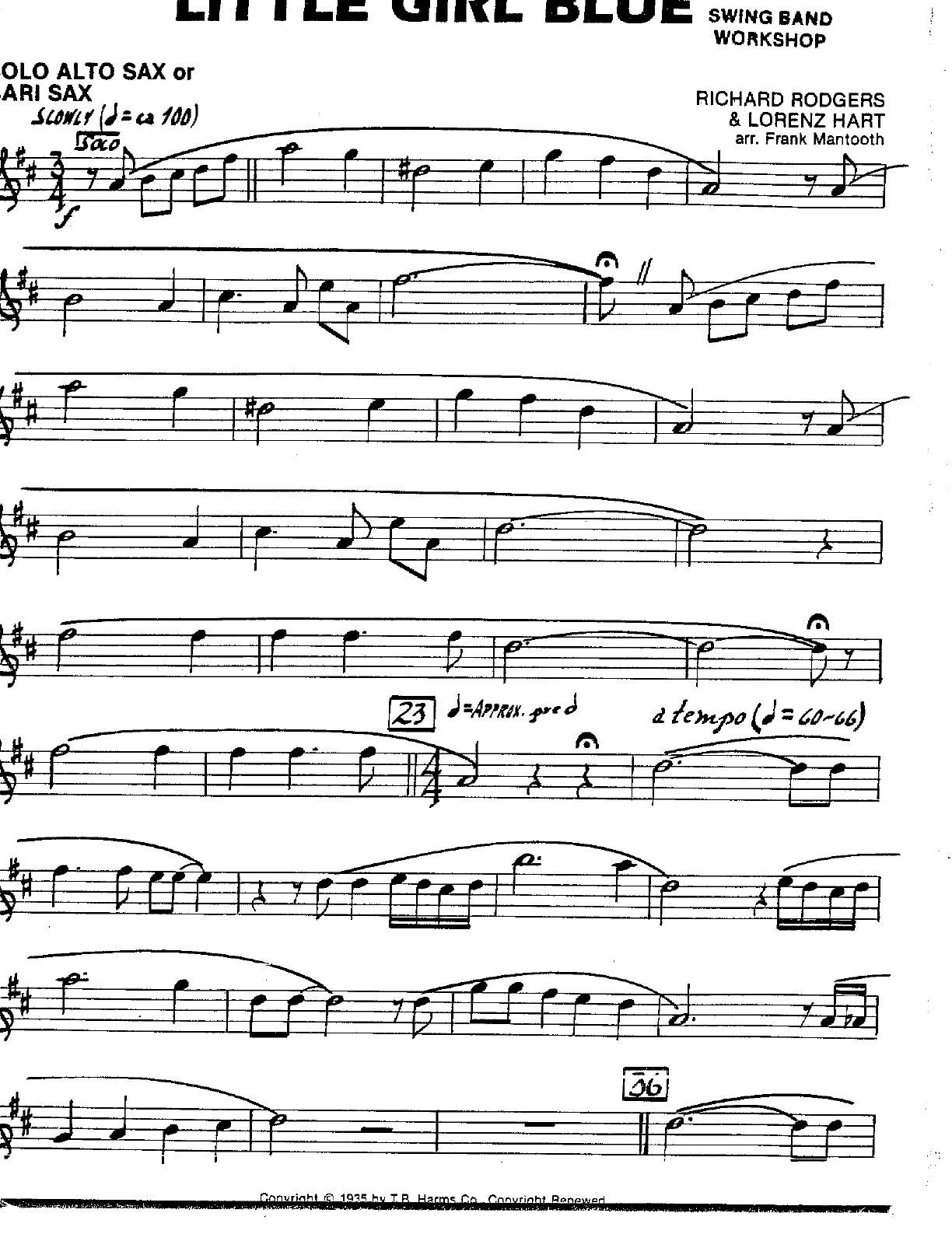
Little Girl Blue (F.Mantooth)
Composed by Richard Rodgers
Arranged by Frank Mantooth
- Ensemble: Big Band
- Pages: 29
- Instruments (21): Solo Alto Sax, Solo Bari Sax, Solo Flugelhorn, Solo Tenor Sax, Solo Trombone, 1st Eb Alto Saxophone, 2nd Eb Alto Saxophone, 1st Bb Tenor Saxophone, 2nd Bb Tenor Saxophone, Eb Baritone Saxophone, 1st Bb Trumpet, 2nd Bb Trumpet, 3rd Bb Trumpet, 4th Bb Trumpet, 1st Trombone, 2nd Trombone, 3rd Trombone, 4th Trombone, Guitar, Bass, Piano
- Difficulty: medium
- Content: Individual Parts
- Format: PDF Download (Instant)
- Price: $24.99
Richard Rodgers and Lorenz Hart originally penned "Little Girl Blue" for the 1935 Broadway musical *Jumbo*, introducing a poignant masterpiece of American popular song that would swiftly transition into an essential jazz standard. Over the decades, the tune's bittersweet melodic contour and sophisticated harmonic structure invited definitive interpretations from jazz royalty, most notably Nina Simone's haunting vocal rendition and various instrumental explorations by icons like Chet Baker and Stan Getz. The composition epitomizes the mid-thirties theater-to-jazz crossover, balancing a deceptively simple lyrical lament with an underlying melancholy that resonates deeply within the jazz idiom. Frank Mantooth’s inspired big band interpretation transforms this familiar standard into a lush, contemporary modal-leaning ballad that prioritizes rich textural coloration and emotional depth. Unfurling at a relaxed, introspective tempo, the arrangement establishes a reflective mood from the outset through shimmering, expanded chord voicings that exploit the full spectrum of the modern big band palette. Mantooth avoids straightforward thematic delivery, instead weaving the melody through dense, chromatic harmony and shifting tonal centers. The emotional trajectory shifts gradually from a quiet, internal solitude to soaring, passionate collective expression, anchored by sophisticated woodwind doublings and subtle dynamic undulations that evoke a profound sense of late-night introspection. Mantooth’s signature arranging style is stamped indelibly across the score, characterized by thick, contemporary block-chord voicings, unexpected harmonic detours, and meticulous craftsmanship in the inner voices. Rather than relying on a conventional shout chorus, Mantooth constructs a climactic development section that utilizes upper-structure triads and fluid counterpoint to expand the harmonic horizon before gently subsiding into a tranquil resolution. The flugelhorn and tenor saxophone are spotlighted for expressive, lyrical solo statements that require a mature command of tone production and melodic phrasing. Technical demands for the ensemble center on intonation, balance within dense chordal clusters, and maintaining unwavering rhythmic cohesion across rubato-infused tempo stretches. Advanced high school, collegiate, and professional jazz ensembles will find this 21-instrument arrangement an exceptional vehicle for developing sophisticated listening skills, blend, and stylistic nuance. Because the chart relies heavily on subtle dynamic control and intricate harmonic interplay rather than sheer velocity, it offers a refreshing artistic challenge for groups seeking to showcase their expressive maturity. The 29-page score and corresponding parts reward meticulous rehearsal, providing a masterclass in modern big band arranging that leaves a lasting impact on both performers and audiences alike. Conductors approaching this Mantooth arrangement must prioritize pristine intonation and vertical balance, as the dense, contemporary harmonies will quickly expose any tuning discrepancies in the brass and sax sections. The tempo should remain flexible yet steady, treated as a flowing ballad feel rather than a rigid, metronomic pulse. Brass players should be advised to keep their tone warm and velvety, utilizing gentle vibrato and avoiding excessive edge or brightness, particularly in the flugelhorn and trombone voicings. Rehearsal should begin by isolating the chordal clusters in the saxophones and brass independently to ensure that every voice in the extended harmony speaks with equal weight. Pay close attention to the subtle dynamic hairpin markings throughout the arrangement; the emotional impact of the chart relies entirely on the ensemble’s ability to transition seamlessly from delicate pianissimo passages to full-throated, resonant climaxes without forcing the sound. Q: What specific instrumentation and parts are included in this 21-instrument big band arrangement? A: The scoring accommodates a standard modern big band setup comprising 5 saxophones (with specific double requirements like Eb Alto Saxophone 1), 4 trumpets (with flugelhorn assignments), 4 trombones, and a full 4-piece rhythm section plus auxiliary parts to total 21 instruments across 29 pages of music. Q: What is the designated difficulty level of this Frank Mantooth chart? A: This arrangement is graded as advanced, making it best suited for college, advanced high school, and professional jazz ensembles capable of navigating complex extended harmonies and nuanced ballad playing. Q: How does this arrangement fit into the historical tradition of "Little Girl Blue"? A: While staying true to the poignant spirit of the Richard Rodgers and Lorenz Hart 1935 classic, Mantooth reinterprets the standard through a late-20th-century contemporary jazz lens, utilizing rich modal colorations and sophisticated reharmonizations. Q: What elements make this specific Mantooth arrangement unique? A: It is distinguished by Mantooth's signature upper-structure chord voicings, intricate inner-voice counterpoint, and a lack of a traditional high-volume shout chorus, opting instead for a deeply expressive, harmonically expansive climax. Q: What is the recommended performance tempo and duration for this piece? A: The arrangement is set as an expressive, unhurried ballad with a flexible tempo feel, typically clocking in around 4 to 5 minutes depending on the pacing of the featured improvised solos.
Questions and answers
- What is included in the Little Girl Blue (F.Mantooth) PDF?
- The verified current file contains individual parts across 29 pages.
- How many instruments or parts are listed for Little Girl Blue (F.Mantooth)?
- The verified instrumentation list contains 21 entries for this Big Band arrangement.
- Who is credited for Little Girl Blue (F.Mantooth)?
- Composer: Richard Rodgers. Arranger: Frank Mantooth.
- What difficulty is listed for Little Girl Blue (F.Mantooth)?
- The verified difficulty level is medium.
- Can I preview Little Girl Blue (F.Mantooth) before buying?
- Yes. The product page provides a preview generated from the current PDF file.
- How is Little Girl Blue (F.Mantooth) delivered?
- After successful payment, the digital PDF is made available for download. The displayed price is $24.99.
Musicians Also Search For
Little Girl Blue Frank Mantooth PDF • Little Girl Blue Frank Mantooth sheet music • Little Girl Blue arranged by Frank Mantooth • Frank Mantooth big band charts • Frank Mantooth jazz arrangements PDF • Little Girl Blue Richard Rodgers sheet music • Little Girl Blue Richard Rodgers big band arrangements • Richard Rodgers big band charts • Little Girl Blue big band arrangements • Little Girl Blue big band PDF download • Little Girl Blue jazz sheet music • big band sheet music download • Little Girl Blue individual parts download • Little Girl Blue sheet music PDF • buy Little Girl Blue sheet music • download Little Girl Blue PDF • Little Girl Blue jazz charts • best Frank Mantooth big band arrangements • Richard Rodgers arranged by Frank Mantooth • Little Girl Blue printable sheet music • big band repertoire PDF