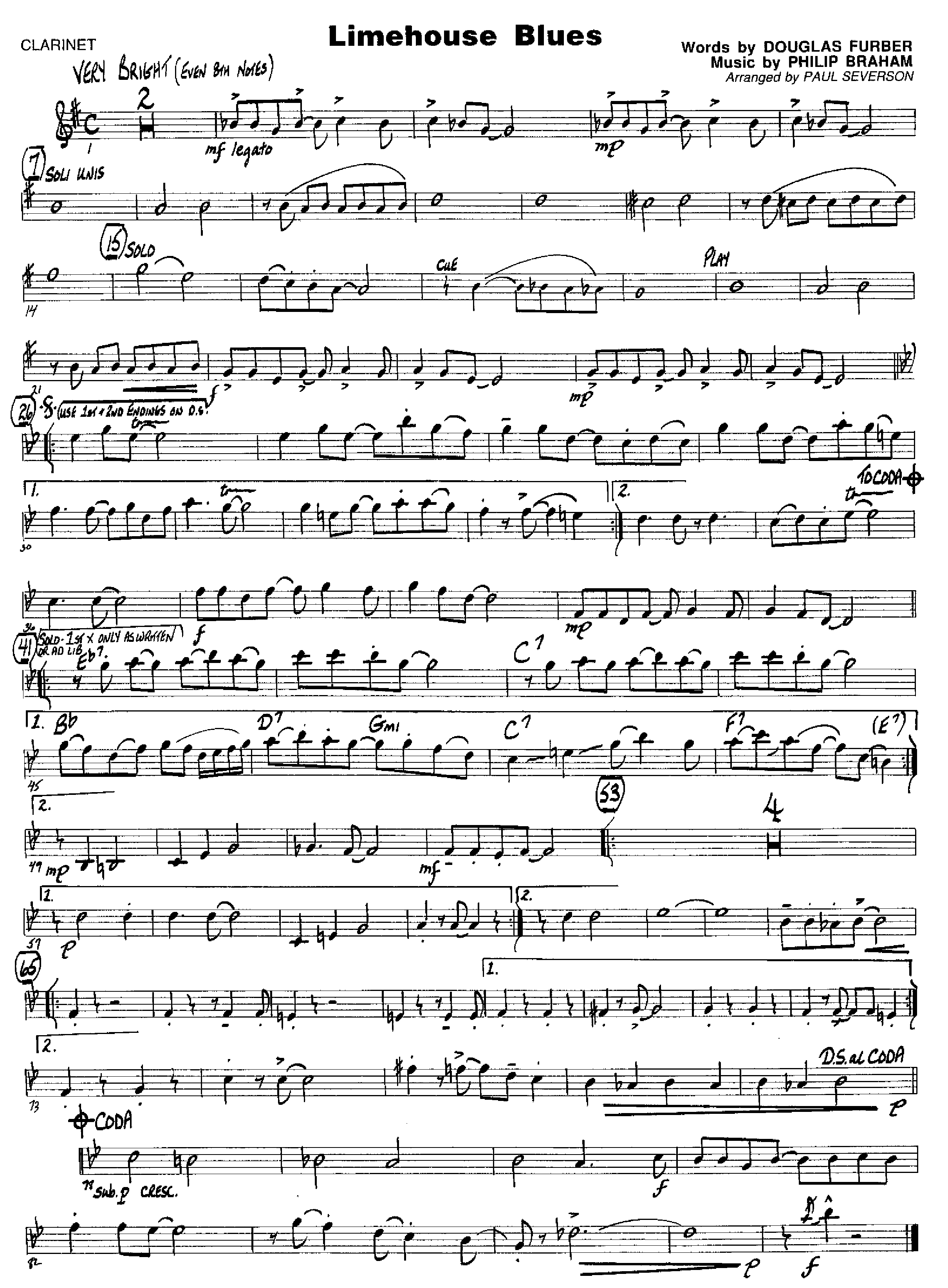
Limehouse Blues (Severson)
Composed by Philip Braham
Arranged by Severson
- Ensemble: Dixieland Band
- Style: Jazz Standard
- Pages: 10
- Difficulty: easy
- Content: Sheet Music
- Format: PDF Download (Instant)
- Price: $18.99
"Limehouse Blues," composed by Philip Braham in 1921 with lyrics by Douglas Furber, emerged from the British musical revue "A to Z" and gained significant popularity after being introduced to American audiences by Gertrude Lawrence in André Charlot's Revue of 1924. This enduring jazz standard, often performed instrumentally, evokes the vibrant and sometimes melancholic atmosphere of London's Limehouse district, historically known for its port and Chinatown. Its bluesy melody and distinctive harmonic progression have made it a favorite among jazz musicians, leading to hundreds of recordings by luminaries such as Louis Armstrong, Duke Ellington, Django Reinhardt, Sidney Bechet, and the Dave Brubeck Quartet, cementing its status as a core jazz repertory piece. The song's cultural impact extended to film, inspiring the 1934 movie of the same name and featuring in iconic dance sequences, most notably Fred Astaire's performance in "Ziegfeld Follies." This particular arrangement by Paul Severson breathes new life into the classic, tailored specifically for the authentic sound of a Dixieland band. Severson, a prolific American arranger and composer known for his extensive work in jazz and commercial music, including numerous Dixieland titles published by Hal Leonard, brings his characteristic clarity and spirited energy to this piece. His approach honors the polyphonic improvisation and collective interplay central to the Dixieland style, featuring a medium-up tempo swing feel that is both driving and danceable. The arrangement is typically set in a bright, accessible key, allowing for the characteristic brass and clarinet flourishes to shine without undue technical strain. Severson's signature often includes well-crafted soli sections that highlight the unique timbres of the Dixieland instrumentation—trumpet, clarinet, trombone, and rhythm section—creating a rich, interwoven texture that is both historically informed and musically engaging. Performance of "Limehouse Blues (Severson)" is a rewarding experience, offering both ensemble cohesion and opportunities for individual expression. The melody is typically carried by the trumpet and clarinet in unison or octaves during the initial statements, with the trombone providing counter-melodies and rhythmic punctuation. Featured solo sections are strategically placed, allowing the clarinet, trumpet, and trombone to engage in their characteristic improvisational dialogue over the rhythm section's steady pulse. The arrangement challenges musicians with its brisk tempo and the need for precise articulation and dynamic contrast, yet it remains highly accessible. The interplay between the front-line instruments, particularly during the collective improvisation sections, demands attentive listening and quick musical reflexes, making it an excellent vehicle for developing ensemble communication. The piece culminates in an energetic shout chorus, driving to a vibrant and satisfying conclusion. This arrangement is ideally suited for high school, college, and community jazz ensembles seeking to explore the foundational sounds of Dixieland jazz. Its clear structure and idiomatic writing make it an excellent teaching tool for understanding the style's conventions, while its inherent musicality and energetic character ensure enthusiastic audience reception. Professional Dixieland bands will also find it a solid, reliable addition to their repertoire, offering a fresh yet authentic take on a beloved standard. The arrangement's detailed notation and thoughtful voicings provide a strong framework for developing a cohesive and swinging performance, making it appropriate for groups aiming for an authentic early jazz sound. To achieve an authentic Dixieland feel for "Limehouse Blues (Severson)," aim for a medium-up tempo around quarter note = 180-200 BPM, maintaining a consistent, buoyant swing eighth-note feel. Key technical challenges include precise articulation in the brass and clarinet, particularly during the rapid-fire melodic passages and soli sections. Encourage a light, crisp attack from the trumpet and clarinet, while the trombone should provide a warm, full sound with clear glissandi where indicated. Collective improvisation sections require careful listening and balance; musicians should aim for polyphonic interplay rather than competing, ensuring each voice contributes to the overall texture. Rehearsal should focus on rhythmic precision in the rhythm section, establishing a solid foundation for the front line. Encourage stylistic embellishments like subtle falls and scoops from the wind instruments to enhance the period sound. **Q: What instruments are included in the "Limehouse Blues (Severson)" arrangement?** A: This Dixieland band arrangement includes parts for trumpet, clarinet, trombone, piano, bass (or tuba), drums, and typically banjo or guitar. The specific instrumentation is designed to capture the classic Dixieland ensemble sound. **Q: What is the difficulty level of this arrangement?** A: This arrangement is considered intermediate to advanced. While technically accessible for experienced high school and college musicians, it offers sufficient challenge in terms of stylistic interpretation, collective improvisation, and ensemble precision to engage community and professional Dixieland bands. **Q: What musical style and historical context does "Limehouse Blues (Severson)" represent?** A: This arrangement is a classic Dixieland jazz interpretation of "Limehouse Blues," a jazz standard composed in 1921. It embodies the energetic, polyphonic style of early 20th-century jazz, reflecting the popular music of the 1920s and 1930s. **Q: What makes Severson's arrangement of "Limehouse Blues" unique?** A: Paul Severson's arrangement is distinguished by its authentic Dixieland voicings, spirited medium-up swing tempo, and well-structured soli sections that highlight the ensemble's collective improvisation. His approach provides a clear, idiomatic framework for this beloved standard, making it both playable and stylistically accurate. **Q: What is the typical performance duration or tempo for this piece?** A: When performed at the recommended medium-up swing tempo of approximately quarter note = 180-200 BPM, "Limehouse Blues (Severson)" typically has a performance duration of around 3-4 minutes, depending on the number and length of improvised solos.
Musicians Also Search For
Limehouse Blues Severson PDF • Limehouse Blues Severson sheet music • Limehouse Blues arranged by Severson • Severson dixieland band charts • Severson jazz arrangements PDF • Limehouse Blues Philip Braham sheet music • Limehouse Blues Philip Braham dixieland band arrangement • Philip Braham dixieland band charts • Limehouse Blues dixieland band arrangement • Limehouse Blues dixieland band PDF download • Limehouse Blues jazz ensemble sheet music • dixieland band sheet music instant download • Limehouse Blues sheet music with parts • Limehouse Blues Jazz Standard chart • Jazz Standard dixieland band arrangements • buy Limehouse Blues sheet music online • download Limehouse Blues PDF • Limehouse Blues jazz chart • best Severson dixieland band arrangements • Philip Braham songs arranged by Severson • Limehouse Blues printable sheet music • dixieland band repertoire PDF