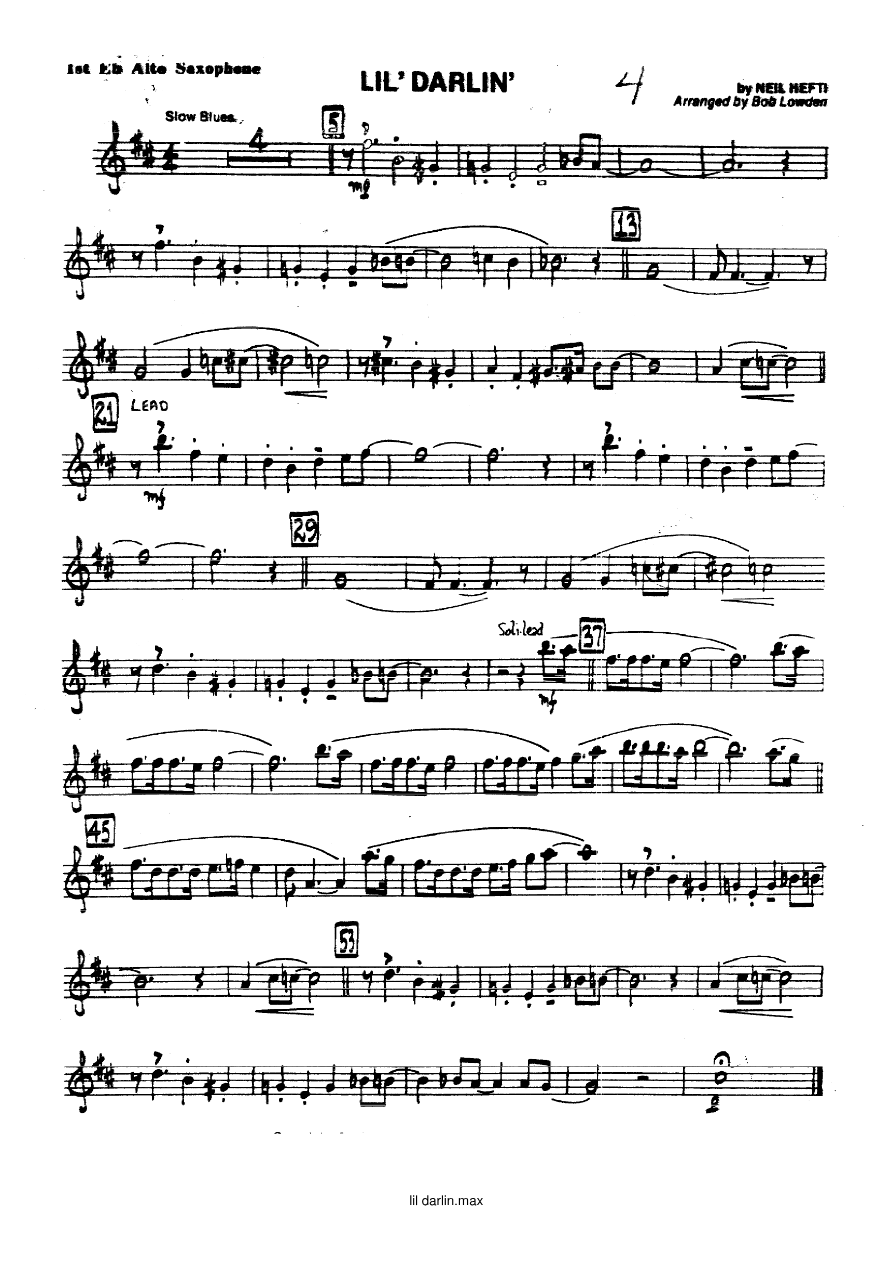
lil Darlin' (B.Lowden)
Composed by Neal Hefti
Arranged by Bob Lowden
- Ensemble: Big Band
- Style: Jazz Standard
- Pages: 18
- Instruments (17): 1st Eb Alto Saxophone, 2nd Eb Alto Saxophone, 1st Bb Tenor Saxophone, 2nd Bb Tenor Saxophone, Eb Baritone Saxophone, 1st Bb Trumpet, 2nd Bb Trumpet, 3rd Bb Trumpet, 4th Bb Trumpet, 1st Trombone, 2nd Trombone, 3rd Trombone, 4th Trombone, Drums, Electric Guitar, Electric Bass, Piano
- Difficulty: easy
- Content: Individual Parts
- Format: PDF Download (Instant)
- Price: $24.99
Neal Hefti's "Li'l Darlin'," a quintessential jazz standard, emerged from the vibrant big band era of the mid-20th century, first gaining widespread recognition as a cornerstone of the Count Basie Orchestra's "Atomic Basie" album in 1957. This iconic recording, often cited as a pinnacle of the Basie band's "New Testament" period, solidified the piece's place in the jazz canon, showcasing its understated elegance and sophisticated simplicity. "Li'l Darlin'" is celebrated for its deceptively simple melodic lines and its profound, relaxed swing feel, embodying the cool, effortless sophistication characteristic of the Basie sound. It stands as a testament to Hefti's genius for crafting memorable, yet harmonically rich, compositions that allow a big band to breathe and groove with unparalleled grace. The original recording, featuring the Basie band at its peak, highlighted the ensemble's impeccable dynamics and the subtle interplay between sections, establishing a benchmark for big band artistry. Bob Lowden's arrangement of "Li'l Darlin'" masterfully captures the essence of this beloved standard while imbuing it with his signature clarity and approachable big band voicings. Lowden preserves the original's medium-slow swing tempo, maintaining the relaxed, almost conversational mood that defines the piece. The arrangement is set in the key of C major, a comfortable key that allows for warm, resonant brass and saxophone voicings. Lowden's treatment emphasizes the melodic beauty of Hefti's composition, ensuring that the primary melody is clearly articulated, initially by the alto saxophone, then transitioning to a full saxophone soli, and later to the brass section. His voicings are characteristically clean and balanced, providing a rich harmonic backdrop without ever obscuring the lyrical content. The arrangement avoids overly complex rhythmic figures, focusing instead on sustained tones and smooth transitions, allowing the band to concentrate on blend, balance, and the crucial element of swing. A standout feature of Lowden's arrangement is its thoughtful distribution of melodic material and its accessible solo opportunities. The lead alto saxophone carries the initial melodic statement, requiring a player with a warm tone and excellent control. This is followed by an impeccably voiced saxophone soli that requires precise ensemble playing and dynamic control to achieve the desired blend. The arrangement features a written solo for tenor saxophone, offering a chance for a developing soloist to shine within the piece's harmonic framework. Lowden's understanding of big band dynamics is evident in his carefully constructed shout choruses, which build intensity gradually before returning to the piece's serene main theme. The arrangement culminates in a gentle fade, leaving the listener with the lingering warmth of the melody. This arrangement is ideally suited for high school and college jazz ensembles, as well as community bands, offering a rewarding performance experience that develops crucial ensemble skills such as blend, intonation, and dynamic control, all within the context of a timeless jazz classic. Its clear structure and well-crafted parts make it an excellent teaching tool for understanding big band phrasing and the art of the medium-slow swing. Conductors should emphasize a relaxed, unhurried medium-slow swing feel throughout, ensuring that the eighth notes are played with a smooth, even swing. The primary technical challenge lies in achieving a unified ensemble sound, particularly in the saxophone soli sections where precise intonation and blend are paramount. Encourage musicians to listen across sections and match dynamics carefully. Articulation should be light and legato for the most part, with subtle accents on beat two and four in the rhythm section to propel the swing. There are no special techniques like plungers or doits required, allowing the focus to remain on core musicianship. Rehearsal time should be dedicated to shaping phrases, especially in the melodic lines, and ensuring that the rhythm section maintains a consistent, understated groove without rushing. Q: What instruments are included in this arrangement? A: This arrangement is scored for a standard 17-piece big band: Alto Saxophone 1 & 2, Tenor Saxophone 1 & 2, Baritone Saxophone, Trumpet 1-4, Trombone 1-4, Piano, Bass, and Drums. Q: What is the difficulty level of Bob Lowden's "Li'l Darlin'" arrangement? A: This arrangement is rated as medium-easy to medium difficulty, making it suitable for high school, college, and community jazz ensembles. It focuses on fundamental big band concepts like blend, balance, and swing feel rather than extreme technical demands. Q: What is the musical style and historical context of "Li'l Darlin'"? A: "Li'l Darlin'" is a classic jazz standard composed by Neal Hefti, most famously recorded by the Count Basie Orchestra in 1957. It embodies the relaxed, cool, medium-slow swing style characteristic of the "New Testament" Basie era. Q: What makes Bob Lowden's arrangement of "Li'l Darlin'" unique? A: Lowden's arrangement is distinctive for its clear, accessible voicings, faithful preservation of the original's relaxed mood, and well-placed, approachable solo opportunities. It provides a clean, pedagogically sound approach to a beloved standard. Q: What is the typical performance duration and tempo for this piece? A: The typical performance duration for this arrangement is approximately 3-4 minutes. It should be played at a medium-slow swing tempo, around 80-90 beats per minute, emphasizing a relaxed and unhurried feel.
Questions and answers
- What is included in the lil Darlin' (B.Lowden) PDF?
- The verified current file contains individual parts across 18 pages.
- How many instruments or parts are listed for lil Darlin' (B.Lowden)?
- The verified instrumentation list contains 17 entries for this Big Band arrangement.
- Who is credited for lil Darlin' (B.Lowden)?
- Composer: Neal Hefti. Arranger: Bob Lowden.
- What difficulty is listed for lil Darlin' (B.Lowden)?
- The verified difficulty level is easy.
- What style is listed for lil Darlin' (B.Lowden)?
- The catalog lists the style as Jazz Standard.
- Can I preview lil Darlin' (B.Lowden) before buying?
- Yes. The product page provides a preview generated from the current PDF file.
- How is lil Darlin' (B.Lowden) delivered?
- After successful payment, the digital PDF is made available for download. The displayed price is $24.99.
Musicians Also Search For
lil Darlin' Bob Lowden PDF • lil Darlin' Bob Lowden sheet music • lil Darlin' arranged by Bob Lowden • Bob Lowden big band charts • Bob Lowden jazz arrangements PDF • lil Darlin' Neal Hefti sheet music • lil Darlin' Neal Hefti big band arrangements • Neal Hefti big band charts • lil Darlin' big band arrangements • lil Darlin' big band PDF download • lil Darlin' jazz sheet music • big band sheet music download • lil Darlin' individual parts download • lil Darlin' sheet music PDF • lil Darlin' Jazz Standard charts • Jazz Standard big band arrangements • buy lil Darlin' sheet music • download lil Darlin' PDF • lil Darlin' jazz charts • best Bob Lowden big band arrangements • Neal Hefti arranged by Bob Lowden • lil Darlin' printable sheet music • big band repertoire PDF