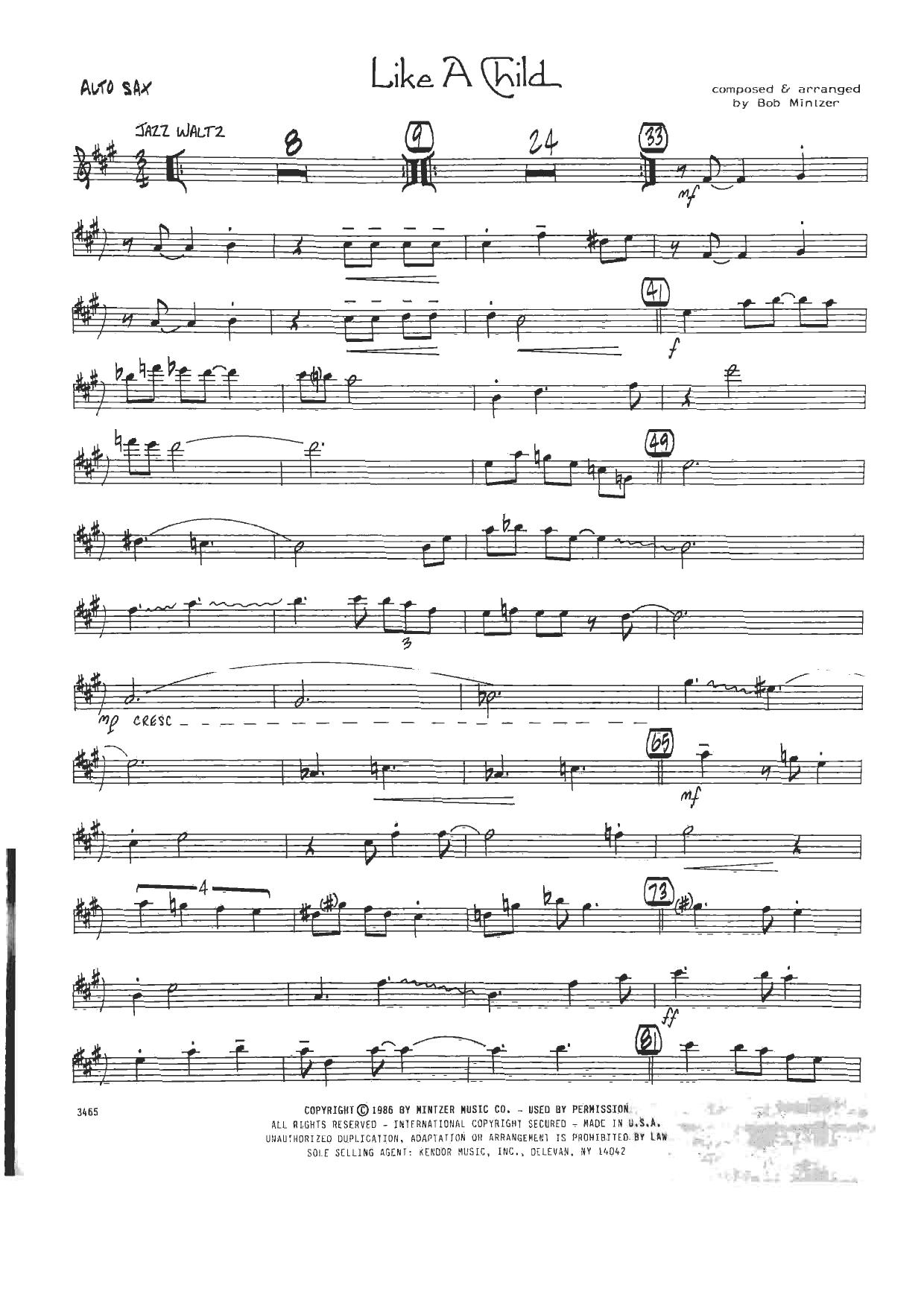
Like A Child (B.MIntzer)
Composed by Bob Mintzer
Arranged by Bob Mintzer
- Ensemble: Big Band
- Pages: 67
- Instruments (17): Bb Soprano Saxophone, Eb Alto Saxophone, 1st Bb Tenor Saxophone, 2nd Bb Tenor Saxophone, Eb Baritone Saxophone, 1st Bb Trumpet, 2nd Bb Trumpet, 3rd Bb Trumpet, 4th Bb Trumpet, 1st Trombone, 2nd Trombone, 3rd Trombone, 4th Trombone, Piano, Guitar, Bass, Drums
- Difficulty: advanced
- Content: Individual Parts
- Format: PDF Download (Instant)
- Price: $24.99
Composed and arranged by Grammy-winning saxophonist, composer, and big band luminary Bob Mintzer, "Like A Child" originally appeared on his acclaimed 1988 studio album *Spectrum* released on DMP Records. Representing the sophisticated contemporary big band writing of the late 1980s, this composition highlights Mintzer’s signature ability to fuse hard-bop harmonic complexity with modern groove elements and accessible melodic clarity. As a cornerstone of the modern big band repertoire, the piece exemplifies the writer's knack for creating dense, highly interactive ensemble textures that stretch beyond traditional swing-era formulas while honoring the lineage of jazz composition established by giants like Thad Jones and Wayne Shorter. Musically, the work unfolds at a driving, energetic medium-up tempo, anchored by a contemporary rhythmic drive that balances syncopated jazz-rock feels with straight-ahead momentum. The harmonic landscape is rich with extended chord voicings, chromatic inner-voice movement, and modal shifts that generate a youthful, optimistic, and searching mood. Rather than relying on simple diatonic resolutions, Mintzer utilizes shifting tonal centers and interwoven counterpoint to create an emotionally dynamic canvas. The overall sonic architecture evokes a sense of boundless curiosity and unrestrained wonder, moving seamlessly from delicate, transparent ensemble passages to roaring, high-octane tuttis. Mintzer’s structural approach relies heavily on seamless integration between the rhythm section and the horn tiers, utilizing interlocking 17-instrument voicings where saxophones, trumpets, and trombones frequently function as a unified, fluid choir. Rich sax solis and intricate background figures showcase his masterclass understanding of woodwind balance, while carefully paced shout choruses build organic dramatic tension across the chart's 67 pages. The melody is initially introduced with great clarity, often shared or doubled across multiple sections before opening up into sophisticated development sections that demand exceptional internal time and stylistic flexibility from every player on the bandstand. Performance-wise, the chart features prominent solo opportunities—traditionally calling for advanced improvisational facility—alongside demanding ensemble reading requirements. Technical hurdles include navigating rapid-fire unison lines, intricate syncopated figures across the brass sections, and maintaining pristine intonation through dense fourth-based and upper-structure triad voicings. The rhythm section carries a heavy responsibility, requiring a drummer adept at driving a contemporary jazz groove without overplaying, and a bassist capable of locking in a crisp, supportive foundation. It is an exceptionally rewarding piece for advanced college ensembles, top-tier high school bands, and professional repertory orchestras seeking to challenge their section work and contemporary jazz vocabulary. Succeeding with this arrangement requires meticulous attention to articulation balance and rhythmic precision across all sections. The tempo should be kept steady and forward-moving, ensuring that the underlying groove breathes without dragging during complex transitional phrases. Conductors should pay close attention to the dynamic markings; Mintzer frequently contrasts sparse, exposed accompaniment figures with thunderous ensemble hits, and the transition between these dynamics must be abrupt and clean. Woodwinds must blend tightly during unison and harmonized soli passages, ensuring that no single voice sticks out unless designated as the primary melodic carrier. Brass players should avoid over-blowing in the upper registers; instead, focus on a warm, centered core tone that projects through the complex harmonic matrix. Rehearsals should initially isolate the rhythm section to lock in the groove and anticipated syncopations before layering in the horn sections section by section. Emphasize clean articulation on short notes and smooth, connected phrasing on linear scalar runs to capture the signature Mintzer big band polish. Q: What instruments and parts are included in this arrangement? A: This comprehensive 67-page big band publication includes a full conductor score and individual parts for a standard 17-instrument ensemble: Alto Saxophones (1-2), Tenor Saxophones (1-2), Baritone Saxophone, Trumpets (1-4), Trombones (1-4), Guitar, Piano, Bass, and Drums. Q: What is the difficulty level of this chart? A: This arrangement is rated as advanced (Grade 5), making it best suited for collegiate jazz ensembles, advanced high school all-state bands, and professional repertory big bands that possess strong readers and confident soloists. Q: What is the musical style and historical background of the piece? A: Written in the late 1980s by Bob Mintzer, the piece reflects the sophisticated contemporary jazz style popularized during his tenure with major large ensembles, blending post-bop harmonies, intricate counterpoint, and modern rhythmic feels. Q: What makes this specific Mintzer arrangement unique? A: It features Mintzer’s signature dense harmonic voicings, interlocking horn writing that treats the big band as a unified chamber orchestra, and sophisticated transitions that bridge classic swing sensibilities with modern jazz composition. Q: What is the performance duration and tempo feel of the arrangement? A: The arrangement is written at a driving, energetic medium-up tempo with a contemporary groove feel, providing a substantial performance length that typically spans six to eight minutes depending on the length of improvised solo choruses.
Questions and answers
- What is included in the Like A Child (B.MIntzer) PDF?
- The verified current file contains a conductor score and individual parts across 67 pages.
- How many instruments or parts are listed for Like A Child (B.MIntzer)?
- The verified instrumentation list contains 17 entries for this Big Band arrangement.
- Who is credited for Like A Child (B.MIntzer)?
- Composer: Bob Mintzer. Arranger: Bob Mintzer.
- What difficulty is listed for Like A Child (B.MIntzer)?
- The verified difficulty level is advanced.
- Can I preview Like A Child (B.MIntzer) before buying?
- Yes. The product page provides a preview generated from the current PDF file.
- How is Like A Child (B.MIntzer) delivered?
- After successful payment, the digital PDF is made available for download. The displayed price is $24.99.
Musicians Also Search For
Like A Child Bob Mintzer PDF • Like A Child Bob Mintzer sheet music • Like A Child arranged by Bob Mintzer • Bob Mintzer big band charts • Bob Mintzer jazz arrangements PDF • Like A Child Bob Mintzer big band arrangements • Like A Child big band arrangements • Like A Child big band PDF download • Like A Child jazz sheet music • big band sheet music download • Like A Child conductor score PDF • Like A Child individual parts download • Like A Child sheet music PDF • buy Like A Child sheet music • download Like A Child PDF • Like A Child jazz charts • best Bob Mintzer big band arrangements • Like A Child printable sheet music • big band repertoire PDF