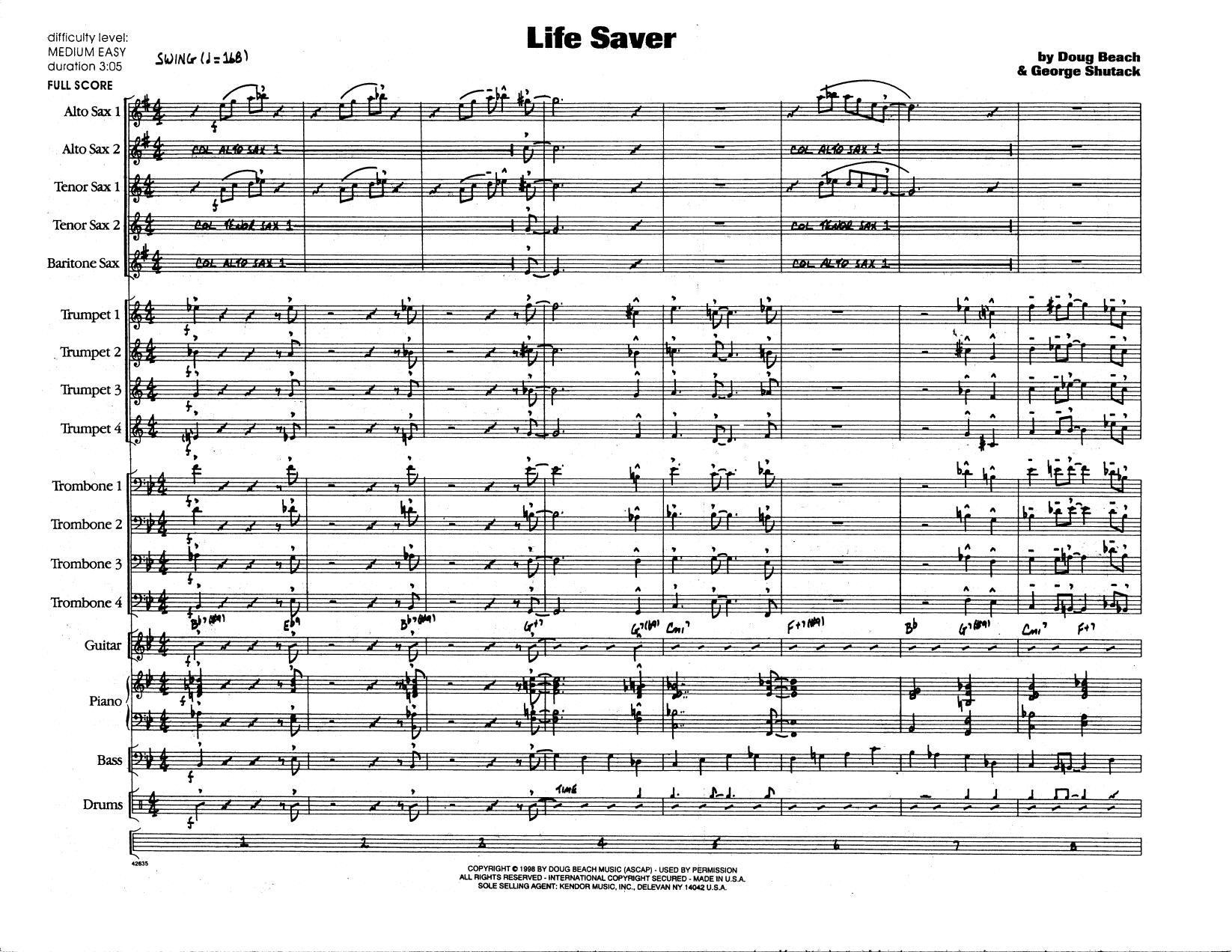
Life Saver (D.Beach-G.Shutack)
Composed by Doug Beach
Arranged by Doug Beach
- Ensemble: Big Band
- Pages: 48
- Instruments (17): 1st Eb Alto Sax, 2nd Eb Alto Sax, 1st Bb Tenor Sax, 2nd Bb Tenor Sax, Eb Baritone Sax, 1st Bb Trumpet, 2nd Bb Trumpet, 3rd Bb Trumpet, 4th Bb Trumpet, 1st Trombone, 2nd Trombone, 3rd Trombone, 4th Trombone, Guitar, Piano, Bass, Drums
- Difficulty: medium
- Content: Individual Parts
- Format: PDF Download (Instant)
- Price: $24.99
Written by renowned composer, educator, and publisher Doug Beach in collaboration with George Shutack, "Life Saver" stands as a quintessential pillar of modern educational and contemporary big band repertoire. Emerging from the vibrant tradition of Chicago-area jazz composition, Beach’s writing captures the sophisticated yet accessible aesthetic that defined late-20th and early-21st-century collegiate and advanced high school jazz writing. While not a historical pre-war standard, "Life Saver" has earned its reputation as a modern staple on festival adjudication lists and concert stages alike, celebrated for its infectious groove and masterclass-level structural pacing. Driving forward with an energetic, straight-ahead medium-up swing feel in 4/4 time, the composition radiates an upbeat, confident mood characterized by crisp articulation and forward momentum. The harmonic language balances traditional functional jazz harmony with contemporary modal colorings, utilizing rich maj9 and altered dominant voicings that give the brass and saxophone sections a lush, professional sheen. The emotional trajectory moves dynamically from a buoyant, head-turning opening theme to an exhilarating, high-octane shout chorus that demands precision and stamina from every section of the ensemble. Doug Beach’s signature arranging style shines through in the meticulous voice-leading and transparent textural layering. Rather than burying the ensemble in dense, monolithic blocks, Beach spaces his voicings wide to maximize acoustic clarity, allowing inner-voice movements to weave seamlessly through the chord changes. The saxophones are treated to tight, harmonically rich soli passages that require absolute unanimity in phrasing and intonation, while the brass counterlines punctuate the texture with sharp, punchy accents. The rhythm section acts as the primary engine, anchored by a driving bass line and a flexible drum groove that encourages a natural, forward-leaning swing interpretation without ever dragging. Melodic duties are shared dynamically across the ensemble, transitioning fluidly from the lead trumpet and alto saxophone to robust full-ensemble declarations. Built-in solo opportunities provide a showcase for developing or advanced improvisers to stretch out over standard-friendly changes, backed by tightly wound background figures that build natural tension. Technically, the chart rewards groups that excel at dynamic contrast, crisp articulations (such as marcato stabs and controlled falls), and stylistic uniformity. Advanced high school bands with strong section players and well-developed collegiate ensembles will find this arrangement an ideal vehicle for refining professional big band habits, offering enough technical challenge to stimulate growth while remaining deeply rewarding to rehearse and perform. Conductors should approach "Life Saver" with a primary focus on time feel and section articulation. The tempo must remain relentlessly steady; avoid rushing during the loud ensemble passages or dragging during the softer developmental sections. The swing eighth-note interpretation should lean toward a modern, lighter articulation style rather than a heavy, exaggerated gate—think Count Basie meets contemporary collegiate jazz ensemble standards. Key technical challenges lie in the fast-moving saxophone soli and the crisp execution of syncopated brass figures. Ensure that the rhythm section—particularly the drummer and bassist—locks in early on the underlying pulse, using a steady ride cymbal pattern to drive the ensemble. Dynamics are the secret weapon of this chart: make sure the background figures sit comfortably underneath the designated soloists by dropping dynamic levels by at least two notches. Encourage the brass section to use controlled, clean falls and doits where indicated, avoiding overblown tones that can muddy Beach’s carefully crafted vertical chord structures. Q: What instruments and parts are included in this 17-instrument big band arrangement? A: The instrumentation comprises a standard 17-piece big band lineup featuring 5 saxophones (Alto 1, Alto 2, Tenor 1, Tenor 2, Baritone), 4 trumpets, 4 trombones, and a full rhythm section of piano, guitar, bass, and drums, supported by a comprehensive 48-page conductor score. Q: What is the difficulty level of Doug Beach's "Life Saver"? A: This arrangement is graded as medium-advanced, making it an ideal choice for skilled high school jazz ensembles, university lab bands, and advanced community big bands looking to develop precision and swing feel. Q: What is the musical style and historical background of this piece? A: "Life Saver" is a contemporary jazz composition written in the straight-ahead swing tradition by Doug Beach and George Shutack, reflecting the sophisticated educational big band style popularized from the late 1980s onward. Q: What makes this specific arrangement unique within the big band repertoire? A: The arrangement is uniquely characterized by Doug Beach's signature transparent horn voicings, interactive background figures, and a meticulously crafted shout chorus that balances modern harmonic depth with infectious, driving groove. Q: What is the recommended performance tempo and duration for this arrangement? A: While tempo can be adjusted slightly to fit the ensemble's technical comfort zone, it is designed to be performed at a brisk medium-up swing tempo, yielding a performance duration of approximately 4 to 5 minutes.
Questions and answers
- What is included in the Life Saver (D.Beach-G.Shutack) PDF?
- The verified current file contains a conductor score and individual parts across 48 pages.
- How many instruments or parts are listed for Life Saver (D.Beach-G.Shutack)?
- The verified instrumentation list contains 17 entries for this Big Band arrangement.
- Who is credited for Life Saver (D.Beach-G.Shutack)?
- Composer: Doug Beach. Arranger: Doug Beach.
- What difficulty is listed for Life Saver (D.Beach-G.Shutack)?
- The verified difficulty level is medium.
- Can I preview Life Saver (D.Beach-G.Shutack) before buying?
- Yes. The product page provides a preview generated from the current PDF file.
- How is Life Saver (D.Beach-G.Shutack) delivered?
- After successful payment, the digital PDF is made available for download. The displayed price is $24.99.
Musicians Also Search For
Life Saver Doug Beach PDF • Life Saver Doug Beach sheet music • Life Saver arranged by Doug Beach • Doug Beach big band charts • Doug Beach jazz arrangements PDF • Life Saver Doug Beach big band arrangements • Life Saver big band arrangements • Life Saver big band PDF download • Life Saver jazz sheet music • big band sheet music download • Life Saver conductor score PDF • Life Saver individual parts download • Life Saver sheet music PDF • buy Life Saver sheet music • download Life Saver PDF • Life Saver jazz charts • best Doug Beach big band arrangements • Life Saver printable sheet music • big band repertoire PDF