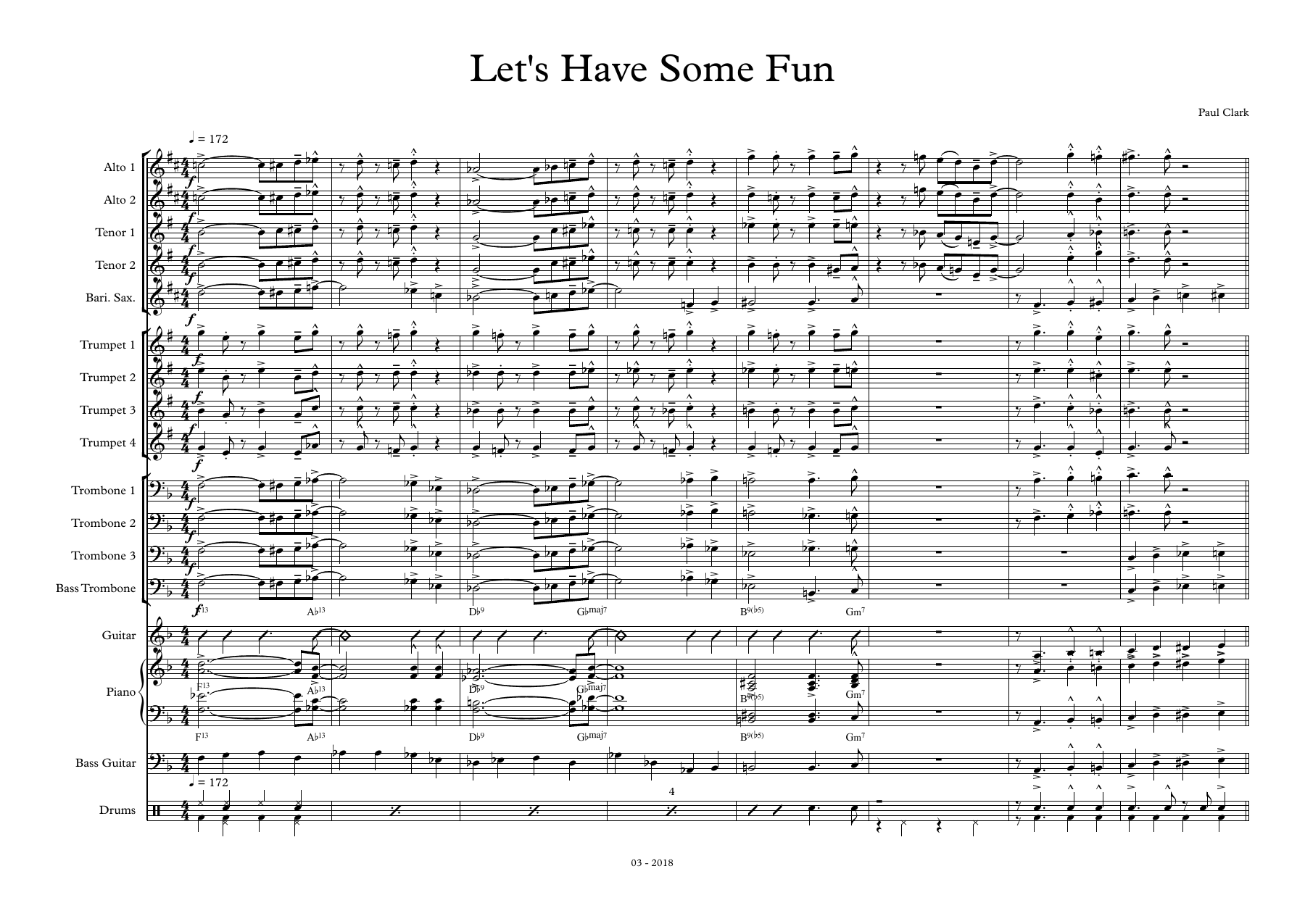
Let's Have Some Fun (P.Clark)
Composed by Paul Clark
Arranged by P.Clark
- Ensemble: Big Band
- Style: Jazz Standard
- Pages: 44
- Instruments (17): Alto Saxophone 1, Alto Saxophone 2, Tenor Saxophone 1, Tenor Saxophone 2, Baritone Saxophone, Trumpet 1, Trumpet 2, Trumpet 3, Trumpet 4, Trombone 1, Trombone 2, Trombone 3, Bass Trombone, Guitar, Piano, Bass Guitar, Drum Set
- Difficulty: medium
- Content: Individual Parts
- Format: PDF Download (Instant)
- Price: $24.99
"Let's Have Some Fun" by Paul Clark, presented here in an exhilarating big band arrangement by P.Clark, embodies the vibrant spirit of contemporary jazz-funk with a nod to the soulful grooves of the late 1970s and early 1980s. While not a traditional "jazz standard" in the historical sense of Tin Pan Alley or bebop repertoire, Clark's original composition has garnered significant recognition within modern jazz circles for its infectious energy and sophisticated harmonic language, establishing itself as a contemporary standard for bands seeking a high-energy, audience-engaging piece. It captures the essence of a feel-good, celebratory jam, reminiscent of fusion pioneers like Herbie Hancock's Head Hunters or the Yellowjackets, but with a distinct, modern big band voice. The piece is characterized by its driving, medium-up funk groove, typically set in a bright major key, designed to instantly uplift and energize both performers and listeners. P.Clark's arrangement masterfully translates the original's infectious character for the full power of a 17-piece big band. The arranger's signature approach is evident in the meticulously crafted voicings, which provide a rich, full-bodied sound without sacrificing clarity or rhythmic precision. Expect tight, unison horn lines punctuated by complex, yet accessible, harmonic clusters that propel the groove forward. The arrangement features compelling soli sections for the saxophones and brass, showcasing the ensemble's precision and dynamic control. A standout feature is the expertly orchestrated shout chorus, building in intensity and layering textures to a thrilling climax, a hallmark of P.Clark's ability to maximize the big band's sonic potential. The piece maintains its primary key throughout, focusing on rhythmic interplay and dynamic contrast rather than extensive modulation, ensuring a cohesive and impactful musical statement. The performance of "Let's Have Some Fun" offers numerous rewarding moments. The primary melody is typically carried by the lead alto saxophone or trumpet, often doubled by other sections to create a powerful, unified statement. The arrangement provides ample opportunity for featured improvisation, with designated solo sections over the driving funk changes, usually for tenor saxophone and trumpet, allowing soloists to stretch out and interact with the rhythm section. Technical challenges include maintaining the tight rhythmic precision of the funk groove, particularly in the brass and saxophone soli passages, and executing the dynamic shifts with conviction. The rewarding aspect lies in the sheer joy of performing such an energetic and well-crafted piece, where every section contributes to an undeniable sense of collective fun and musicality. This arrangement is ideally suited for college-level jazz ensembles, advanced community big bands, and professional groups seeking a vibrant, contemporary addition to their repertoire. Its blend of accessible groove, sophisticated harmonies, and exciting solo opportunities makes it a fantastic vehicle for showcasing a band's rhythmic prowess, ensemble precision, and individual solo talent. High school bands with strong lead players and a solid rhythm section foundation could also tackle this piece, finding it an excellent challenge to develop funk articulation and ensemble tightness. Conductors should emphasize a consistent, driving medium-up funk groove from the outset, ensuring the rhythm section locks in tightly, particularly the bass and drums. The tempo should feel energetic but not rushed, allowing the intricate horn lines to articulate clearly. Key technical challenges include the precise execution of sixteenth-note figures in the brass and saxophone soli, which require meticulous rehearsal for rhythmic accuracy and unified articulation. Encourage a light, crisp articulation in the horns, avoiding overly heavy attacks that can bog down the funk feel. Dynamics are crucial; ensure clear distinctions between written forte and piano passages, with particular attention to the gradual build-up in the shout chorus. Soloists should be encouraged to embrace the funk aesthetic, utilizing rhythmic phrasing and blues-infused melodic ideas. No special mutes are explicitly required, but precise cut-offs and releases are essential for maintaining the piece's sharp, contemporary edge. Q: What instruments are included in this arrangement? A: This big band arrangement includes parts for 17 instruments: Alto Saxophone 1, Alto Saxophone 2, Tenor Saxophone 1, Tenor Saxophone 2, Baritone Saxophone, Trumpet 1, Trumpet 2, Trumpet 3, Trumpet 4, Trombone 1, Trombone 2, Trombone 3, Trombone 4, Guitar, Piano, Bass, and Drums. Q: What is the difficulty level of "Let's Have Some Fun (P.Clark)"? A: This arrangement is rated as Medium-Advanced. It is suitable for college-level jazz ensembles, advanced community big bands, and professional groups due to its demanding rhythmic precision, intricate soli sections, and requirements for strong improvisational skills. Q: What musical style and historical context does this piece represent? A: "Let's Have Some Fun" is an original composition by Paul Clark that falls into the contemporary jazz-funk genre. It draws inspiration from the energetic, groove-oriented fusion sounds of the late 1970s and early 1980s, updated with modern big band voicings and harmonic sensibilities. Q: What makes P.Clark's arrangement of "Let's Have Some Fun" unique? A: P.Clark's arrangement is distinguished by its expertly crafted, full-bodied voicings, driving funk groove translation for big band, and thrilling, layered shout chorus. It effectively balances sophisticated ensemble writing with ample space for improvisation, capturing the original's infectious energy. Q: What is the typical performance duration and tempo for this arrangement? A: The typical performance duration for "Let's Have Some Fun" is approximately 4-5 minutes, depending on the length of the improvised solos. It is designed to be played at a medium-up funk tempo, generally around 120-130 beats per minute, maintaining a consistent, energetic groove.
Musicians Also Search For
Let's Have Some Fun P.Clark PDF • Let's Have Some Fun P.Clark sheet music • Let's Have Some Fun arranged by P.Clark • P.Clark big band charts • P.Clark jazz arrangements PDF • Let's Have Some Fun Paul Clark sheet music • Let's Have Some Fun Paul Clark big band arrangement • Paul Clark big band charts • Let's Have Some Fun big band arrangement • Let's Have Some Fun big band PDF download • Let's Have Some Fun jazz ensemble sheet music • big band sheet music instant download • Let's Have Some Fun conductor score PDF • Let's Have Some Fun individual parts download • Let's Have Some Fun sheet music with parts • Let's Have Some Fun Jazz Standard chart • Jazz Standard big band arrangements • buy Let's Have Some Fun sheet music online • download Let's Have Some Fun PDF • Let's Have Some Fun jazz chart • best P.Clark big band arrangements • Paul Clark songs arranged by P.Clark • Let's Have Some Fun printable sheet music • big band repertoire PDF