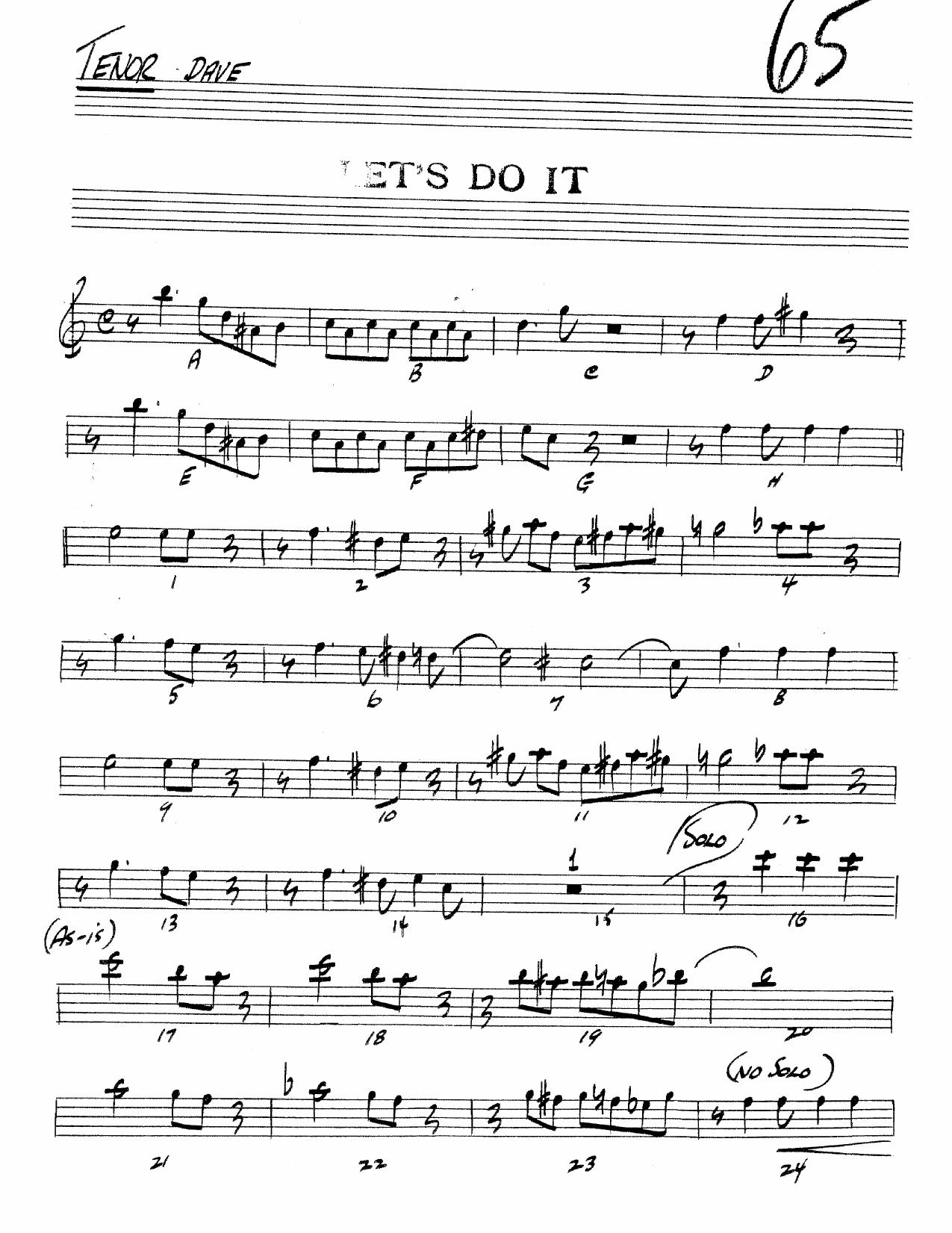
Let's Do It - Dave Pell Octet - Ts,Bs,Trp,Trb+Rhythm (comp. Cole Porter)
Composed by Cole Porter
- Ensemble: Small Ensemble
- Pages: 26
- Instruments (9): Tenor Saxophone, Bass Clarinet, Baritone Saxophone, Trumpet, Trombone, Piano, Guitar, Bass, Drums
- Difficulty: easy
- Content: Individual Parts
- Format: PDF Download (Instant)
- Price: $12.99
Cole Porter's timeless standard, "Let's Do It (Let's Fall in Love)," originally penned in 1928 for the musical *Paris*, stands as a witty and sophisticated cornerstone of the Great American Songbook. This iconic tune, celebrated for its clever lyrical double entendres and elegant melodic contour, quickly became a jazz standard, famously interpreted by countless vocalists and instrumentalists, including Eartha Kitt, Louis Armstrong, and Frank Sinatra. Its enduring appeal lies in its charming, conversational quality and its ability to adapt across various jazz styles, from early swing to more modern interpretations. This particular arrangement, capturing the essence of the Dave Pell Octet's signature West Coast cool jazz sound, transports the listener to the sophisticated, laid-back atmosphere of the mid-20th century, evoking a sense of effortless swing and melodic clarity. This arrangement of "Let's Do It" is set at a medium-swing tempo, typically around 120-130 BPM, maintaining a relaxed yet propulsive 4/4 feel. The original key, often C Major or Eb Major, is likely preserved or thoughtfully transposed to best suit the octet's instrumentation, ensuring a bright, clear timbre. The musical character is one of understated elegance and melodic interplay, characteristic of the Dave Pell Octet's approach. Expect transparent voicings, clean lines, and a focus on ensemble blend rather than overt power. The mood is sophisticated and lighthearted, inviting both performers and listeners into its charming narrative. The arrangement likely features a head-in, head-out structure, with ample space for improvisation over the familiar chord changes. While the arranger remains unknown, their treatment clearly draws inspiration from the Dave Pell Octet's distinctive style. This typically involves a precise, almost chamber-jazz approach to ensemble playing, emphasizing linear clarity and tight harmonic voicings. Expect the melody to be initially carried by the tenor saxophone, possibly in unison or octaves with the trumpet, establishing the tune's iconic theme. Soli sections featuring the horn quartet (Tenor Sax, Baritone Sax, Trumpet, Trombone) are highly probable, showcasing intricate counterpoint and close-voiced harmonies that are a hallmark of this era and ensemble type. Solo opportunities will undoubtedly be provided for the tenor saxophone, trumpet, and potentially the trombone, allowing for expressive improvisation over the tune's accessible harmonic progression. The arrangement's technical demands are moderate, requiring good intonation, blend, and rhythmic precision from all players, particularly in the tightly voiced ensemble passages. This arrangement is ideally suited for college-level jazz ensembles, advanced high school groups, or community bands seeking to explore the nuances of West Coast cool jazz. Its manageable technical demands, combined with its emphasis on ensemble blend and melodic interpretation, make it a rewarding piece for developing musicians to refine their articulation, phrasing, and improvisational skills within a classic small-group context. Professional groups will appreciate its authentic stylistic representation and the opportunity to showcase precise ensemble playing and individual soloists. The clarity of the voicings and the engaging melodic lines make it an excellent choice for concert programming, offering a refreshing contrast to larger, more bombastic big band charts. Approach this arrangement with a focus on precision and blend, aiming for the laid-back, sophisticated feel characteristic of the Dave Pell Octet. Maintain a consistent medium-swing tempo, ensuring the rhythm section provides a light, driving pulse without overpowering the horns. Intonation is paramount, especially in the close-voiced soli sections; encourage players to listen across the section and adjust. Articulation should be clean and precise, with a balance between legato phrasing on melodic lines and crisp attacks on rhythmic figures. There are no special techniques like plungers or doits indicated, emphasizing a "straight-ahead" cool jazz delivery. Rehearsal time should be dedicated to balancing the horn quartet, ensuring each voice is heard clearly within the harmonic structure, and refining the rhythmic accuracy of the ensemble hits. Soloists should be encouraged to develop melodic, lyrical improvisations that complement the arrangement's overall aesthetic. Q: What instruments are included in this arrangement? A: This arrangement is scored for a 7-instrument small ensemble: Tenor Saxophone, Baritone Saxophone, Trumpet, Trombone, Piano, Bass, and Drums. Q: What is the difficulty level of this arrangement? A: This arrangement is rated as medium difficulty, suitable for college-level jazz ensembles, advanced high school bands, or proficient community and professional groups. Q: What musical style and historical context does this arrangement represent? A: This arrangement embodies the West Coast cool jazz style of the mid-20th century, specifically evoking the sound of the Dave Pell Octet, and is based on Cole Porter's classic 1928 standard. Q: What makes this arrangement unique compared to other versions of "Let's Do It"? A: Its uniqueness lies in its authentic emulation of the Dave Pell Octet's small-group, cool jazz aesthetic, featuring precise voicings, clear melodic lines, and a focus on ensemble blend and understated sophistication. Q: What is the typical performance duration and tempo for this piece? A: The typical performance duration is approximately 3-4 minutes, maintaining a medium-swing tempo, generally around 120-130 beats per minute.
Questions and answers
- What is included in the Let's Do It - Dave Pell Octet - Ts,Bs,Trp,Trb+Rhythm (comp. Cole Porter) PDF?
- The verified current file contains individual parts across 26 pages.
- How many instruments or parts are listed for Let's Do It - Dave Pell Octet - Ts,Bs,Trp,Trb+Rhythm (comp. Cole Porter)?
- The verified instrumentation list contains 9 entries for this Small Ensemble arrangement.
- Who is credited for Let's Do It - Dave Pell Octet - Ts,Bs,Trp,Trb+Rhythm (comp. Cole Porter)?
- Composer: Cole Porter.
- What difficulty is listed for Let's Do It - Dave Pell Octet - Ts,Bs,Trp,Trb+Rhythm (comp. Cole Porter)?
- The verified difficulty level is easy.
- Can I preview Let's Do It - Dave Pell Octet - Ts,Bs,Trp,Trb+Rhythm (comp. Cole Porter) before buying?
- Yes. The product page provides a preview generated from the current PDF file.
- How is Let's Do It - Dave Pell Octet - Ts,Bs,Trp,Trb+Rhythm (comp. Cole Porter) delivered?
- After successful payment, the digital PDF is made available for download. The displayed price is $12.99.
Musicians Also Search For
Let's Do It - Dave Pell Octet - Ts,Bs,Trp,Trb+Rhythm Cole Porter sheet music • Let's Do It - Dave Pell Octet - Ts,Bs,Trp,Trb+Rhythm Cole Porter small ensemble arrangements • Cole Porter small ensemble charts • Let's Do It - Dave Pell Octet - Ts,Bs,Trp,Trb+Rhythm small ensemble arrangements • Let's Do It - Dave Pell Octet - Ts,Bs,Trp,Trb+Rhythm small ensemble PDF download • Let's Do It - Dave Pell Octet - Ts,Bs,Trp,Trb+Rhythm jazz sheet music • small ensemble sheet music download • Let's Do It - Dave Pell Octet - Ts,Bs,Trp,Trb+Rhythm individual parts download • Let's Do It - Dave Pell Octet - Ts,Bs,Trp,Trb+Rhythm sheet music PDF • buy Let's Do It - Dave Pell Octet - Ts,Bs,Trp,Trb+Rhythm sheet music • download Let's Do It - Dave Pell Octet - Ts,Bs,Trp,Trb+Rhythm PDF • Let's Do It - Dave Pell Octet - Ts,Bs,Trp,Trb+Rhythm jazz charts • Let's Do It - Dave Pell Octet - Ts,Bs,Trp,Trb+Rhythm printable sheet music • small ensemble repertoire PDF