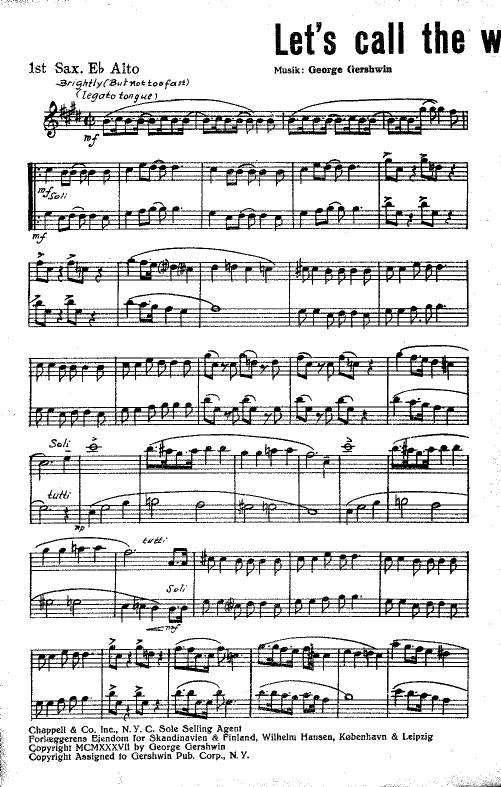
Let's Call The Whole Thing Off (J.Mason)
Composed by George Gershwin
Arranged by Jack Mason
- Ensemble: Big Band
- Pages: 29
- Instruments (15): 1st Sax. Eb Alto, 3rd Sax. Eb Alto, 2nd Sax. Bb Tenor, 1st Trumpet in Bb, 2nd Trumpet in Bb, 3rd Trumpet in Bb, 1st Trombone, 2nd Trombone, 1st Violins A-B, Violin C, Cello, Bass, Drums, Guitar, Piano
- Difficulty: medium
- Content: Individual Parts
- Format: PDF Download (Instant)
- Price: $24.99
George and Ira Gershwin’s timeless masterpiece "Let's Call The Whole Thing Off," originally introduced by Fred Astaire and Ginger Rogers in the 1937 musical film *Shall We Dance*, stands as one of the definitive gems of the Great American Songbook. Immortalized further by landmark jazz interpretations from vocal icons like Ella Fitzgerald and Louis Armstrong, the tune possesses a playful, conversational lyricism and an infectious melody that naturally lends itself to jazz adaptation. Its enduring appeal lies in the clever juxtaposition of pronunciation differences ("potato/potahto") set against a sophisticated, swinging harmonic framework that has kept it a staple of mainstream jazz repertoire for nearly a century. Jack Mason’s masterful big band arrangement captures the wit and buoyant energy of the original composition while infusing it with a vibrant, swinging instrumental vitality. Written in a classic medium-swing feel (approx. quarter note = 120-126), the chart opens with a catchy, teasing vamp that sets a lighthearted yet driving mood. The arrangement balances sparkling ensemble passages with rich, traditional big-band voicings, evoking the golden age of swing while maintaining a fresh, crisp clarity. The harmonic palette features clever secondary dominants and subtle chromatic passing tones that enrich the Gershwin progression without ever obscuring its instantly recognizable melody. Throughout the chart, the melodic weight is cleverly distributed across the ensemble, featuring crisp woodwind interplay and robust brass punctuations. The arrangement includes well-crafted soli sections where the saxophones and brass converse in tight, harmonized counterpoint, building toward an exhilarating, high-energy shout chorus that showcases the full dynamic range of the big band. Interspersed within the arrangement are designated solo changes—ideal for featuring a proficient lead alto saxophone or trumpet player—allowing individual improvisers to stretch out over a secure, swinging background foundation. The rhythm section plays a pivotal role, with the piano and guitar outlining essential comping shells while the bass and drums lock into an undeniable, buoyant pocket. Advanced high school ensembles, collegiate jazz orchestras, and professional community big bands will find this chart to be an exceptionally rewarding addition to their libraries. While the technical demands are approachable enough for developing bands with strong section players, the sophisticated articulation requirements and stylistic nuance demand careful attention from the conductor. Precision in swing eighth-note interpretation, dynamic control during ensemble build-ups, and stylistic cohesion make this Jack Mason arrangement a guaranteed crowd-pleaser that bridges nostalgic charm with high-caliber big band execution. To capture the authentic spirit of this Jack Mason arrangement, the conductor must prioritize a relaxed yet driving medium-swing feel. Ensure the rhythm section establishes an unhurried, buoyant groove from the downbeat, avoiding any tendency to rush the tempo during dense ensemble passages. Technically, the primary challenge lies in the uniform execution of articulation markings. Short, crisp staccatos and well-placed accents must be tightly synchronized across all sections, particularly during the energetic soli segments. Brass players should utilize subtle, tasteful falls and doits where indicated, avoiding over-exaggeration that could compromise the classic swing aesthetic. Rehearsal should begin by isolating the rhythm section to lock in the foundational groove before layering in the horns section by section. Pay close attention to the dynamic contrast between the understated verse statements and the roaring shout chorus; maintaining dynamic discipline ensures the arrangement's structural peaks and valleys have maximum emotional and sonic impact. Q: What instruments and parts are included in this big band arrangement? A: The 29-page set includes standard big band instrumentation featuring 14 core parts: Alto Saxophone 1, Alto Saxophone 3, Tenor Saxophone 2, Trumpet 1, Trumpet 2, alongside full complementary rhythm and horn sections. Q: What is the difficulty level of this arrangement? A: This chart is graded as medium difficulty, making it exceptionally well-suited for advanced high school bands, collegiate jazz ensembles, and professional community big bands looking for a polished swing chart. Q: What is the musical style and historical context of this piece? A: Written in a classic medium-swing style, this arrangement reimagines George Gershwin's 1937 Tin Pan Alley classic, drawing inspiration from the golden era of big band swing and legendary vocal interpretations. Q: What makes Jack Mason's arrangement unique? A: Mason’s treatment stands out through its witty conversational phrasing between sections, clever harmonic embellishments of the classic Gershwin progression, and a brilliantly structured shout chorus that builds maximum excitement. Q: What is the performance duration and tempo feel of the chart? A: The arrangement is designed for a medium swing tempo of approximately quarter note = 120–126, resulting in a performance duration of roughly 3 to 4 minutes depending on solo extensions.
Questions and answers
- What is included in the Let's Call The Whole Thing Off (J.Mason) PDF?
- The verified current file contains individual parts across 29 pages.
- How many instruments or parts are listed for Let's Call The Whole Thing Off (J.Mason)?
- The verified instrumentation list contains 15 entries for this Big Band arrangement.
- Who is credited for Let's Call The Whole Thing Off (J.Mason)?
- Composer: George Gershwin. Arranger: Jack Mason.
- What difficulty is listed for Let's Call The Whole Thing Off (J.Mason)?
- The verified difficulty level is medium.
- Can I preview Let's Call The Whole Thing Off (J.Mason) before buying?
- Yes. The product page provides a preview generated from the current PDF file.
- How is Let's Call The Whole Thing Off (J.Mason) delivered?
- After successful payment, the digital PDF is made available for download. The displayed price is $24.99.
Musicians Also Search For
Let's Call The Whole Thing Off Jack Mason PDF • Let's Call The Whole Thing Off Jack Mason sheet music • Let's Call The Whole Thing Off arranged by Jack Mason • Jack Mason big band charts • Jack Mason jazz arrangements PDF • Let's Call The Whole Thing Off George Gershwin sheet music • Let's Call The Whole Thing Off George Gershwin big band arrangements • George Gershwin big band charts • Let's Call The Whole Thing Off big band arrangements • Let's Call The Whole Thing Off big band PDF download • Let's Call The Whole Thing Off jazz sheet music • big band sheet music download • Let's Call The Whole Thing Off individual parts download • Let's Call The Whole Thing Off sheet music PDF • buy Let's Call The Whole Thing Off sheet music • download Let's Call The Whole Thing Off PDF • Let's Call The Whole Thing Off jazz charts • best Jack Mason big band arrangements • George Gershwin arranged by Jack Mason • Let's Call The Whole Thing Off printable sheet music • big band repertoire PDF