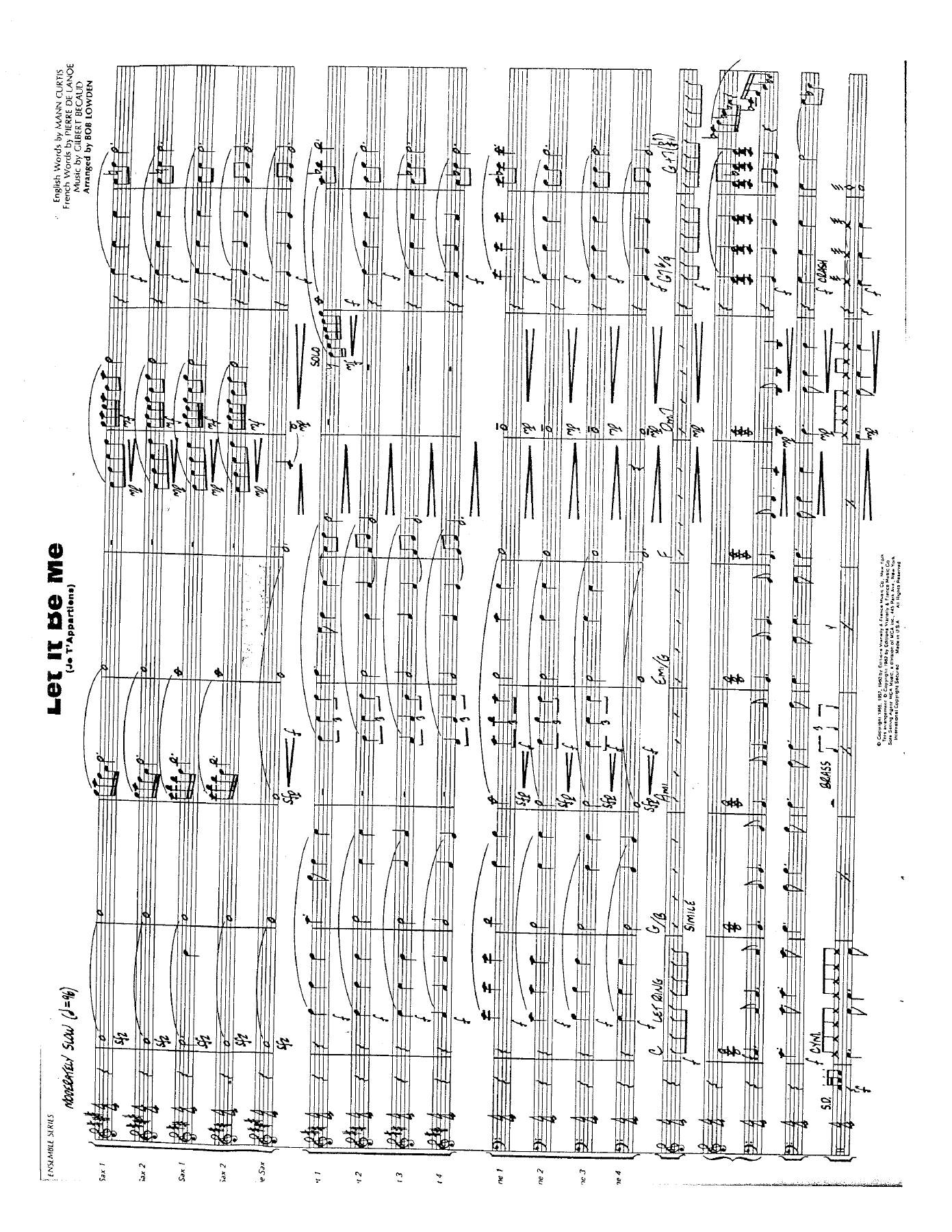
Let It Be Me (B.Lowden)
Composed by Gilbert Becaud, Pierre Delanoe, Manny Curtis
Arranged by Bob Lowden
- Ensemble: Big Band
- Style: Jazz Standard
- Pages: 46
- Instruments (17): Alto Sax 1, Alto Sax 2, Tenor Sax 1, Tenor Sax 2, Baritone Sax, Trumpet 1, Trumpet 2, Trumpet 3, Trumpet 4, Trombone 1, Trombone 2, Trombone 3, Trombone 4, Guitar, Piano, Bass, Drums
- Difficulty: medium
- Content: Individual Parts
- Format: PDF Download (Instant)
- Price: $24.99
"Let It Be Me," originally composed as "Je t'appartiens" by Gilbert Bécaud and Pierre Delanoë in 1955, stands as a timeless ballad that transcended its French origins to become a beloved jazz standard. The English lyrics, penned by Manny Curtis, transformed the piece into a poignant declaration of devotion, first gaining traction with Jill Corey's 1957 rendition before being immortalized by The Everly Brothers in 1960. Their iconic harmonies propelled the song to a top-ten hit on the US Billboard Hot 100, cementing its place in the American popular music canon and inspiring countless covers across genres, from R&B to country and, notably, jazz. The song's enduring melodic beauty and heartfelt lyrical sentiment make it a natural fit for the expressive landscape of big band jazz. This arrangement by the esteemed Bob Lowden captures the tender essence of "Let It Be Me" within a sophisticated big band framework. Lowden, known for his prolific contributions to jazz and concert band literature, skillfully translates the song's intimate ballad character into a lush, medium-slow swing feel, typically around 80-90 beats per minute. The arrangement likely resides in a comfortable, accessible key, allowing the rich harmonies to resonate fully. Expect a mood of heartfelt romance and gentle yearning, evoking a classic, nostalgic big band sound. Lowden's approach often features balanced voicings, ensuring clarity and warmth across the ensemble, and a gradual build of intensity that culminates in a satisfying emotional arc. Bob Lowden's distinctive arranging style is evident in his treatment of this standard. His arrangements are frequently characterized by accessible yet artful voicings, often featuring well-crafted soli sections that allow different instrumental families to shine. While specific details of this arrangement would require a score review, Lowden's general practice suggests a thoughtful distribution of melodic lines, perhaps beginning with a featured soloist (trumpet or alto saxophone are common choices for ballads) before transitioning to ensemble sections. There will likely be a beautifully voiced saxophone soli, showcasing the section's blend, and possibly a brass choir moment for added warmth and power. Technical challenges are generally moderate, focusing on breath control, sustained phrasing, and precise ensemble balance, rather than extreme ranges or rapid passages. The reward lies in performing a truly expressive and emotionally resonant piece that allows the band to demonstrate its collective musicality and sensitivity. This arrangement is ideally suited for college, community, and advanced high school jazz ensembles. Its emphasis on musicality, phrasing, and ensemble blend makes it an excellent teaching tool for developing expressive playing, while its familiar melody and rich harmonies offer a rewarding performance experience for both musicians and audiences. Professional bands will appreciate the opportunity to showcase their interpretive skills and create a memorable, moving musical statement. Conductors should aim for a true medium-slow swing feel, emphasizing a relaxed, flowing eighth-note interpretation rather than a rigid subdivision. A tempo range of quarter note = 80-90 BPM will allow the lyrical lines to breathe. Key technical challenges include maintaining precise intonation and blend, particularly in the sustained chord voicings within the saxophone and brass sections. Encourage musicians to listen across the ensemble, tuning to the lead voice and ensuring a unified sound. Phrasing should be long and legato, with careful attention to dynamics to build and release tension. There are no specialized techniques like plunger mutes or doits typically required for this style of ballad, but expressive vibrato in the brass and saxophone sections will enhance the romantic mood. Rehearsal time should be dedicated to shaping melodic contours, balancing the ensemble during soli passages, and ensuring that the rhythm section provides a supportive, understated groove that propels the ballad without overpowering it. Q: What instruments and parts are included in this arrangement? A: This big band arrangement includes parts for 17 instruments, typically comprising Alto Saxophone 1 & 2, Tenor Saxophone 1 & 2, Baritone Saxophone, Trumpet 1-4, Trombone 1-4, Piano, Bass, Drums, and Guitar. The full conductor score is also included. Q: What is the difficulty level of "Let It Be Me (B.Lowden)"? A: This arrangement is generally considered suitable for college, community, and advanced high school jazz ensembles. It emphasizes musicality, blend, and lyrical phrasing, offering moderate technical challenges. Q: What is the musical style and historical context of this piece? A: "Let It Be Me" is a jazz standard, originally a French song ("Je t'appartiens") from 1955 by Gilbert Bécaud and Pierre Delanoë. It gained widespread popularity in English, notably by The Everly Brothers in 1960, and is characterized by its romantic, ballad-like quality. Q: What makes Bob Lowden's arrangement of "Let It Be Me" unique? A: Bob Lowden's arrangements are known for their accessible yet sophisticated voicings and thoughtful construction. This arrangement transforms the classic ballad into a lush big band setting with a medium-slow swing feel, featuring rich harmonies and well-crafted ensemble sections. Q: What is the approximate performance duration or ideal tempo for this arrangement? A: While specific duration can vary with interpretation, this arrangement is best performed at a medium-slow swing tempo, typically around 80-90 beats per minute, allowing for expressive phrasing and emotional depth.
Questions and answers
- What is included in the Let It Be Me (B.Lowden) PDF?
- The verified current file contains a conductor score and individual parts across 46 pages.
- How many instruments or parts are listed for Let It Be Me (B.Lowden)?
- The verified instrumentation list contains 17 entries for this Big Band arrangement.
- Who is credited for Let It Be Me (B.Lowden)?
- Composer: Gilbert Becaud, Pierre Delanoe, Manny Curtis. Arranger: Bob Lowden.
- What difficulty is listed for Let It Be Me (B.Lowden)?
- The verified difficulty level is medium.
- What style is listed for Let It Be Me (B.Lowden)?
- The catalog lists the style as Jazz Standard.
- Can I preview Let It Be Me (B.Lowden) before buying?
- Yes. The product page provides a preview generated from the current PDF file.
- How is Let It Be Me (B.Lowden) delivered?
- After successful payment, the digital PDF is made available for download. The displayed price is $24.99.
Musicians Also Search For
Let It Be Me Bob Lowden PDF • Let It Be Me Bob Lowden sheet music • Let It Be Me arranged by Bob Lowden • Bob Lowden big band charts • Bob Lowden jazz arrangements PDF • Let It Be Me Gilbert Becaud, Pierre Delanoe, Manny Curtis sheet music • Let It Be Me Gilbert Becaud, Pierre Delanoe, Manny Curtis big band arrangements • Gilbert Becaud, Pierre Delanoe, Manny Curtis big band charts • Let It Be Me big band arrangements • Let It Be Me big band PDF download • Let It Be Me jazz sheet music • big band sheet music download • Let It Be Me conductor score PDF • Let It Be Me individual parts download • Let It Be Me sheet music PDF • Let It Be Me Jazz Standard charts • Jazz Standard big band arrangements • buy Let It Be Me sheet music • download Let It Be Me PDF • Let It Be Me jazz charts • best Bob Lowden big band arrangements • Gilbert Becaud, Pierre Delanoe, Manny Curtis arranged by Bob Lowden • Let It Be Me printable sheet music • big band repertoire PDF