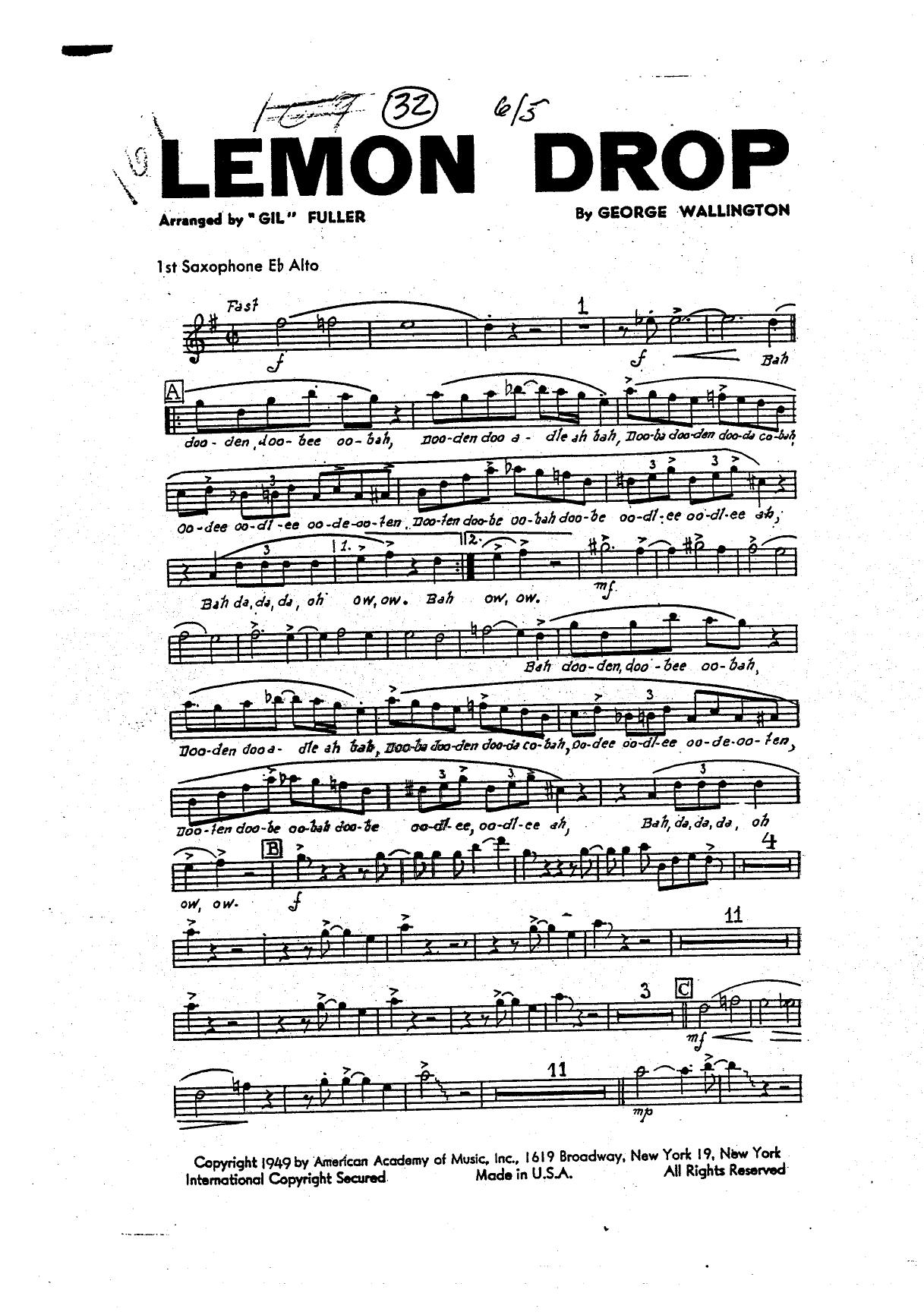
Lemon Drop (G.Fuller)
Composed by Dizzy Gillespie
Arranged by Gil Fuller-D.GILLESPIE
- Ensemble: Big Band
- Pages: 32
- Instruments (15): 1st Saxophone Eb Alto, 2nd Saxophone Bb Tenor, 3rd Saxophone Eb Alto, 4th Saxophone Bb Tenor, 5th Saxophone Eb Baritone, 1st Trumpet in Bb, 2nd Trumpet in Bb, 3rd Trumpet in Bb, 1st Trombone, 2nd Trombone, 3rd Trombone, Piano, Guitar, Bass, Drums
- Difficulty: medium
- Content: Individual Parts
- Format: PDF Download (Instant)
- Price: $24.99
Dizzy Gillespie’s iconic bebop anthem "Lemon Drop," originally recorded and popularized during the late 1940s explosion of modern jazz, stands as a masterclass in harmonic velocity and rhythmic ingenuity. Written by Gillespie and famously associated with his groundbreaking big bands, the tune emerged from an era when jazz transitioned from dance-hall entertainment to high-art virtuosity. Built upon rapid-fire rhythm changes and ingenious melodic contours, "Lemon Drop" quickly transcended its origins as a vehicle for scat singing and instrumental pyrotechnics, cementing its legacy as an enduring bebop standard that tests the limits of ensemble precision and individual agility. Blistering up-tempo swing defines the core musical character of this chart, propelling listeners and performers into a high-energy vortex of classic 1940s bebop. Operating at a breakneck pace in a bright swing feel, the arrangement radiates an electric, breathless intensity. The mood is fiercely exhilarating, characterized by razor-sharp staccato phrasing, cascading harmonic sequences, and an irrepressible sense of joyful urgency. It evokes the smoke-filled atmosphere of mid-century Manhattan jazz clubs where musical boundaries were aggressively pushed, demanding absolute fearlessness and unyielding concentration from everyone on the bandstand. Gil Fuller’s legendary arranging partnership with Dizzy Gillespie yields a sophisticated treatment that balances structural clarity with ferocious harmonic complexity. Fuller masterfully harnesses the eight-instrument frontline—featuring a punchy sax trio of alto, tenor, and baritone, alongside trumpet, trombone, and rhythm section support—to create a dense, modern big band texture scaled for a nimble ensemble. Signature Fuller techniques shine through in the razor-sharp horn solis and interlocking counterpoint, where individual lines weave independently before collapsing into unified, harmonically rich shout choruses laced with extended upper-structure extensions and characteristic bebop alterations. Sustaining the breakneck momentum requires exceptional finger technique and articulation control, particularly from the saxophone and brass sections who share the relentless melodic weight. Featured solo spaces allow standout improvisers to stretch out over the rapid rhythm changes, while tightly knit ensemble passages demand immaculate breath support and synchronized tongue articulation. The thrill of the chart culminates in high-octane ensemble trading and a climactic final chorus that leaves both audience and performers breathless. It is an immensely rewarding centerpiece that celebrates the intellectual and physical thrill of classic bebop craftsmanship. Advanced collegiate, professional, and elite community jazz ensembles are best suited to tackle this demanding 32-page score. Due to the blistering tempo, complex harmonic vocabulary, and the sheer endurance required across all eight parts, middle-tier or developing high school bands will find the technical hurdles steep. However, for mature groups possessing strong sight-reading skills, rapid execution capabilities, and a deep appreciation for the Gillespie-Fuller canon, this arrangement serves as an extraordinary vehicle to showcase elite ensemble cohesion and historical stylistic authenticity. Conquering "Lemon Drop" begins with establishing an unwavering, unhurried macro-tempo; do not let the band rush the underlying eighth-note swing subdivision, as the complex bop heads will easily blur if the tempo creeps upward. The primary technical hurdle lies in the precise execution of fast, chromatic bebop lines across the horn section. Saxophones and brass must prioritize ultra-clean articulation, utilizing a crisp "dah-dit" tongue stroke to ensure every note speaks clearly at speed. Rehearsals should initially commence at a drastically reduced tempo, locking in the inner-voice balance and dynamic contrasts before gradually ramping up to performance velocity. Pay meticulous attention to the short, accented staccato markings, which provide the rhythmic punch necessary to propel Fuller’s chart forward. Horn players should avoid overblowing during dense ensemble passages, ensuring that the intricate harmonic inner voices remain transparent beneath the primary melodic line. Q: What specific instruments and parts are included in this 32-page arrangement? A: The chart is scored for an 8-instrument ensemble featuring Alto Saxophone, Tenor Saxophone, Baritone Saxophone, Trumpet, and Trombone, alongside a rhythm section framework. Q: What is the designated difficulty level for this chart? A: This arrangement is strictly designed for advanced collegiate, professional, and elite community jazz bands due to its blistering tempo and complex bebop vocabulary. Q: What musical style and historical era does "Lemon Drop" represent? A: It represents the high-water mark of 1940s bebop, combining Dizzy Gillespie's pioneering melodic language with the sophisticated, driving arranging style of Gil Fuller. Q: What makes Gil Fuller and Dizzy Gillespie's treatment unique compared to standard big band charts? A: It condenses massive big band energy and complex harmonic structures into a lean 8-instrument format, utilizing interlocking counterpoint, razor-sharp solis, and dense upper-structure extensions. Q: What is the expected performance tempo and duration of the piece? A: The arrangement is performed at a very fast, driving up-tempo swing feel typical of classic bebop, generally lasting between 3 to 4 minutes depending on the length of improvised solo choruses.
Questions and answers
- What is included in the Lemon Drop (G.Fuller) PDF?
- The verified current file contains individual parts across 32 pages.
- How many instruments or parts are listed for Lemon Drop (G.Fuller)?
- The verified instrumentation list contains 15 entries for this Big Band arrangement.
- Who is credited for Lemon Drop (G.Fuller)?
- Composer: Dizzy Gillespie. Arranger: Gil Fuller-D.GILLESPIE.
- What difficulty is listed for Lemon Drop (G.Fuller)?
- The verified difficulty level is medium.
- Can I preview Lemon Drop (G.Fuller) before buying?
- Yes. The product page provides a preview generated from the current PDF file.
- How is Lemon Drop (G.Fuller) delivered?
- After successful payment, the digital PDF is made available for download. The displayed price is $24.99.
Musicians Also Search For
Lemon Drop Gil Fuller-D.GILLESPIE PDF • Lemon Drop Gil Fuller-D.GILLESPIE sheet music • Lemon Drop arranged by Gil Fuller-D.GILLESPIE • Gil Fuller-D.GILLESPIE big band charts • Gil Fuller-D.GILLESPIE jazz arrangements PDF • Lemon Drop Dizzy Gillespie sheet music • Lemon Drop Dizzy Gillespie big band arrangements • Dizzy Gillespie big band charts • Lemon Drop big band arrangements • Lemon Drop big band PDF download • Lemon Drop jazz sheet music • big band sheet music download • Lemon Drop individual parts download • Lemon Drop sheet music PDF • buy Lemon Drop sheet music • download Lemon Drop PDF • Lemon Drop jazz charts • best Gil Fuller-D.GILLESPIE big band arrangements • Dizzy Gillespie arranged by Gil Fuller-D.GILLESPIE • Lemon Drop printable sheet music • big band repertoire PDF