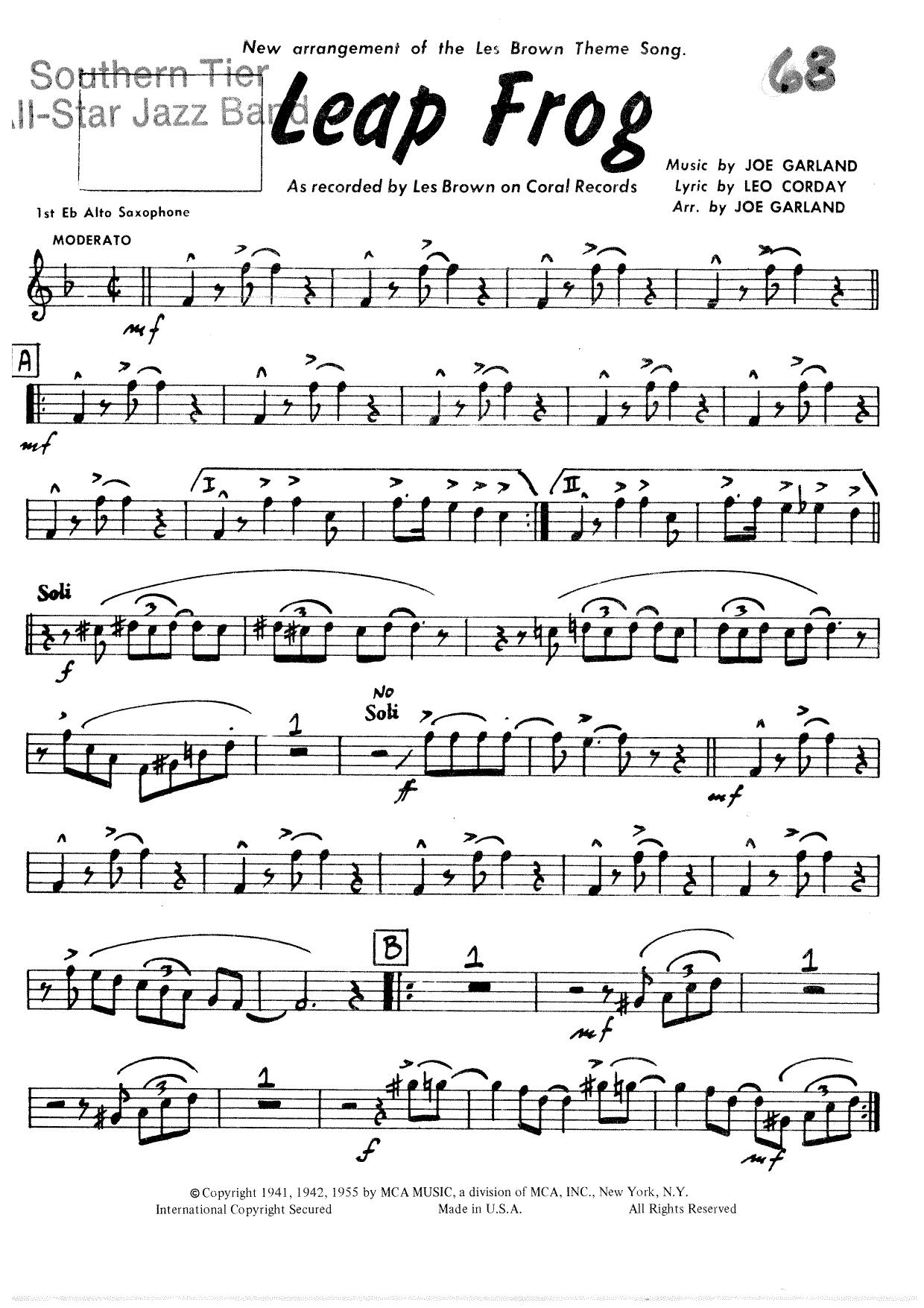
Leap Frog (J.Garland) sheet music preview

Leap Frog (J.Garland)

Composed by Joe Garland

Arranged by Les Brown

  • Ensemble: Big Band
  • Pages: 28
  • Instruments (14): 1st Eb Alto Saxophone, 2nd Bb Tenor Saxophone, 3rd Eb Alto Saxophone, 4th Bb Tenor Saxophone, 5th Eb Baritone Saxophone, 1st Bb Trumpet, 2nd Bb Trumpet, 3rd Bb Trumpet, 1st Trombone, 2nd Trombone, 3rd Trombone, Bass, Piano, Drums
  • Difficulty: medium
  • Content: Individual Parts
  • Format: PDF Download (Instant)
  • Price: $24.99

Joe Garland’s high-octane swing masterpiece "Leap Frog" is forever immortalized as the definitive theme song and signature tour de force of the legendary Les Brown and His Band of Renown. Originally penned by Garland—who also authored the swing-era anthem "In the Mood"—the composition was famously recorded by Les Brown in 1941 and later re-recorded to even greater acclaim in 1951, cementing its status as a textbook example of polished, precision-driven big band swing. Emerging from the height of the big band era, the arrangement showcases the immaculate discipline, swinging momentum, and tight ensemble cohesion that made Brown’s orchestra one of the most successful and enduring organizations in American popular music. Driving forward at a brisk, exhilarating cut-time swing tempo, "Leap Frog" is an explosion of irrepressible energy and bright, optimistic mood. The chart opens with an iconic, cascading motivic motif that immediately sets a playful yet fiercely challenging tone, mimicking the literal hopping and vaulting implied by its title. Harmonically rich yet rhythmically accessible, the arrangement thrives on a buoyant 4/4 swing feel underpinned by crisp ride cymbal patterns and a walking bassline. The emotional trajectory is pure exhilaration; it captures the breathless excitement of wartime and post-war swing culture, demanding absolute precision from every section to maintain its relentless forward propulsion without ever rushing the beat. Les Brown’s signature arranging style—often characterized by crystal-clear voicings, sophisticated yet direct harmonic structures, and meticulously balanced reed solis—shines brilliantly throughout this chart. Rather than relying on ultra-modern harmonic extensions, Brown maximizes the color of the standard big band palette, utilizing close-interval sax solis and punchy brass counter-lines that interlock with surgical precision. The arrangement features rapid-fire unison lines between the saxophones and muted trumpets, creating a bright, biting timbre. A textbook building shout chorus elevates the tension near the climax, releasing into a high-register brass fanfare that showcases the power and stamina of the lead players before snapping back into the infectious main theme. Melodic duties are shared dynamically across the ensemble, though the woodwind section carries the lion's share of the rapid-fire thematic material. The chart features designated solo space that allows a proficient improviser to stretch out over standard swing changes, supported by punchy background riffs from the brass. Technical challenges center heavily on endurance, articulation clarity, and finger dexterity, particularly for the saxophone section navigating fast, scalar passages at high tempos. Rhythm section players must maintain a rock-solid, driving pulse, as the arrangement's success relies entirely on rhythmic stability. Advanced high school, collegiate, and professional jazz ensembles will find this chart deeply rewarding, as it serves as both an audience-pleasing showstopper and an elite masterclass in swing-era stylistic execution. Conquering Les Brown’s "Leap Frog" requires meticulous attention to lightweight, sparkling articulation and endurance. The tempo is brisk; conductors should establish a subdivision firmly in the mind of the rhythm section before counting off to prevent the tempo from dragging during complex ensemble passages. The primary technical hurdle lies in the fast, cascading unison passages shared by the saxophones and upper brass. Players must utilize a dry, staccato tongue stroke to ensure notes do not blur together, maintaining absolute rhythmic alignment across the entire band. Saxophonists should practice passages slowly with a metronome, focusing on finger independence and evenness of tone. Brass players will encounter frequent demands for cup or harmon mutes; ensure all players use matching mute types to maintain a unified section timbre. Falls and doits should be executed with clean pitch control rather than sloppy slides, preserving the sophisticated sheen characteristic of the Les Brown library. In rehearsal, isolate the rhythm section first to lock in the relentless swing groove, then layer the sax soli sections independently before merging them with the brass punches. Dynamic contrast is vital—sub-ito pianos following loud ensemble hits will make the shout chorus soar. Q: What instruments and parts are included in this arrangement? A: This 28-page big band chart is scored for a standard 16-instrument ensemble, featuring parts for two alto saxophones, two tenor saxophones, baritone saxophone, four trumpets, four trombones, and a full rhythm section comprising piano, guitar, bass, and drums. Q: What is the difficulty level of this arrangement? A: This chart is rated as advanced, making it best suited for college ensembles, advanced high school jazz bands, and professional or community big bands due to its fast tempo and demanding articulation requirements. Q: What is the historical style and musical context of "Leap Frog"? A: Composed by Joe Garland and famously arranged and recorded by Les Brown in the early 1940s and 1951, this piece is a classic swing-era instrumental standard defined by its high-energy, precision-driven big band style. Q: What makes this specific Les Brown arrangement unique? A: It is distinguished by its signature rapid-fire, cascading unison lines, tightly interlocked reed solis, and a brilliantly structured shout chorus that showcases the precision and polish of the Les Brown orchestra. Q: What is the performance duration and tempo feel of the piece? A: The arrangement is written in a bright, driving 4/4 cut-time swing feel, designed to run for approximately 3 minutes when performed at the recommended high-energy tempo.

Questions and answers

What is included in the Leap Frog (J.Garland) PDF?
The verified current file contains individual parts across 28 pages.
How many instruments or parts are listed for Leap Frog (J.Garland)?
The verified instrumentation list contains 14 entries for this Big Band arrangement.
Who is credited for Leap Frog (J.Garland)?
Composer: Joe Garland. Arranger: Les Brown.
What difficulty is listed for Leap Frog (J.Garland)?
The verified difficulty level is medium.
Can I preview Leap Frog (J.Garland) before buying?
Yes. The product page provides a preview generated from the current PDF file.
How is Leap Frog (J.Garland) delivered?
After successful payment, the digital PDF is made available for download. The displayed price is $24.99.

Musicians Also Search For

Leap Frog Les Brown PDFLeap Frog Les Brown sheet musicLeap Frog arranged by Les BrownLes Brown big band chartsLes Brown jazz arrangements PDFLeap Frog Joe Garland sheet musicLeap Frog Joe Garland big band arrangementsJoe Garland big band chartsLeap Frog big band arrangementsLeap Frog big band PDF downloadLeap Frog jazz sheet musicbig band sheet music downloadLeap Frog individual parts downloadLeap Frog sheet music PDFbuy Leap Frog sheet musicdownload Leap Frog PDFLeap Frog jazz chartsbest Les Brown big band arrangementsJoe Garland arranged by Les BrownLeap Frog printable sheet musicbig band repertoire PDF

All arrangements by Les Brown All Joe Garland sheet music