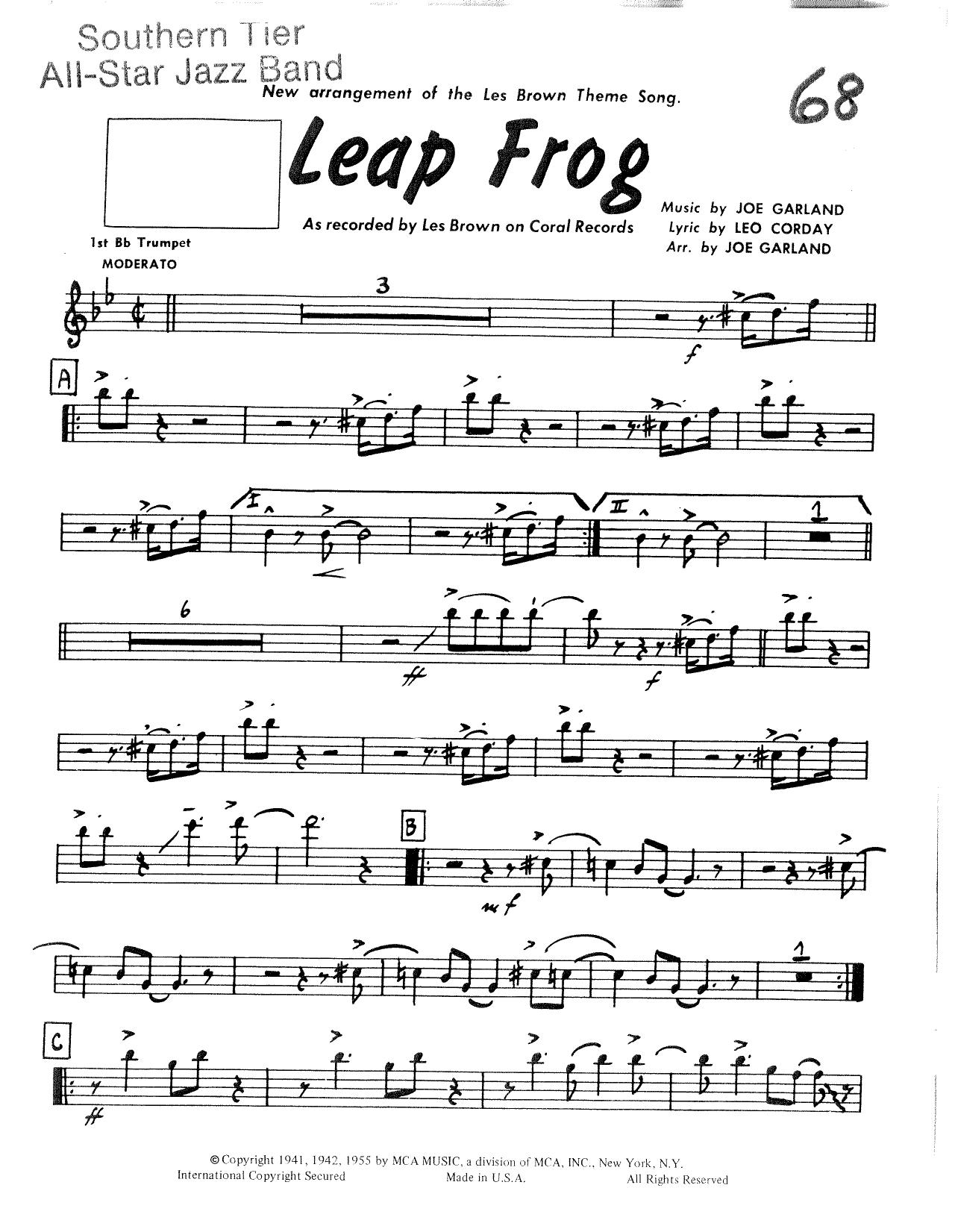
Leap Frog (J.Gardland) sheet music preview

Leap Frog (J.Gardland)

Composed by Joe Garland

Arranged by J.Gardland

  • Ensemble: Big Band
  • Style: Jazz Standard
  • Pages: 17
  • Instruments (9): 1st Bb Trumpet, 2nd Bb Trumpet, 3rd Bb Trumpet, 1st Trombone, 2nd Trombone, 3rd Trombone, Bass, Piano, Drums
  • Difficulty: easy
  • Content: Individual Parts
  • Format: PDF Download (Instant)
  • Price: $24.99

Originally penned by saxophonist and composer Joe Garland, "Leap Frog" stands as one of the most exhilarating testaments to the high-octane excitement of the late swing era. Immortalized most famously by Les Brown and His Band of Renown—who adopted it as their definitive theme song—the composition is celebrated for its relentless forward momentum, intricate chromatic lines, and virtuosic demands on every section of the ensemble. Emerging from an era where big bands competed fiercely on radio broadcasts and in dance halls for sheer kinetic energy, "Leap Frog" captures the pinnacle of swing-era showmanship, blending tightly wound counterpoint with infectious, foot-tapping rhythmic drive. Driving forward at a brisk, breathless tempo, this arrangement crackles with an irrepressible, high-energy swing feel in 4/4 time. The mood is exuberant, playful, and relentlessly upbeat, evoking the frantic, joyful atmosphere of a packed 1940s ballroom floor. The harmonic landscape is anchored by bright, brass-heavy textures and cascading woodwind-style figures adapted for the brass front line, creating an atmosphere of sheer athletic musicianship. From the opening statement to the final explosive chord, the arrangement maintains a blistering pace that demands absolute precision and stamina from every player on the bandstand. In this meticulous treatment by J. Gardland, the arrangement honors the blistering velocity of the original while streamlining the orchestration for a nimble nine-piece instrumentation. Gardland ingeniously distributes the dense, multi-layered counterpoint across three trumpets and two trombones, ensuring that the harmonic richness and polyphonic interplay of a full 17-piece orchestra are preserved without sacrificing transparency. The chart features tightly interlaced soli sections where the trumpets and trombones weave interlocking melodic fragments, building an intense momentum that culminates in a roaring, high-register shout chorus. Extended dominant harmonies and sharp chromatic passing tones are leveraged to keep the ears engaged, avoiding stale nostalgia in favor of biting, modern-leaning articulation. Carrying the iconic, leaping thematic material, the trumpet section acts as the primary melodic engine, supported by robust, punchy counter-melodies in the lower brass. Open horns dominate the texture, though sharp staccato articulations and dynamic contrast are vital for achieving the requisite period style. While the arrangement is designed as a collective ensemble showcase rather than a vehicle for extended soloing, brief, punctuated breakout spots allow individual lead players to shine. The primary technical challenges lie in the sheer velocity of the double-tonguing requirements in the trumpet section and the need for absolute synchronization in the trombone slide work during rapid-fire unison passages. Advanced high school ensembles, collegiate jazz labs, and professional compact big bands will find this chart to be a thrilling centerpiece for a concert program. Because the nine-instrument configuration strips away the safety net of a massive section, individual players must possess strong sight-reading skills, dependable endurance, and a mature sense of swing subdivision. For a group looking to showcase technical brilliance, stylistic accuracy, and sheer adrenaline, this version of "Leap Frog" delivers an unforgettable performance experience. Achieving success with this arrangement of "Leap Frog" hinges on maintaining a relentless, controlled velocity without allowing the tempo to rush. The conductor should establish a crisp, driving medium-up swing feel (around quarter note = 208–220 BPM), ensuring that the rhythm section locks into a feather-light ride cymbal pattern that propels the horns. Trumpets must focus on clean, razor-sharp articulation, utilizing crisp tongue strokes on every staccato note to prevent the rapid chromatic lines from slurring together. The trombones need to execute their quick positions with minimal slide noise, keeping their background figures cleanly tucked beneath the lead trumpet melody. During rehearsal, isolate the interlocking soli sections at half-tempo, gradually building speed while emphasizing uniform breath support and dynamic shading. Pay close attention to the dynamic peaks leading into the shout chorus, ensuring the ensemble holds back just enough to allow for a dramatic, roof-raising climax. Q: What instruments and parts are included in this arrangement? A: This arrangement is scored for a 9-instrument ensemble, specifically featuring three trumpet parts (Trumpet 1, 2, 3) and two trombone parts (Trombone 1, 2), alongside a standard rhythm section framework. Q: What is the difficulty level of this chart? A: This is an advanced-level arrangement suited for collegiate jazz bands, advanced high school groups, and professional compact ensembles due to its fast tempo and intricate chromatic writing. Q: What is the historical style and background of the piece? A: "Leap Frog" is a classic swing-era jazz standard composed by Joe Garland and famously associated with the Les Brown orchestra, representing the pinnacle of high-energy, fast-tempo big band arrangements. Q: What makes this specific J. Gardland arrangement unique? A: It brilliantly condenses the dense counterpoint and high-octane energy of a full 17-piece big band chart into a nimble 9-instrument layout without losing any of its harmonic punch or polyphonic complexity. Q: What is the performance tempo and expected duration? A: The arrangement is designed to be played at a brisk, driving tempo of approximately 210 BPM, resulting in a high-energy performance lasting roughly 3 minutes.

Questions and answers

What is included in the Leap Frog (J.Gardland) PDF?
The verified current file contains individual parts across 17 pages.
How many instruments or parts are listed for Leap Frog (J.Gardland)?
The verified instrumentation list contains 9 entries for this Big Band arrangement.
Who is credited for Leap Frog (J.Gardland)?
Composer: Joe Garland. Arranger: J.Gardland.
What difficulty is listed for Leap Frog (J.Gardland)?
The verified difficulty level is easy.
What style is listed for Leap Frog (J.Gardland)?
The catalog lists the style as Jazz Standard.
Can I preview Leap Frog (J.Gardland) before buying?
Yes. The product page provides a preview generated from the current PDF file.
How is Leap Frog (J.Gardland) delivered?
After successful payment, the digital PDF is made available for download. The displayed price is $24.99.

Musicians Also Search For

Leap Frog J.Gardland PDFLeap Frog J.Gardland sheet musicLeap Frog arranged by J.GardlandJ.Gardland big band chartsJ.Gardland jazz arrangements PDFLeap Frog Joe Garland sheet musicLeap Frog Joe Garland big band arrangementsJoe Garland big band chartsLeap Frog big band arrangementsLeap Frog big band PDF downloadLeap Frog jazz sheet musicbig band sheet music downloadLeap Frog individual parts downloadLeap Frog sheet music PDFLeap Frog Jazz Standard chartsJazz Standard big band arrangementsbuy Leap Frog sheet musicdownload Leap Frog PDFLeap Frog jazz chartsbest J.Gardland big band arrangementsJoe Garland arranged by J.GardlandLeap Frog printable sheet musicbig band repertoire PDF

All arrangements by J.Gardland All Joe Garland sheet music