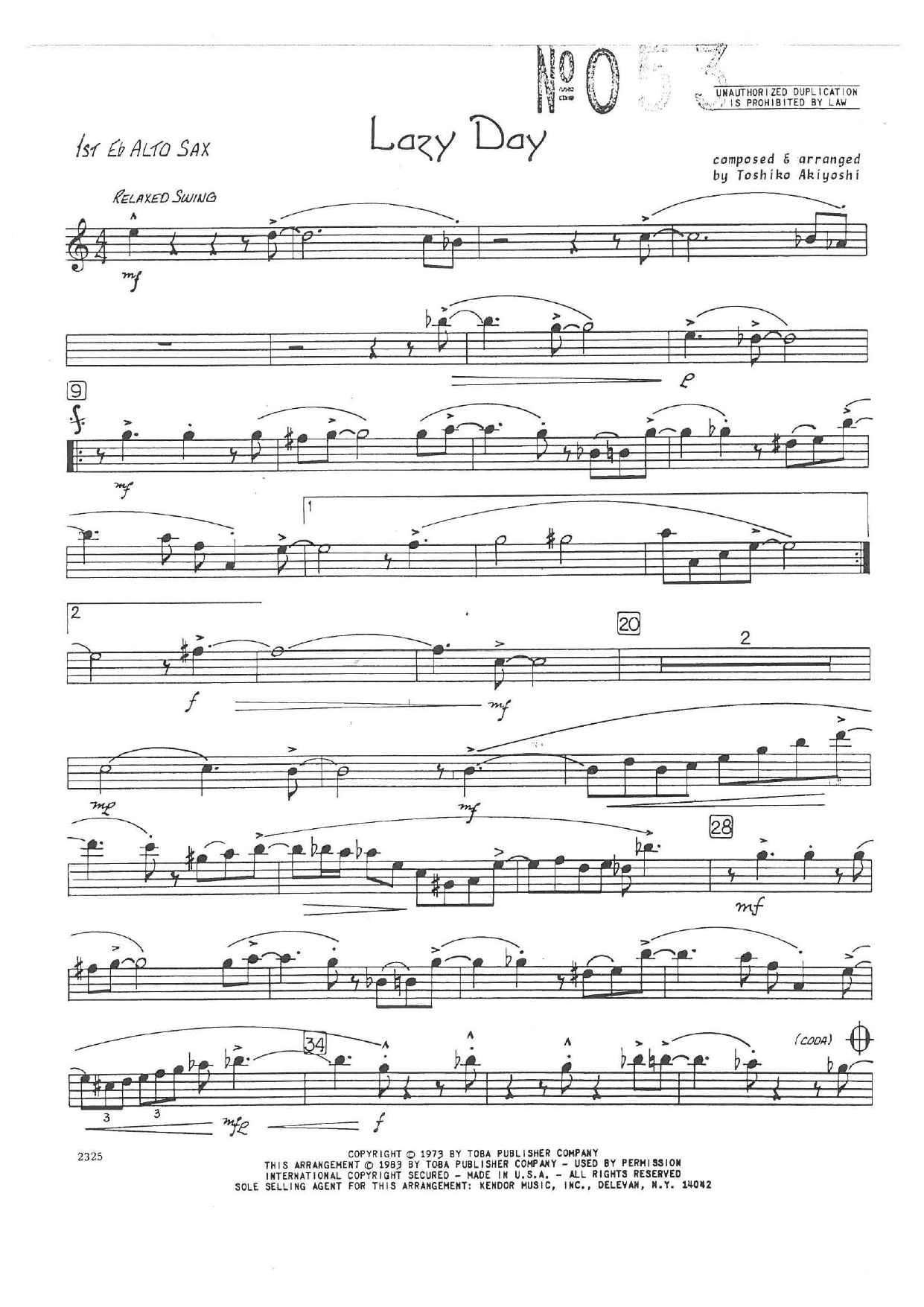
Lazy Day (T.Akiyoshi)
Composed by Toshiko Akiyoshi
Arranged by Toshiko Akiyoshi
- Ensemble: Big Band
- Pages: 40
- Instruments (16): 1st Eb Alto Sax, 2nd Eb Alto Sax, 1st Bb Tenor Sax, 2nd Bb Tenor Sax, Eb Baritone Sax, 1st Bb Trumpet, 2nd Bb Trumpet, 3rd Bb Trumpet, 4th Bb Trumpet, 1st Trombone, 2nd Trombone, 3rd Trombone, 4th Trombone, Piano/Guitar, Bass, Drums
- Difficulty: medium
- Content: Individual Parts
- Format: PDF Download (Instant)
- Price: $24.99
Toshiko Akiyoshi stands as a towering figure in modern big band jazz, renowned for her ability to seamlessly fuse traditional American swing and bebop vocabulary with distinct elements of traditional Japanese music. Composed and recorded during a prolific era of her legendary big band—co-led with her husband, saxophonist Lew Tabackin—"Lazy Day" captures Akiyoshi's genius for economical yet deeply sophisticated writing. Rather than relying solely on brute volume or relentless up-tempo pyrotechnics, Akiyoshi crafts a soundscape that highlights intricate counterpoint, rich chordal voicings, and a deeply narrative approach to arrangement. Her body of work defined a vital chapter of contemporary large-ensemble jazz, earning multiple Grammy nominations and establishing her orchestra as one of the most cohesive and distinctive units in jazz history. Radiating a relaxed yet sophisticated medium-swing groove, "Lazy Day" belies its deceptively simple title through clever harmonic twists and subtle rhythmic displacement. The composition establishes an unhurried, contemplative mood that slowly builds in warmth and intensity without ever losing its signature laid-back composure. Akiyoshi utilizes lush, extended voicings in the brass and reed sections, creating a transparent texture where individual lines breathe independently. The harmonic language draws heavily on modern modal concepts and upper-structure triads, giving the piece a sophisticated color palette that feels both timeless and distinctively modern. The emotional trajectory shifts seamlessly from introspective, smoky verses to jubilant, swinging ensemble interjections that evoke the effortless flow of a warm afternoon. True to Akiyoshi’s compositional style, the arrangement showcases masterclass integration between the saxophone section and the brass, frequently employing dense, interlocking counterlines rather than standard block harmonization. The woodwinds take center stage for evocative soli passages that demand exceptional blend, intonation, and stylistic unity, while the brass punctuates the texture with muted colors and warm, rounded attacks. A meticulously constructed shout chorus serves as the structural climax, building tension through clever rhythmic unison lines and dynamic swells before resolving gracefully into the main theme. Solo opportunities are provided for key members of the ensemble, allowing soloists to stretch out over changes that favor lyrical phrasing and melodic development over rapid-fire technical display. Advanced college, university, and professional jazz orchestras will find this chart an immensely rewarding centerpiece for a concert program. The technical demands reside less in breakneck speed and far more in ensemble cohesion, stylistic precision, rhythmic subtlety, and the capacity to maintain a relaxed groove at a moderate tempo. Rhythm section players must possess a strong internal pulse and familiarity with subtle comping concepts, while horn players will benefit from refined control over dynamics and intonation. Conductor-focused and thorough, the included 40-page conductor score provides comprehensive insight into Akiyoshi's structural nuances, making "Lazy Day" an essential acquisition for serious big bands seeking to explore the upper echelons of modern compositional artistry. Navigating "Lazy Day" successfully requires the ensemble to master a relaxed, behind-the-beat medium-swing feel that never drags. The primary technical hurdle lies in maintaining absolute rhythmic precision and a warm, unified sound during exposed soli sections where there is no heavy percussion to prop up the time. Conductors should emphasize horizontal linear phrasing over vertical chord-bashing, ensuring that countermelodies weave seamlessly through the texture. Pay close attention to articulation markings: short notes must be crisp without being clipped, and sustained passages require a rich, continuous airflow. Brass players should experiment with subtle cup or basket mutes where indicated to achieve the signature smoky, atmospheric timbre characteristic of the Akiyoshi-Tabackin sound. In rehearsal, isolate the rhythm section first to lock in the foundational groove before layering in the horns section by section, ensuring the bass and drums establish a buoyant, conversational foundation. Q: What instruments and parts are included in this arrangement? A: This complete 17-instrument big band arrangement includes parts for two alto saxophones, two tenor saxophones, baritone saxophone, four trumpets, four trombones, piano, guitar, bass, drums, and a comprehensive 40-page conductor score. Q: What is the difficulty level of this arrangement? A: This piece is rated as advanced, making it best suited for university, college, community, and professional jazz orchestras that excel at stylistic nuance, blend, and subtle swing feels. Q: What is the musical style and historical context of "Lazy Day"? A: Written and arranged by Toshiko Akiyoshi, this piece reflects her signature modern big band style, combining traditional American swing and bebop concepts with sophisticated contemporary harmonies and counterpoint. Q: What makes this Toshiko Akiyoshi arrangement unique? A: It is distinguished by its intricate linear writing, transparent and innovative chord voicings, interactive counterpoint between sections, and a relaxed groove that builds dramatic intensity without relying on high-velocity tempos. Q: What is the expected performance tempo and duration? A: The arrangement is set in a medium-swing tempo feel that prioritizes an unhurried, conversational groove, with a typical performance duration ranging between 5 to 7 minutes depending on solo extensions.
Questions and answers
- What is included in the Lazy Day (T.Akiyoshi) PDF?
- The verified current file contains a conductor score and individual parts across 40 pages.
- How many instruments or parts are listed for Lazy Day (T.Akiyoshi)?
- The verified instrumentation list contains 16 entries for this Big Band arrangement.
- Who is credited for Lazy Day (T.Akiyoshi)?
- Composer: Toshiko Akiyoshi. Arranger: Toshiko Akiyoshi.
- What difficulty is listed for Lazy Day (T.Akiyoshi)?
- The verified difficulty level is medium.
- Can I preview Lazy Day (T.Akiyoshi) before buying?
- Yes. The product page provides a preview generated from the current PDF file.
- How is Lazy Day (T.Akiyoshi) delivered?
- After successful payment, the digital PDF is made available for download. The displayed price is $24.99.
Musicians Also Search For
Lazy Day Toshiko Akiyoshi PDF • Lazy Day Toshiko Akiyoshi sheet music • Lazy Day arranged by Toshiko Akiyoshi • Toshiko Akiyoshi big band charts • Toshiko Akiyoshi jazz arrangements PDF • Lazy Day Toshiko Akiyoshi big band arrangements • Lazy Day big band arrangements • Lazy Day big band PDF download • Lazy Day jazz sheet music • big band sheet music download • Lazy Day conductor score PDF • Lazy Day individual parts download • Lazy Day sheet music PDF • buy Lazy Day sheet music • download Lazy Day PDF • Lazy Day jazz charts • best Toshiko Akiyoshi big band arrangements • Lazy Day printable sheet music • big band repertoire PDF