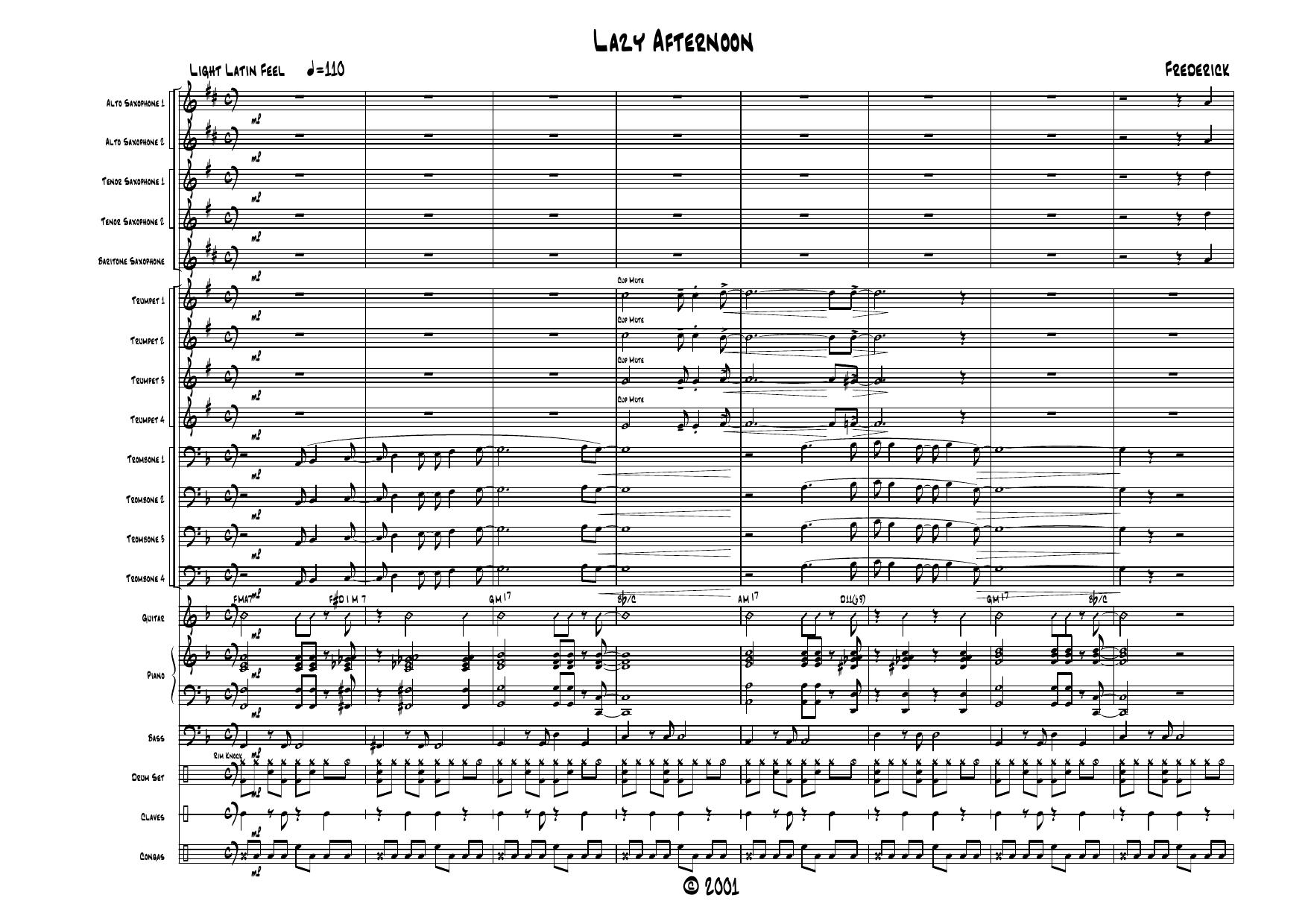
Lazy Afternoon (Frederick)
Composed by Frederick
Arranged by Frederick
- Ensemble: Big Band
- Style: Jazz Standard
- Pages: 35
- Instruments (19): Alto Saxophone 1, Alto Saxophone 2, Tenor Saxophone 1, Tenor Saxophone 2, Baritone Saxophone, Trumpet 1, Trumpet 2, Trumpet 3, Trumpet 4, Trombone 1, Trombone 2, Trombone 3, Trombone 4, Guitar, Piano, Bass, Drum Set, Claves, Congas
- Difficulty: medium
- Content: Individual Parts
- Format: PDF Download (Instant)
- Price: $24.99
Evoking the sultry, unhurried atmosphere of a mid-summer twilight, "Lazy Afternoon" captures the quintessential essence of mid-century cool jazz and sophisticated modal balladry. Originally conceived within the rich compositional lineage of the post-bop era, the tune has long been revered by instrumentalists for its deceptive simplicity and lush harmonic underpinnings. Its legacy is rooted in the tradition of smoky club dates and late-night radio broadcasts, where horn players used its spacious melodic contours to explore deep, introspective lyricism. This modern big band adaptation honors that venerable lineage while injecting a refreshed, contemporary vitality tailored for full ensemble exploration. At a relaxed, hypnotic slow-swing tempo (around 64 beats per minute), the arrangement unfolds in a warm, resonant key that maximizes the lush lower-register capabilities of the saxophone section and the melancholic beauty of muted brass. The mood is contemplative yet quietly commanding, evoking a sense of suspended time through shimmering chord clusters and undulating rhythmic suspensions. The harmonic palette stretches beyond standard triadic extensions, utilizing suspended fourths, sharp-elevenths, and minor-major seventh sonorities that create a bittersweet emotional landscape. The overall energy is restrained, relying on internal tension and subtle dynamic swells rather than sheer volume to captivate the listener. Arranger Frederick brings a masterclass in texture and color to this chart, utilizing a sophisticated approach to voicing that blends traditional Count Basie-style block chords with modern, Gil Evans-esque impressionistic washes. The arrangement avoids predictable scoring by weaving counter-melodies through the inner voices of the trombones while the saxophones carry a sustained, breathy pad. A standout feature of Frederick’s treatment is a lush, five-part sax soli that builds organically out of the bridge, demanding pristine intonation and unified phrasing. Rather than employing a traditional high-energy shout chorus, Frederick crafts a gradual, cumulative dynamic build that peaks in a towering, harmonically rich tutti statement before dissolving back into the tranquil, twilight mood of the head. The melody is initially introduced by a featured flugelhorn or alto saxophone, supported by a sparse, pulsing rhythm section laying down a feather-light ride cymbal groove. Improvised solo space is thoughtfully allocated for a tenor saxophone or piano, providing ample room for expressive, linear storytelling over a cyclical, modal-leaning vamp. Technical challenges lie primarily in maintaining a steady, unhurried subdivision at such a slow tempo, where microscopic timing discrepancies become glaringly apparent. Brass players must exercise supreme breath control and mastery of color tones, particularly when executing subtle cup or harmon mute passages. Advanced high school, collegiate, and professional jazz orchestras will find this chart deeply rewarding, as it tests an ensemble's maturity, balance, and collective listening skills far beyond standard technical dexterity. Success with this arrangement hinges entirely on the ensemble's ability to internalize a deep, relaxed swing feel at a slow tempo. Conductors should ensure the rhythm section maintains an ultra-steady, unpushed pulse—the bass should anchor the beat with a half-note or gentle walking feel, while the drummer utilizes sparse, atmospheric brushwork rather than heavy ride patterns. Technically, the primary challenge is blend and intonation across extended chords; horn players must actively tune their thirds and sevenths against the root movements. Pay close attention to dynamic markings, as the chart relies heavily on micro-dynamics rather than broad loud-soft contrasts. Cup mutes are required for the trumpet section in the opening choruses to achieve the necessary dark, veiled timbre. Rehearsal should begin by having the rhythm section and soloists run the form independently to lock in the harmonic groove before integrating the horn sections. Q: What instruments and parts are included in this publication? A: The complete 35-page package includes a full conductor score and 19 individual instrument parts: Alto Saxophone 1, Alto Saxophone 2, Tenor Saxophone 1, Tenor Saxophone 2, Baritone Saxophone, 4 Trumpets (with doubling options for flugelhorn), 4 Trombones, Guitar, Piano, Bass, and Drums. Q: What is the difficulty level of this arrangement? A: This chart is graded as advanced-intermediate to advanced, making it ideal for college ensembles, advanced high school jazz bands, and professional community big bands seeking a sophisticated mood piece. Q: What is the musical style and historical context of "Lazy Afternoon"? A: Written in the style of a classic cool-jazz and modal ballad, this piece channels the introspective, sophisticated atmosphere of 1950s and 60s lounge and club jazz standards. Q: What makes Frederick’s arrangement unique compared to other big band charts? A: It features distinctive impressionistic voicings, an intricate five-part saxophone soli, and a unique structural arc that replaces a standard loud shout chorus with a lush, harmonically rich tutti crescendo. Q: What is the performance duration and suggested tempo for this piece? A: The arrangement runs approximately 5 to 6 minutes when performed at the suggested tempo of a relaxed 64 beats per minute.
Questions and answers
- What is included in the Lazy Afternoon (Frederick) PDF?
- The verified current file contains a conductor score and individual parts across 35 pages.
- How many instruments or parts are listed for Lazy Afternoon (Frederick)?
- The verified instrumentation list contains 19 entries for this Big Band arrangement.
- Who is credited for Lazy Afternoon (Frederick)?
- Composer: Frederick. Arranger: Frederick.
- What difficulty is listed for Lazy Afternoon (Frederick)?
- The verified difficulty level is medium.
- What style is listed for Lazy Afternoon (Frederick)?
- The catalog lists the style as Jazz Standard.
- Can I preview Lazy Afternoon (Frederick) before buying?
- Yes. The product page provides a preview generated from the current PDF file.
- How is Lazy Afternoon (Frederick) delivered?
- After successful payment, the digital PDF is made available for download. The displayed price is $24.99.
Musicians Also Search For
Lazy Afternoon Frederick PDF • Lazy Afternoon Frederick sheet music • Lazy Afternoon arranged by Frederick • Frederick big band charts • Frederick jazz arrangements PDF • Lazy Afternoon Frederick big band arrangements • Lazy Afternoon big band arrangements • Lazy Afternoon big band PDF download • Lazy Afternoon jazz sheet music • big band sheet music download • Lazy Afternoon conductor score PDF • Lazy Afternoon individual parts download • Lazy Afternoon sheet music PDF • Lazy Afternoon Jazz Standard charts • Jazz Standard big band arrangements • buy Lazy Afternoon sheet music • download Lazy Afternoon PDF • Lazy Afternoon jazz charts • best Frederick big band arrangements • Lazy Afternoon printable sheet music • big band repertoire PDF