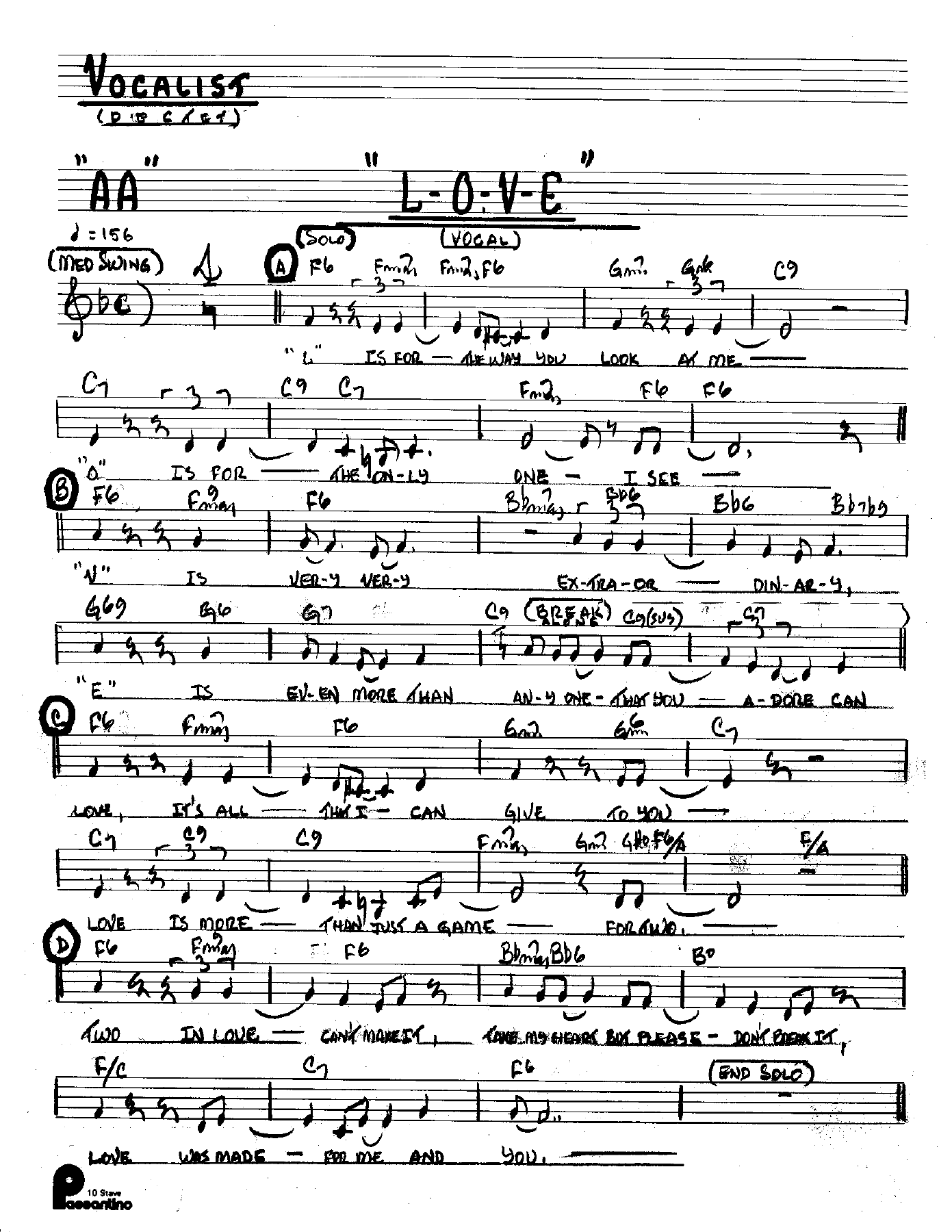
L-O-V-E (Kenton Dectet #AA)
Composed by Bert Kaempfert, Milt Gabler
Arranged by Stan Kenton Dected 176
- Ensemble: Small Ensemble
- Style: Jazz Standard
- Pages: 34
- Instruments (11): Vocalist, Alto Sax, Tenor Sax, Baritone Sax, Trumpet 1, Trumpet 2, Trombone, Drums, Bass, Piano, Vibes
- Difficulty: easy
- Content: Individual Parts
- Format: PDF Download (Instant)
- Price: $12.99
The beloved standard "L-O-V-E," originally composed by Bert Kaempfert and Milt Gabler, first charmed audiences in 1965 with Nat King Cole's iconic rendition. This era, often dubbed the "Golden Age" of vocal jazz and pop, saw a resurgence of sophisticated orchestral arrangements and polished vocal performances. "L-O-V-E" quickly ascended to jazz standard status due to its catchy, memorable melody, straightforward yet elegant harmonic progression, and universal theme. Its enduring appeal lies in its timeless message and its ability to evoke a sense of nostalgic romance and lighthearted joy, making it a staple in both jazz clubs and popular culture. Stan Kenton Dectet 176's arrangement of "L-O-V-E" transforms this classic into a vibrant, medium-swing small ensemble chart, masterfully capturing the original's charm while infusing it with the Dectet's signature harmonic richness and dynamic flair. Set primarily in the key of F major, the arrangement maintains a bright, optimistic mood throughout. The musical character is defined by a bouncy, infectious medium swing feel in 4/4 time, encouraging a relaxed yet precise rhythmic interpretation. The energy is consistently uplifting, making it an ideal choice for setting a sophisticated, celebratory atmosphere. The Dectet's distinctive approach often features tightly voiced brass and woodwind sections, creating a full sound despite the smaller instrumentation, and this arrangement is no exception. This particular arrangement showcases Stan Kenton Dectet 176's unparalleled ability to craft intricate yet accessible charts. The melody is initially carried by a unison or harmonized woodwind section, often featuring the alto saxophone, before being passed to the brass, creating textural variety. Expect sophisticated voicings that lean into Kenton's modern jazz sensibilities, employing extended harmonies and colorful dissonances that resolve beautifully, adding depth without obscuring the original's melodic clarity. There are ample opportunities for featured solos, typically for alto saxophone and trumpet, allowing soloists to interpret the familiar changes with creative freedom. Technical challenges include precise articulation in the swing figures, maintaining blend and balance within the tight voicings, and navigating occasional chromatic passages. The chart culminates in a spirited shout chorus, characteristic of Kenton's style, where the full ensemble delivers a powerful, harmonically rich statement before a final, polished flourish. Performing this arrangement is rewarding for its blend of familiar melody with fresh, engaging harmonic and rhythmic treatments, offering both comfort and challenge to musicians. This arrangement is ideally suited for college-level jazz ensembles, advanced high school groups, or community big bands seeking to expand their small ensemble repertoire. Its thoughtful scoring and harmonic sophistication provide an excellent educational opportunity for developing musicians to engage with advanced voicings and ensemble interplay. Professional small ensembles will also find it a polished and engaging addition to their book, offering a fresh take on a beloved standard that showcases both individual talent and collective precision. The blend of accessibility and musical depth ensures it appeals to a wide range of performers and audiences. Conductors should emphasize a consistent, relaxed medium swing feel, ensuring the eighth notes are properly swung without becoming stiff. Pay close attention to the dynamic contrasts, particularly in the soli sections, to bring out the intricate voicings. Technical challenges include achieving precise articulation, especially in the brass, and maintaining excellent blend and balance within the tightly voiced woodwind and brass sections. Rehearsal time should be dedicated to intonation in sustained chords and navigating the occasional chromatic passing tones that add Kenton's signature harmonic color. Soloists should be encouraged to explore the harmonic landscape while respecting the original melody's charm. No special techniques like plunger mutes or falls are explicitly notated, allowing for a clean, polished sound, though tasteful embellishments can be added at the conductor's discretion. Q: What instruments/parts are included in the "L-O-V-E (Kenton Dectet #AA)" arrangement? A: This arrangement for small ensemble typically includes parts for alto saxophone, tenor saxophone, baritone saxophone, two trumpets, trombone, piano, bass, and drums, consistent with a dectet instrumentation. Q: What is the difficulty level of this arrangement? A: This arrangement is considered advanced intermediate to advanced, suitable for college-level jazz ensembles, advanced high school groups, and professional small ensembles due to its intricate voicings, harmonic sophistication, and precise rhythmic demands. Q: What is the musical style and historical context of this arrangement? A: This is a medium-swing jazz standard arrangement of "L-O-V-E," a song made famous by Nat King Cole in 1965. The arrangement reflects the sophisticated, harmonically rich style characteristic of the Stan Kenton Dectet era. Q: What makes this Stan Kenton Dectet 176 arrangement unique? A: This arrangement is unique for its distinctive Stan Kenton Dectet voicings, which provide a full sound with a smaller ensemble, its sophisticated harmonic language, and its balance of familiar melody with engaging, modern jazz treatments, including a spirited shout chorus. Q: What is the typical performance duration or tempo for this piece? A: The arrangement is designed for a medium swing tempo, typically around 120-140 beats per minute. The overall performance duration will vary slightly depending on the length of improvised solos, but generally falls between 3:30 and 4:30 minutes.
Questions and answers
- What is included in the L-O-V-E (Kenton Dectet #AA) PDF?
- The verified current file contains individual parts across 34 pages.
- How many instruments or parts are listed for L-O-V-E (Kenton Dectet #AA)?
- The verified instrumentation list contains 11 entries for this Small Ensemble arrangement.
- Who is credited for L-O-V-E (Kenton Dectet #AA)?
- Composer: Bert Kaempfert, Milt Gabler. Arranger: Stan Kenton Dected 176.
- What difficulty is listed for L-O-V-E (Kenton Dectet #AA)?
- The verified difficulty level is easy.
- What style is listed for L-O-V-E (Kenton Dectet #AA)?
- The catalog lists the style as Jazz Standard.
- Can I preview L-O-V-E (Kenton Dectet #AA) before buying?
- Yes. The product page provides a preview generated from the current PDF file.
- How is L-O-V-E (Kenton Dectet #AA) delivered?
- After successful payment, the digital PDF is made available for download. The displayed price is $12.99.
Musicians Also Search For
L-O-V-E Stan Kenton Dected 176 PDF • L-O-V-E Stan Kenton Dected 176 sheet music • L-O-V-E arranged by Stan Kenton Dected 176 • Stan Kenton Dected 176 small ensemble charts • Stan Kenton Dected 176 jazz arrangements PDF • L-O-V-E Bert Kaempfert, Milt Gabler sheet music • L-O-V-E Bert Kaempfert, Milt Gabler small ensemble arrangements • Bert Kaempfert, Milt Gabler small ensemble charts • L-O-V-E small ensemble arrangements • L-O-V-E small ensemble PDF download • L-O-V-E jazz sheet music • small ensemble sheet music download • L-O-V-E individual parts download • L-O-V-E sheet music PDF • L-O-V-E Jazz Standard charts • Jazz Standard small ensemble arrangements • buy L-O-V-E sheet music • download L-O-V-E PDF • L-O-V-E jazz charts • best Stan Kenton Dected 176 small ensemble arrangements • Bert Kaempfert, Milt Gabler arranged by Stan Kenton Dected 176 • L-O-V-E printable sheet music • small ensemble repertoire PDF