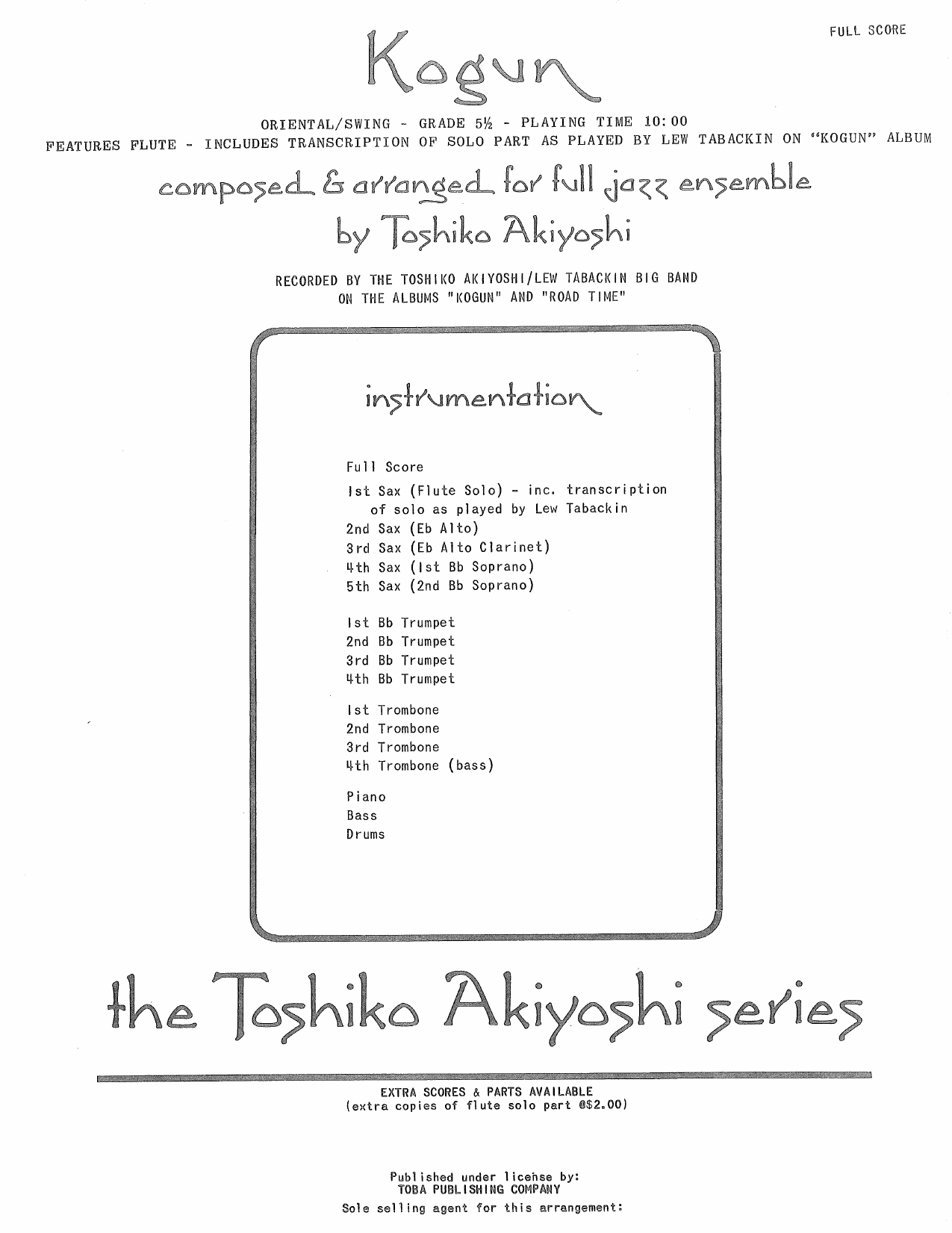
Kogun (T.Akiyoshi)
Composed by Toshiko Akiyoshi
Arranged by Toshiko Akiyoshi
- Ensemble: Big Band
- Pages: 48
- Instruments (17): 1st Sax (Flute Solo), 2nd Sax (Eb Alto), 3rd Sax (Eb Alto Clarinet), 4th Sax (1st Bb Soprano), 5th Sax (2nd Bb Soprano), 1st Bb Trumpet, 2nd Bb Trumpet, 3rd Bb Trumpet, 4th Bb Trumpet, 1st Trombone, 2nd Trombone, 3rd Trombone, 4th (Bass) Trombone, Piano, Bass, Drums, Flute Cadenza
- Difficulty: medium
- Content: Individual Parts
- Format: PDF Download (Instant)
- Price: $24.99
Toshiko Akiyoshi’s monumental composition "Kogun" stands as a towering achievement in modern big band jazz, originally introduced on her critically acclaimed 1974 album *Long Yellow Road*. Merging traditional Japanese musical elements with cutting-edge, post-bop American big band orchestration, Akiyoshi crafted a masterpiece that explores themes of cultural identity, isolation, and historical memory. The title translates to "solitary soldier," a concept vividly brought to life through dramatic programmatic writing that evokes ancient Japanese court music (*gagaku*) alongside blistering, hard-driving swing. This composition cemented Akiyoshi and her co-writer/husband Lew Tabackin as major innovators in expanding the stylistic boundaries of the traditional jazz orchestra. A dynamic sonic journey, "Kogun" shifts dramatically between haunting, atmospheric textures and ferocious, high-energy modal jazz. The piece opens with evocative, unaccompanied woodwind and brass motifs that utilize microtonal bending and pentatonic scalar derivations, deliberately reminiscent of traditional Japanese flute (*shakuhachi*) and string (*koto*) aesthetics. Without warning, the ensemble erupts into a furious, high-octane groove characterized by driving odd-meter pulses and thick, dissonant chord clusters. The emotional arc swings violently from profound melancholy and solemn introspection to explosive, cathartic intensity, demanding absolute precision and deep stylistic versatility from every member of the ensemble. Akiyoshi’s arranging genius shines through her brilliant economy of texture and masterclass use of counterpoint. Rather than relying on standard block-chord voicings, she treats the big band like a chamber orchestra, pitting sections against one another in intricate, interlocking polyphonic lines. The woodwinds—utilizing flute and clarinet doublings—weave delicate filigree around aggressive, plunger-muted brass statements. A searing tenor saxophone solo, written specifically with Lew Tabackin's blistering technique and tonal flexibility in mind, serves as the emotional epicenter of the chart, pushing the soloist to navigate shifting harmonic landscapes and explosive ensemble backgrounds. Performing "Kogun" requires a mature ensemble capable of navigating complex meter changes, advanced harmonic reading, and demanding stylistic juxtapositions. While scored for an innovative 8-instrument big band instrumentation (featuring Alto Sax, Tenor Sax, Baritone Sax, Trumpet, Trombone, and a robust rhythm section framework), the density of the writing demands players with strong individual independence. The rhythm section must act as an elastic engine, capable of translating subtle rubato cues into unrelenting, aggressive swing feels. The shout chorus is a masterclass in tension and release, building layers of chromatic dissonance before resolving into a breathtaking, resonant final chord. Advanced collegiate, community, and professional jazz orchestras will find "Kogun" a deeply rewarding centerpiece for festival performance and serious concert programming. Its unique synthesis of Japanese folk heritage and progressive American big band jazz offers audiences an unforgettable listening experience while challenging musicians to expand their technical and expressive boundaries far beyond standard swing repertoire. Conductors must approach "Kogun" with a meticulous focus on stylistic duality, balancing the free, organic flow of traditional Japanese idioms with the razor-sharp precision of modern jazz orchestration. The opening section requires absolute dynamic control and careful listening across the ensemble; performers must treat sustained tones with a living, breathing vibrato control that mimics traditional string and wind articulation. When the tempo shifts into the driving swing groove, the rhythm section must anchor the pulse firmly while avoiding heavy-handedness, allowing the complex horn counterlines to speak clearly. Special attention should be paid to extended techniques, including precise execution of plunger mutes, dramatic fall-offs, and controlled pitch bends in the brass. Rehearsals should begin by isolating the polyphonic sectional lines independently before attempting full-ensemble passages, ensuring that every voice in the counterpoint maintains equal weight and transparency. Q: What instruments and parts are included in this 8-instrument arrangement of "Kogun"? A: The arrangement is scored for an 8-instrument core ensemble featuring Alto Saxophone, Tenor Saxophone, Baritone Saxophone, Trumpet, Trombone, and a complete rhythm section (piano, bass, and drums), thoughtfully condensed by Akiyoshi to retain the rich harmonic density of her full-orchestra charts. Q: What is the difficulty level of this arrangement? A: This piece is graded as advanced/professional, requiring a high level of technical proficiency, excellent sight-reading skills, familiarity with modal jazz harmony, and the ability to execute complex meter changes and ensemble counterpoint. Q: What is the historical and stylistic background of "Kogun"? A: Composed by Toshiko Akiyoshi and released in 1974 on the album *Long Yellow Road*, "Kogun" is a landmark fusion piece that merges traditional Japanese musical concepts like *gagaku* with progressive, post-bop American big band jazz. Q: What makes this Toshiko Akiyoshi arrangement unique? A: It is unique for its programmatic storytelling, brilliant use of polyphonic counterpoint, integration of authentic Japanese folk scales into a jazz framework, and its demanding tenor saxophone feature that mimics traditional wind instrumentation. Q: What is the approximate performance duration and tempo framework of the piece? A: The piece features a variable duration averaging around 7 to 9 minutes, opening with a rubato, atmospheric exposition before settling into a fast, driving modal swing tempo.
Questions and answers
- What is included in the Kogun (T.Akiyoshi) PDF?
- The verified current file contains a conductor score and individual parts across 48 pages.
- How many instruments or parts are listed for Kogun (T.Akiyoshi)?
- The verified instrumentation list contains 17 entries for this Big Band arrangement.
- Who is credited for Kogun (T.Akiyoshi)?
- Composer: Toshiko Akiyoshi. Arranger: Toshiko Akiyoshi.
- What difficulty is listed for Kogun (T.Akiyoshi)?
- The verified difficulty level is medium.
- Can I preview Kogun (T.Akiyoshi) before buying?
- Yes. The product page provides a preview generated from the current PDF file.
- How is Kogun (T.Akiyoshi) delivered?
- After successful payment, the digital PDF is made available for download. The displayed price is $24.99.
Musicians Also Search For
Kogun Toshiko Akiyoshi PDF • Kogun Toshiko Akiyoshi sheet music • Kogun arranged by Toshiko Akiyoshi • Toshiko Akiyoshi big band charts • Toshiko Akiyoshi jazz arrangements PDF • Kogun Toshiko Akiyoshi big band arrangements • Kogun big band arrangements • Kogun big band PDF download • Kogun jazz sheet music • big band sheet music download • Kogun conductor score PDF • Kogun individual parts download • Kogun sheet music PDF • buy Kogun sheet music • download Kogun PDF • Kogun jazz charts • best Toshiko Akiyoshi big band arrangements • Kogun printable sheet music • big band repertoire PDF