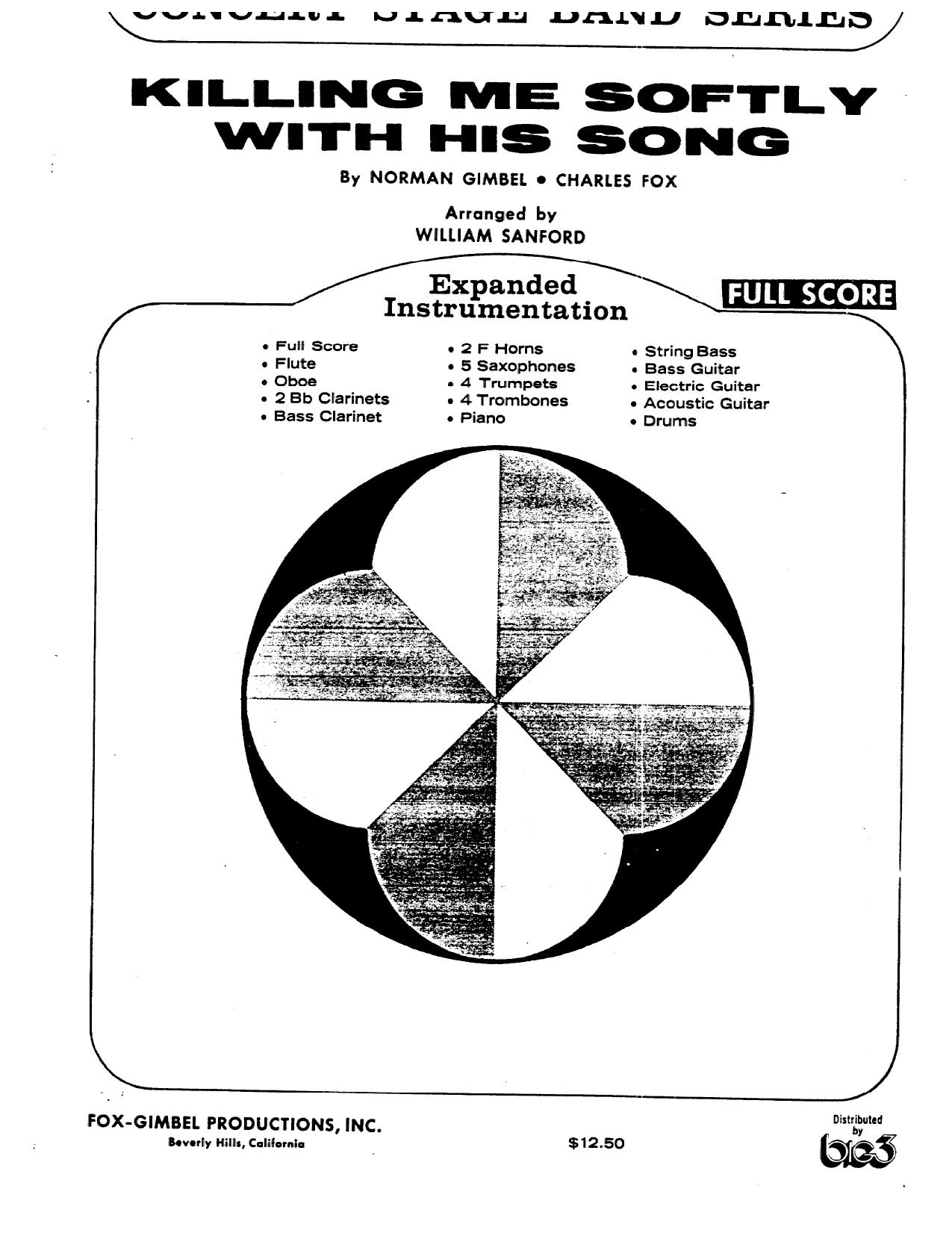
Killing Me Softly (W.Sanford)
Composed by Charles Fox
Arranged by W.Sanford
- Ensemble: Big Band
- Style: Jazz Standard
- Pages: 50
- Instruments (27): Full Score, Flute, Oboe, 1st Bb Clarinet, 2nd Bb Clarinet, Bass Clarinet, 1st F Horn, 2nd F Horn, 1st Eb Alto Saxophone, 2nd Eb Alto Saxophone, 1st Bb Tenor Saxophone, 2nd Bb Tenor Saxophone, Eb Baritone Saxophone, 1st Bb Trumpet, 2nd Bb Trumpet, 3rd Bb Trumpet, 4th Bb Trumpet, 1st Trombone, 2nd Trombone, 3rd Trombone, 4th Trombone (Bass), Acoustic Guitar, Electric Guitar, Drums, Piano, Bass Guitar, String Bass
- Difficulty: advanced
- Content: Individual Parts
- Format: PDF Download (Instant)
- Price: $24.99
"Killing Me Softly with His Song," originally composed by Charles Fox with lyrics by Norman Gimbel, first emerged in 1972 with a recording by Lori Lieberman, though it was Roberta Flack's iconic 1973 rendition that catapulted it to global fame and cemented its status as a jazz and pop standard. This soulful ballad, born from Lieberman's profound experience at a Don McLean concert, captures a deeply emotional narrative of being captivated and understood through music. Flack's definitive interpretation, characterized by her rich, pure vocal delivery and a subtly building arrangement, resonated deeply, earning her multiple Grammy Awards and establishing the song as a timeless expression of vulnerability and musical connection. Its enduring appeal lies in its universal theme and its beautifully crafted melody, which has allowed it to transcend genres, from the Fugees' hip-hop interpretation to countless instrumental jazz covers. W. Sanford's big band arrangement of "Killing Me Softly" reimagines this beloved jazz standard with a sophisticated, medium-swing feel, set in a key that allows for both vocal and instrumental flexibility. The arrangement maintains the original's poignant mood while infusing it with the dynamic energy and harmonic richness characteristic of a contemporary big band setting. Sanford's distinctive approach is evident in the artful interplay between sections, featuring lush saxophone voicings that provide a warm, enveloping backdrop for the melody, contrasted with precise brass figures that punctuate and drive the harmonic progression. Expect carefully constructed soli sections that showcase the ensemble's precision and blend, alongside moments of extended harmony that add depth and a modern jazz sensibility without straying from the song's emotional core. The arrangement thoughtfully distributes the melodic lead, initially presenting it in the saxophone section to establish a smooth, lyrical tone, before transitioning to the brass for a more assertive statement. This dynamic exchange ensures continuous interest and highlights the full spectrum of the big band's capabilities. While specific featured solos are not explicitly indicated, the arrangement provides ample space for improvisation, typically over the form by a tenor saxophone or trumpet, allowing skilled soloists to expressively interpret the harmonic landscape. Technical challenges include achieving a cohesive ensemble sound, particularly in the nuanced voicings and dynamic swells, and maintaining a consistent, relaxed medium-swing groove throughout. The rewarding aspect of performing this arrangement lies in its ability to evoke profound emotion through a powerful, unified ensemble, making it an excellent vehicle for developing musicality and expressive performance. This arrangement is ideally suited for college-level big bands, advanced community ensembles, and professional groups seeking a fresh yet respectful treatment of a modern classic. Conductors should emphasize a relaxed, yet precise, medium-swing feel from the outset, ensuring the rhythm section lays down a solid, unhurried foundation. The primary technical challenge lies in achieving seamless transitions between the lyrical saxophone passages and the more incisive brass statements, requiring meticulous attention to blend and balance. Encourage woodwind players, particularly those on flute and oboe, to maintain a warm, focused tone that cuts through the ensemble without becoming strident. Brass players should focus on controlled dynamics, utilizing plunger mutes where indicated for specific expressive effects, and executing falls and doits with stylistic accuracy to enhance the jazz idiom. Rehearsal time should be dedicated to isolating and refining the ensemble voicings, particularly in the denser harmonic sections, to ensure clarity and proper intonation. Attention to dynamic shaping throughout the piece will be crucial for conveying the emotional arc of the arrangement. Q: What instruments and parts are included in this arrangement? A: This comprehensive big band arrangement includes parts for 26 instruments: Flute, Oboe, Bb Clarinet 1, Bb Clarinet 2, Bass Clarinet, a full saxophone section, a full brass section (trumpets and trombones), and a complete rhythm section. It also comes with a conductor's score, totaling 61 pages. Q: What is the difficulty level of this arrangement? A: This arrangement is rated as advanced intermediate to advanced. It is suitable for college-level big bands, experienced community ensembles, and professional groups due to its intricate voicings, dynamic demands, and potential for improvised solos. Q: What musical style and historical context does "Killing Me Softly" represent in this arrangement? A: This arrangement presents "Killing Me Softly" as a jazz standard, maintaining its soulful and emotional character within a medium-swing big band setting. The original song gained fame in the early 1970s through Roberta Flack's iconic recording, blending pop sensibility with jazz and R&B influences. Q: What makes W. Sanford's arrangement of "Killing Me Softly" unique? A: W. Sanford's arrangement is distinguished by its sophisticated big band voicings, dynamic interplay between sections, and the inclusion of extended harmonies that enrich the original's emotional depth. It features carefully crafted soli sections and provides opportunities for expressive improvisation while honoring the song's classic feel. Q: What is the approximate performance duration of this arrangement? A: The performance duration of this arrangement is approximately 4-5 minutes, depending on the tempo chosen and the length of any improvised solos.
Questions and answers
- What is included in the Killing Me Softly (W.Sanford) PDF?
- The verified current file contains a conductor score and individual parts across 50 pages.
- How many instruments or parts are listed for Killing Me Softly (W.Sanford)?
- The verified instrumentation list contains 27 entries for this Big Band arrangement.
- Who is credited for Killing Me Softly (W.Sanford)?
- Composer: Charles Fox. Arranger: W.Sanford.
- What difficulty is listed for Killing Me Softly (W.Sanford)?
- The verified difficulty level is advanced.
- What style is listed for Killing Me Softly (W.Sanford)?
- The catalog lists the style as Jazz Standard.
- Can I preview Killing Me Softly (W.Sanford) before buying?
- Yes. The product page provides a preview generated from the current PDF file.
- How is Killing Me Softly (W.Sanford) delivered?
- After successful payment, the digital PDF is made available for download. The displayed price is $24.99.
Musicians Also Search For
Killing Me Softly W.Sanford PDF • Killing Me Softly W.Sanford sheet music • Killing Me Softly arranged by W.Sanford • W.Sanford big band charts • W.Sanford jazz arrangements PDF • Killing Me Softly Charles Fox sheet music • Killing Me Softly Charles Fox big band arrangements • Charles Fox big band charts • Killing Me Softly big band arrangements • Killing Me Softly big band PDF download • Killing Me Softly jazz sheet music • big band sheet music download • Killing Me Softly conductor score PDF • Killing Me Softly individual parts download • Killing Me Softly sheet music PDF • Killing Me Softly Jazz Standard charts • Jazz Standard big band arrangements • buy Killing Me Softly sheet music • download Killing Me Softly PDF • Killing Me Softly jazz charts • best W.Sanford big band arrangements • Charles Fox arranged by W.Sanford • Killing Me Softly printable sheet music • big band repertoire PDF