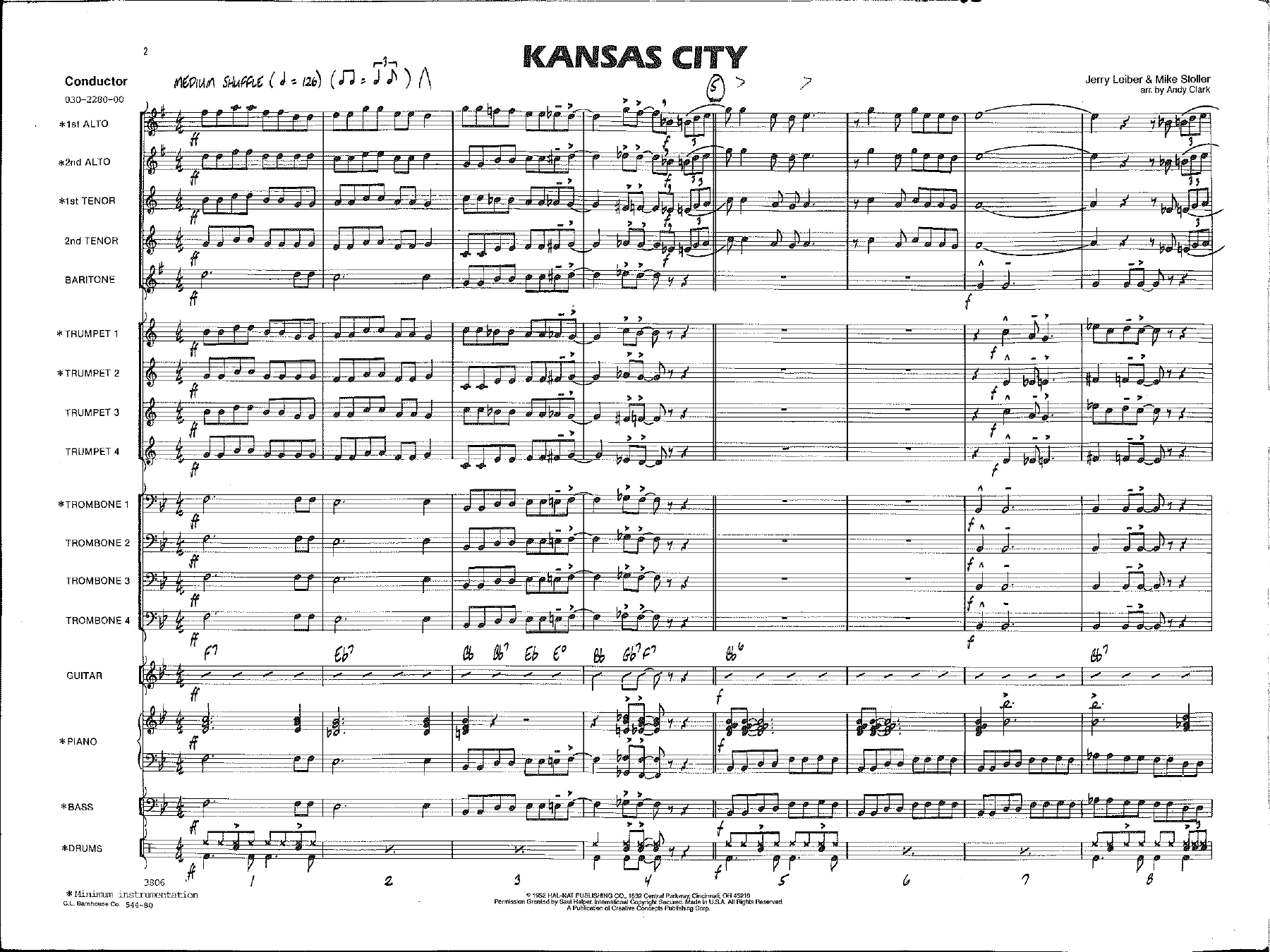
Kansas City (A.Clark) sheet music preview

Kansas City (A.Clark)

Composed by Jerry Leiber and Mike Stoller

Arranged by A.Clark

  • Ensemble: Big Band
  • Style: Jazz Standard
  • Pages: 37
  • Instruments (18): Conductor, Alto Saxophone 1, Alto Saxophone 2, Tenor Saxophone 1, Tenor Saxophone 2, Baritone Saxophone, Trumpet 1, Trumpet 2, Trumpet 3, Trumpet 4, Trombone 1, Trombone 2, Trombone 3, Trombone 4, Guitar, Piano, Bass, Drum Set
  • Difficulty: medium
  • Content: Individual Parts
  • Format: PDF Download (Instant)
  • Price: $24.99

Originally penned by the legendary songwriting duo Jerry Leiber and Mike Stoller in 1952, "Kansas City" quickly transcended its rhythm and blues origins to become a foundational piece in the American musical lexicon. While Wilbert Harrison's 1959 rendition famously topped the charts, its irresistible twelve-bar blues structure and catchy melody have made it a perennial favorite for jazz artists seeking a vehicle for improvisation and ensemble interplay. The song embodies the raw, energetic spirit of early rock and roll and R&B, yet its inherent blues form makes it perfectly adaptable to the sophisticated harmonic and rhythmic language of big band jazz, representing a bridge between these two vital American musical traditions. Its enduring appeal lies in its simplicity and directness, offering a canvas for diverse interpretations while always maintaining its infectious groove. A.Clark’s big band arrangement of "Kansas City" transforms this classic into a vibrant, swinging showcase for a 17-piece ensemble. The arrangement establishes a medium-up swing tempo (around 160-170 bpm) in the key of F Major, immediately setting a bright, energetic, and undeniably danceable mood. Clark's signature approach is evident in the clever reharmonizations and dynamic contrasts that elevate the original's straightforward blues progression. The piece opens with a punchy brass fanfare, immediately grabbing attention, before settling into a driving rhythm section groove. The melody is initially carried by the alto saxophone, offering a clear and articulate statement, which is then passed to the full saxophone section in a tightly voiced soli, showcasing Clark's mastery of sectional writing. This arrangement is a masterclass in building intensity and excitement. Featured solos are strategically placed, offering ample opportunity for a tenor saxophone and trumpet to stretch out over the blues changes, supported by crisp, rhythmic backgrounds from the rest of the band. A.Clark’s arrangement shines in its use of call-and-response figures between the brass and saxophones, culminating in a powerful, driving shout chorus that is both harmonically rich and rhythmically exhilarating. The voicings are full and resonant, utilizing extended harmonies that add a contemporary jazz flavor without sacrificing the bluesy essence of the original. Challenges include precise articulation in the brass, maintaining a consistent swing feel throughout, and navigating the dynamic shifts that are crucial to the arrangement's impact. The rewarding aspect lies in the collective energy generated and the satisfaction of delivering a polished, professional-sounding interpretation of a beloved standard. This arrangement is ideally suited for advanced high school, college, community, and professional jazz ensembles. Its demands for tight ensemble playing, strong lead trumpet and alto saxophone, and capable improvisers make it an excellent teaching tool for developing advanced big band skills. The blend of familiar melody with sophisticated arranging techniques ensures it will be a crowd-pleaser while simultaneously challenging musicians to perform at a high level. The 37 pages of meticulously notated parts ensure clarity and precision for all 17 instruments, making it a valuable addition to any big band library. Conductors should aim for a consistent medium-up swing feel, approximately 160-170 bpm, emphasizing a buoyant, forward-moving groove from the rhythm section. Articulation is paramount, particularly in the brass sections; encourage short, precise stabs and clear attacks to maintain the arrangement's punchy character. The saxophone soli requires careful attention to balance and blend, ensuring the inner voices are heard without overpowering the lead alto. Dynamics play a crucial role in shaping the piece, with sudden contrasts between loud and soft sections adding significant impact; rehearse these transitions meticulously. Soloists should be encouraged to embrace the blues language while exploring harmonic extensions. The shout chorus demands maximum energy and precise rhythmic alignment across all sections, building to a powerful, unified statement. No special techniques like plunger mutes or doits are explicitly notated, allowing the band to focus on fundamental big band execution. Q: What instruments are included in this arrangement of "Kansas City (A.Clark)"? A: This big band arrangement includes parts for 17 instruments: Alto Saxophone 1, Alto Saxophone 2, Tenor Saxophone 1, Tenor Saxophone 2, Baritone Saxophone, Trumpet 1, Trumpet 2, Trumpet 3, Trumpet 4, Trombone 1, Trombone 2, Trombone 3, Trombone 4, Piano, Bass, Drums, and Guitar. Q: What is the difficulty level of this arrangement? A: This arrangement is considered advanced, suitable for advanced high school, college, community, and professional jazz ensembles due to its demands for tight ensemble playing, precise articulation, and capable improvisers. Q: What musical style does this arrangement represent, and what is its historical context? A: This is a big band jazz arrangement of "Kansas City," a jazz standard originally composed by Jerry Leiber and Mike Stoller in 1952. It blends the infectious twelve-bar blues structure of early R&B with sophisticated big band jazz harmonies and swing feel. Q: What makes A.Clark's arrangement of "Kansas City" unique? A: A.Clark's arrangement is distinguished by its vibrant medium-up swing feel, clever reharmonizations, dynamic contrasts, tightly voiced saxophone solis, and powerful, driving shout chorus, elevating the classic into a sophisticated big band showcase. Q: What is the typical performance duration or tempo for this piece? A: The typical performance tempo for this arrangement is a medium-up swing, approximately 160-170 beats per minute, resulting in a performance duration of around 3-4 minutes depending on the length of improvised solos.

Musicians Also Search For

Kansas City A.Clark PDFKansas City A.Clark sheet musicKansas City arranged by A.ClarkA.Clark big band chartsA.Clark jazz arrangements PDFKansas City Jerry Leiber and Mike Stoller sheet musicKansas City Jerry Leiber and Mike Stoller big band arrangementJerry Leiber and Mike Stoller big band chartsKansas City big band arrangementKansas City big band PDF downloadKansas City jazz ensemble sheet musicbig band sheet music instant downloadKansas City conductor score PDFKansas City individual parts downloadKansas City sheet music with partsKansas City Jazz Standard chartJazz Standard big band arrangementsbuy Kansas City sheet music onlinedownload Kansas City PDFKansas City jazz chartbest A.Clark big band arrangementsJerry Leiber and Mike Stoller songs arranged by A.ClarkKansas City printable sheet musicbig band repertoire PDF

All arrangements by A.Clark All Jerry Leiber and Mike Stoller sheet music