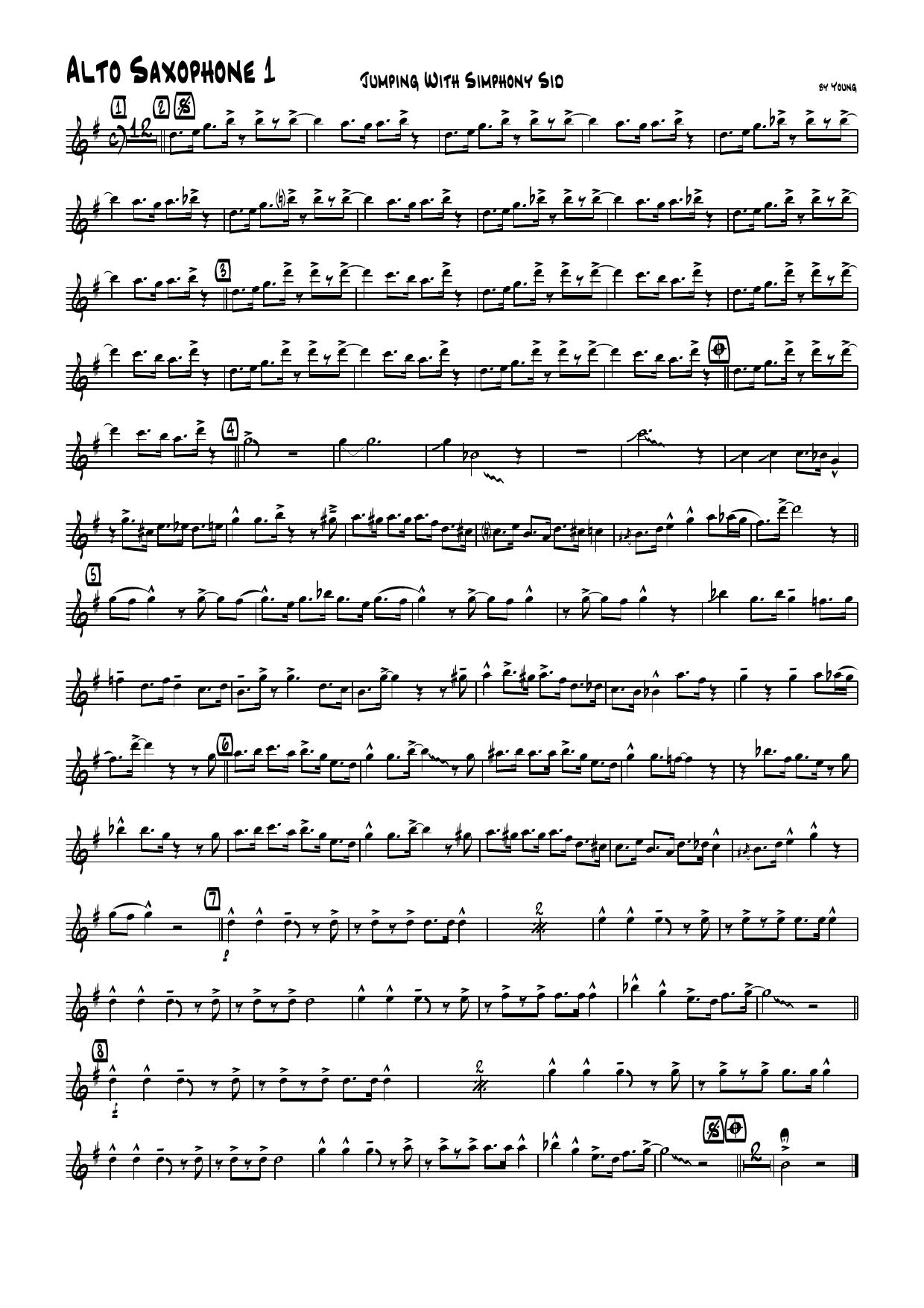
Jumping With Simphony Sid (L.Young)
Composed by Lester Young
Arranged by L.Young
- Ensemble: Big Band
- Style: Jazz Standard
- Pages: 18
- Instruments (17): Alto Saxophone 1, Alto Saxophone 2, Tenor Saxophone 1, Tenor Saxophone 2, Baritone Saxophone, Trumpet in Bb 1, Trumpet in Bb 2, Trumpet in Bb 3, Trumpet in Bb 4, Trombone 1, Trombone 2, Trombone 3, Trombone 4, Guitar, Piano, Bass, Drum Set
- Difficulty: easy
- Content: Individual Parts
- Format: PDF Download (Instant)
- Price: $24.99
Bebop royalty meets big band swing in Lester Young’s iconic anthem, "Jumping With Symphony Sid." Originally conceived by the legendary tenor saxophone innovator—affectionately known as the "Prez"—and popularized through its heavy rotation as the theme song for Symphony Sid Torin’s pioneering late-night jazz radio broadcasts in New York City, this tune serves as a masterclass in cool-school swing and blues-infused phrasing. Rooted in the post-war transition from large-ensemble swing to the smaller, high-velocity combos of bebop, the composition retains an infectious, driving rhythm that bridges the gap between danceable mainstream swing and intellectual modern jazz. It captures the late-night urban sophistication of 1940s 52nd Street, radiating a cool, effortless swagger that has made it an enduring jam-session favorite and a staple of standard jazz repertoire. Driving with an insistent, medium-up swing groove in 4/4 time, this arrangement radiates high energy while maintaining the relaxed, behind-the-beat articulation that defined Lester Young’s signature sound. The mood is effortlessly hip, buoyant, and relentlessly swinging, propelled by a walking bassline and crisp hi-hat accents. The arrangement opens with a punchy, rhythm-section-driven vamp before the full ensemble enters with a razor-sharp riff that immediately establishes the restless, danceable momentum. The tonal landscape balances bright brass counterlines with smooth, interlocking saxophone voicings that evoke the iconic Prez-era cool aesthetic, injecting moments of playful blues inflection into sophisticated, extended harmonies. Arranger L.Young approaches the classic material with a keen ear for dynamic contrast and textural variety, honoring the Lester Young tradition while maximizing the sonic weight of a full 17-piece big band. The chart features a brilliantly crafted saxophone soli that mimics Lester’s linear, horizontal approach to melodic development, stripping away vertical clutter in favor of fluid, horizontal lines. Brass sections trade snappy call-and-response figures that build tension cleanly toward a dynamic, high-octane shout chorus. Rather than overcomplicating the form, the arrangement utilizes clever metric accents, subtle modulations of texture, and space—allowing the inherent blues-based momentum of the composition to drive the performance naturally. Melodic duties are shared dynamically between the saxophone section and the brass, with designated solo space provided for tenor saxophone and trumpet over standard blues changes, inviting players to stretch out in the authentic bebop vernacular. Technical challenges lie primarily in maintaining a consistent, relaxed swing feel at a brisk tempo, requiring clean articulation, precise section blend, and light, transparent phrasing from the rhythm section. Advanced high school bands with strong section leaders, as well as collegiate and professional ensembles, will find this chart immensely rewarding. It offers an ideal vehicle for teaching stylistic subdivision, jazz articulation, and the art of swinging comfortably at a driving tempo without sacrificing warmth or tone. Conductors should establish a comfortable, driving medium-up swing tempo (approx. Quarter Note = 184–192), ensuring that the underlying pulse remains relaxed rather than rushed. The primary technical hurdle rests in executing the syncopated, Lester Young-inspired figures with a light, horizontal conception rather than heavy, vertical accented beats. Saxophones must focus on seamless legato phrasing within slurred passages, while brass players should utilize short, controlled tongue strokes on off-beat accents, incorporating subtle falls and doits only where indicated to preserve stylistic authenticity. Rhythm section players are the engine of this chart: the drummer should keep a steady, feather-light ride cymbal pattern with crisp crisp hi-hat chicks on beats 2 and 4, avoiding over-playing during ensemble passages. Pianists should comp sparingly using rootless, shell-style voicings that leave plenty of air for the horns. Rehearsal should begin by running the ensemble sections at a slower tempo to lock in intonation on the extended chord extensions, gradually working up to performance speed while monitoring the balance of the shout chorus against the primary melody lines. Q: What instruments and parts are included in this big band arrangement? A: The chart is scored for a standard 17-piece big band instrumentation consisting of Alto Saxophone 1 & 2, Tenor Saxophone 1 & 2, Baritone Saxophone, 4 Trumpets, 4 Trombones, Piano, Guitar, Bass, and Drums, spanning an 18-page full score and parts set. Q: What is the difficulty level of this arrangement? A: This arrangement is rated as medium-advanced, making it well-suited for proficient high school jazz ensembles, collegiate bands, and professional community big bands with strong soloists. Q: What is the historical style and context of this piece? A: It is a jazz standard composed by tenor saxophone icon Lester Young, capturing the vibrant 1940s bebop and cool jazz era made famous as the signature theme of radio disc jockey Symphony Sid. Q: What makes this specific L.Young arrangement unique? A: It uniquely balances the relaxed, horizontal phrasing style of Lester Young with a robust 17-piece big band texture, featuring a meticulously crafted saxophone soli and dynamic call-and-response shout choruses. Q: What is the performance duration and recommended tempo for this chart? A: The arrangement performs at a driving medium-up swing tempo of approximately Quarter Note = 184–192, resulting in a total performance duration of roughly 3.5 to 4 minutes depending on solo choruses.
Questions and answers
- What is included in the Jumping With Simphony Sid (L.Young) PDF?
- The verified current file contains individual parts across 18 pages.
- How many instruments or parts are listed for Jumping With Simphony Sid (L.Young)?
- The verified instrumentation list contains 17 entries for this Big Band arrangement.
- Who is credited for Jumping With Simphony Sid (L.Young)?
- Composer: Lester Young. Arranger: L.Young.
- What difficulty is listed for Jumping With Simphony Sid (L.Young)?
- The verified difficulty level is easy.
- What style is listed for Jumping With Simphony Sid (L.Young)?
- The catalog lists the style as Jazz Standard.
- Can I preview Jumping With Simphony Sid (L.Young) before buying?
- Yes. The product page provides a preview generated from the current PDF file.
- How is Jumping With Simphony Sid (L.Young) delivered?
- After successful payment, the digital PDF is made available for download. The displayed price is $24.99.
Musicians Also Search For
Jumping With Simphony Sid L.Young PDF • Jumping With Simphony Sid L.Young sheet music • Jumping With Simphony Sid arranged by L.Young • L.Young big band charts • L.Young jazz arrangements PDF • Jumping With Simphony Sid Lester Young sheet music • Jumping With Simphony Sid Lester Young big band arrangements • Lester Young big band charts • Jumping With Simphony Sid big band arrangements • Jumping With Simphony Sid big band PDF download • Jumping With Simphony Sid jazz sheet music • big band sheet music download • Jumping With Simphony Sid individual parts download • Jumping With Simphony Sid sheet music PDF • Jumping With Simphony Sid Jazz Standard charts • Jazz Standard big band arrangements • buy Jumping With Simphony Sid sheet music • download Jumping With Simphony Sid PDF • Jumping With Simphony Sid jazz charts • best L.Young big band arrangements • Lester Young arranged by L.Young • Jumping With Simphony Sid printable sheet music • big band repertoire PDF