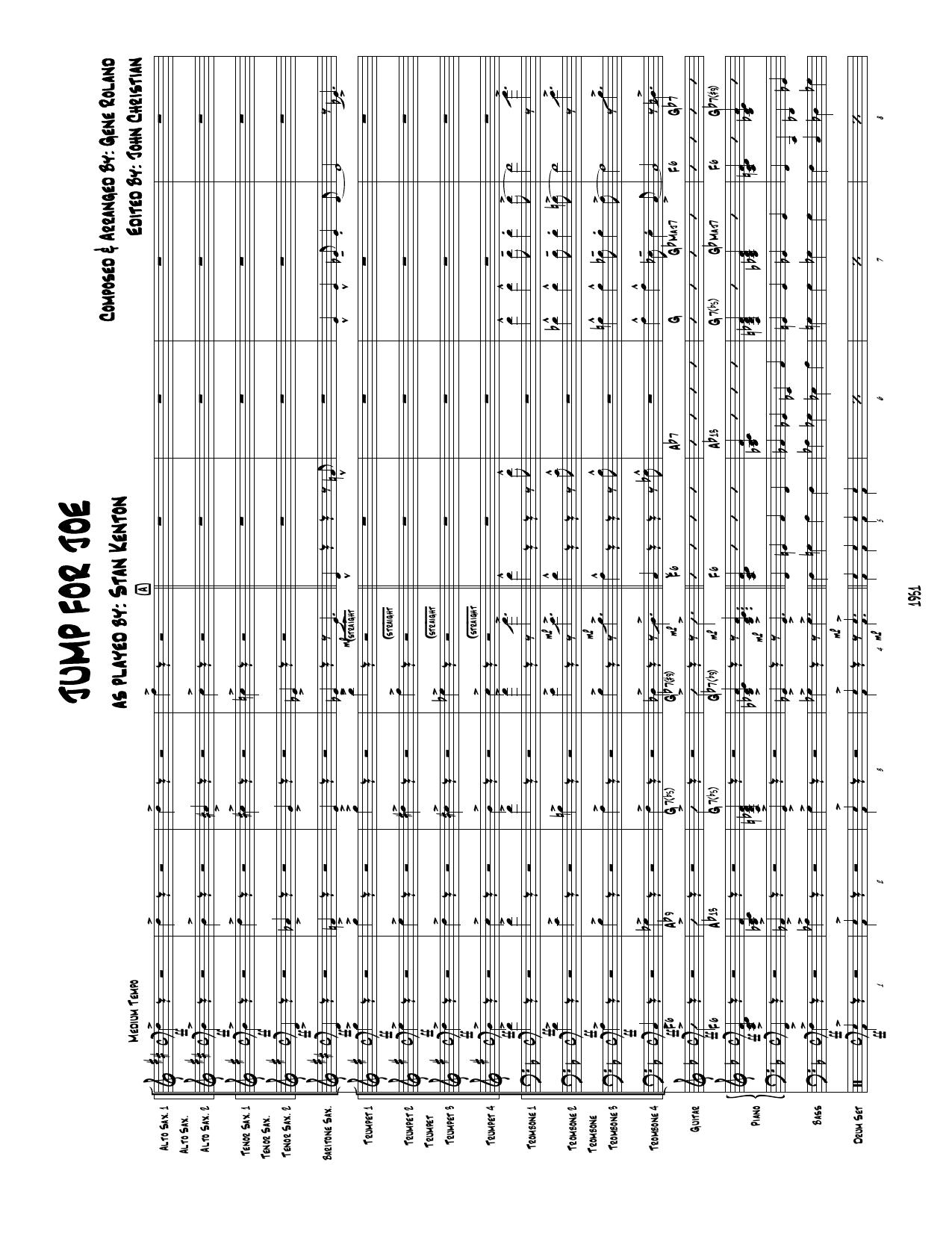
Jump For Joe (G.Roland) S.Kenton (J.Christian) sheet music preview

Jump For Joe (G.Roland) S.Kenton (J.Christian)

Composed by George Roland

Arranged by J.Christian

  • Ensemble: Big Band
  • Pages: 45
  • Instruments (18): 1st Eb Alto Saxophone, 2nd Eb Alto Saxophone, 3rd Bb Tenor Saxophone, 4th Bb Tenor Saxophone, Eb Baritone Saxophone, 1st Bb Trumpet, 2nd Bb Trumpet, 3rd Bb Trumpet, 4th Bb Trumpet, 1st Trombone, 2nd Trombone, 3rd Trombone, 4th Trombone, Guitar, Piano, Bass, Drums, Conductor
  • Difficulty: medium
  • Content: Individual Parts
  • Format: PDF Download (Instant)
  • Price: $24.99

George Roland’s sophisticated composition "Jump For Joe," forever intertwined with the monumental legacy of the Stan Kenton Orchestra and the distinctive arranging hand of J.Christian, stands as a brilliant artifact of mid-century progressive jazz innovation. Emerging from an era when big bands were expanding their harmonic vocabulary and textural palettes beyond standard dance-band conventions, this piece captures the high-octane energy and restless creativity of modern post-war jazz. While Kenton’s ensembles were famous for their massive brass power and wall-of-sound density, this specific chart retains that driving intensity while balancing it with intricate, linear counterpoint and sharp rhythmic drive characteristic of J.Christian's meticulous writing style. Driven by an infectious, high-energy medium-up swing feel in 4/4 time, the work opens with an urgent, hook-laden ostinato figure that immediately commands the listener's attention. The harmonic language is rich with extended alterations, sharp chromatic passing tones, and soaring upper-structure triads that push the brass section into brilliant, sparkling registers. Throughout the chart, J.Christian utilizes sweeping dynamic contrasts, moving seamlessly from tight, punchy, whispered ensemble passages to roaring, brass-heavy shout choruses that test the endurance and lung capacity of any modern big band. The emotional landscape shifts dynamically between sophisticated cool-school detachment and unbridled, visceral swing-era exhilaration. J.Christian’s approach to this arrangement emphasizes section independence and dense, modern voicings where the saxophones weave intricate bebop-inflected lines beneath overarching brass stabs. The melodic burden is shared democratically across the ensemble, though the brass section frequently carries the aggressive thematic weight, punctuated by crisp, articulate counter-melodies from the lower reeds. Featured solo sections provide ample space for creative improvisation, inviting a confident lead alto or trumpet to stretch out over sophisticated changes that nod to the bebop revolution. The technical challenges lie primarily in maintaining crisp articulation at brisk tempos, executing wide interval leaps cleanly in the brass, and locking in the aggressive rhythmic syncopations that define the work’s rhythmic framework. Advanced collegiate ensembles, top-tier high school jazz bands, and professional repertory orchestras will find this chart an exhilarating centerpiece for festival performance or concert programming. Because of the demanding upper-register requirements for the lead trumpet and the stamina needed across all four trombone and five saxophone chairs, the arrangement rewards mature sections equipped with strong sectional listening skills and stylistic flexibility. Delivering this chart successfully requires a deep understanding of West Coast modernism and traditional swing dynamics, making it an intellectually stimulating and deeply satisfying project for conductors seeking to elevate their ensemble's technical precision and tonal refinement. Navigating "Jump For Joe" requires meticulous attention to the stylistic balance between punchy, aggressive modern swing and effortless, flowing linear momentum. The conductor should establish a brisk, driving medium-up tempo, guarding against the tendency of the rhythm section to rush during heavy brass shout choruses. The primary technical challenges stem from the dense, chromatic chord structures and rapid unison passages shared between the saxophones and upper brass. Reeds must focus on a light, dry articulation style during background figures to ensure the featured soloists remain prominent. Brass players should approach high-register entrances with controlled air support rather than forced pressure, utilizing subtle dynamics to shape long phrases rather than blasting through every accent. Special attention must be paid to the rhythm section: the drummer should drive the ensemble with a steady, propulsive ride cymbal pattern while avoiding over-cluttering the spaces behind the horn soli. Rehearsal should begin slowly, isolating complex syncopated figures at half-tempo before merging the sections together to achieve maximum ensemble tightness. Q: What instruments and parts are included in this arrangement? A: This 45-page big band publication includes a full conductor score and individual parts for a standard 17-instrument ensemble: 2 alto saxophones, 2 tenor saxophones, baritone saxophone, 4 trumpets, 4 trombones, guitar, piano, bass, and drums. Q: What is the difficulty level of this J.Christian chart? A: This arrangement is graded as advanced, making it best suited for collegiate jazz ensembles, professional bands, and elite high school groups with strong lead players and experienced improvisers. Q: What is the historical context and musical style of "Jump For Joe"? A: Rooted in the progressive big band tradition associated with Stan Kenton and composed by George Roland, this piece blends mid-century modern jazz harmonies with an energetic, driving swing feel. Q: What makes J.Christian's arrangement unique? A: J.Christian's treatment stands out due to its intricate contrapuntal lines, sophisticated extended harmonies, and brilliant use of dynamic contrast between dense brass shout choruses and delicate reed solis. Q: What is the expected performance duration and tempo framework? A: The arrangement is written in 4/4 time with a brisk, high-energy medium-up swing feel, and typically runs between 4 to 5 minutes depending on the length of the improvised solos.

Questions and answers

What is included in the Jump For Joe (G.Roland) S.Kenton (J.Christian) PDF?
The verified current file contains a conductor score and individual parts across 45 pages.
How many instruments or parts are listed for Jump For Joe (G.Roland) S.Kenton (J.Christian)?
The verified instrumentation list contains 18 entries for this Big Band arrangement.
Who is credited for Jump For Joe (G.Roland) S.Kenton (J.Christian)?
Composer: George Roland. Arranger: J.Christian.
What difficulty is listed for Jump For Joe (G.Roland) S.Kenton (J.Christian)?
The verified difficulty level is medium.
Can I preview Jump For Joe (G.Roland) S.Kenton (J.Christian) before buying?
Yes. The product page provides a preview generated from the current PDF file.
How is Jump For Joe (G.Roland) S.Kenton (J.Christian) delivered?
After successful payment, the digital PDF is made available for download. The displayed price is $24.99.

Musicians Also Search For

Jump For Joe J.Christian PDFJump For Joe J.Christian sheet musicJump For Joe arranged by J.ChristianJ.Christian big band chartsJ.Christian jazz arrangements PDFJump For Joe George Roland sheet musicJump For Joe George Roland big band arrangementsGeorge Roland big band chartsJump For Joe big band arrangementsJump For Joe big band PDF downloadJump For Joe jazz sheet musicbig band sheet music downloadJump For Joe conductor score PDFJump For Joe individual parts downloadJump For Joe sheet music PDFbuy Jump For Joe sheet musicdownload Jump For Joe PDFJump For Joe jazz chartsbest J.Christian big band arrangementsGeorge Roland arranged by J.ChristianJump For Joe printable sheet musicbig band repertoire PDF

All arrangements by J.Christian All George Roland sheet music