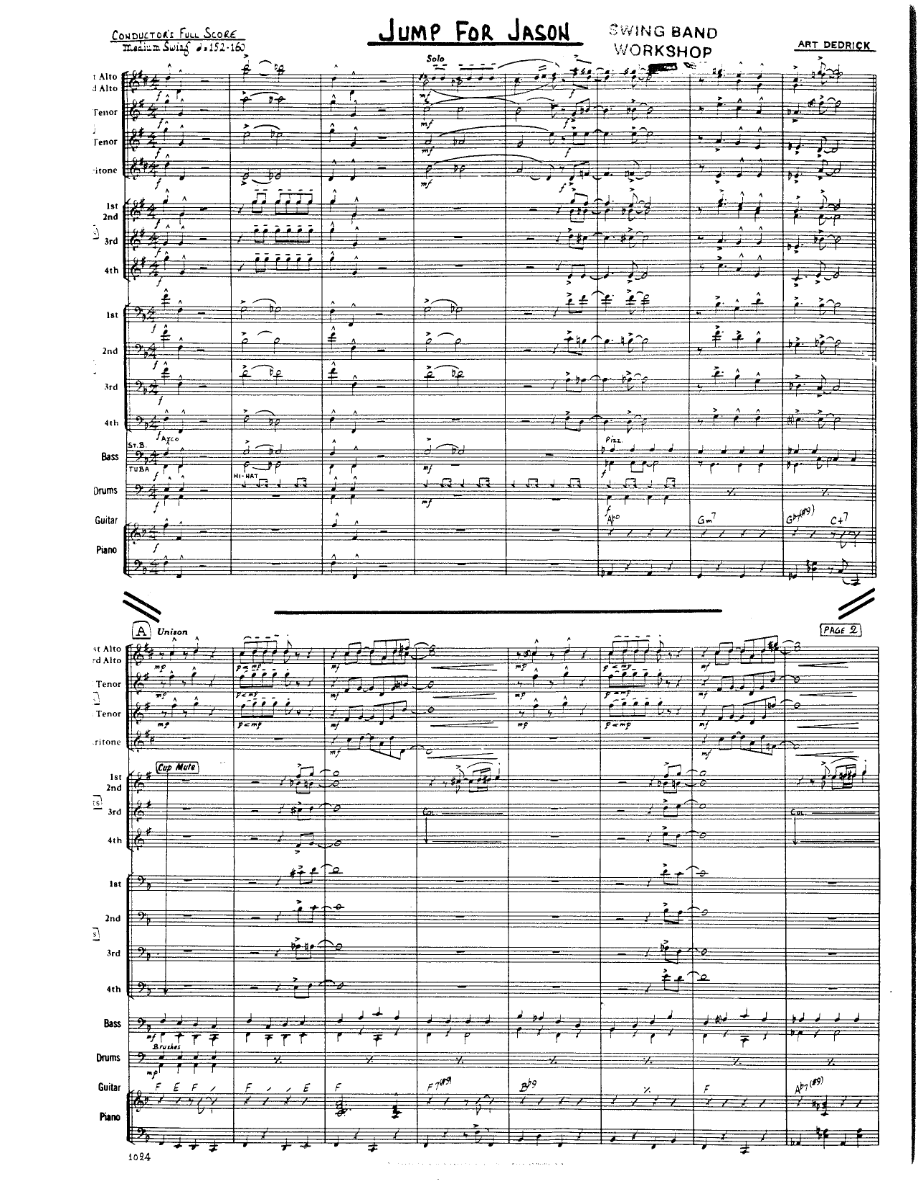
Jump For Jason (A.Dedrick) sheet music preview

Jump For Jason (A.Dedrick)

Composed by Art Dedrick

Arranged by Art Dedrick

  • Ensemble: Big Band
  • Style: Jazz Standard
  • Pages: 41
  • Instruments (18): 1st Eb Alto Sax, 3rd Eb Alto Sax, 2nd Bb Tenor Sax, 4th Bb Tenor Sax, 5th Eb Baritone Sax, 1st Bb Trumpet, 2nd Bb Trumpet, 3rd Bb Trumpet, 4th Bb Trumpet, 1st Trombone, 2nd Trombone, 3rd Trombone, 4th Trombone, Bass Tuba, String Bass, Guitar, Piano, Drums
  • Difficulty: medium
  • Content: Individual Parts
  • Format: PDF Download (Instant)
  • Price: $24.99

"Jump For Jason," composed and arranged by the prolific Art Dedrick, stands as a quintessential example of the mid-20th century big band jazz standard, embodying the vibrant energy and sophisticated harmonic language that defined the era. While not a piece with a singular "hit" recording by a famous artist, Dedrick's compositions and arrangements were widely performed by school, college, and community bands, making his work a foundational part of jazz education and performance repertoire. This particular piece, with its driving swing feel and accessible yet engaging melodic lines, represents the bridge between the robust swing era and the more intricate harmonies of post-bop, making it a timeless addition to any big band's library. It evokes a sense of joyful exuberance and classic big band swagger, perfect for showcasing a band's collective power and individual soloists. Art Dedrick's arrangement of "Jump For Jason" is a masterclass in crafting an engaging big band chart that is both rewarding to play and listen to. True to his signature style, Dedrick employs clear, articulate voicings that ensure every section of the 17-instrument ensemble (including Alto Saxophones 1 & 2, Tenor Saxophones 1 & 2, Baritone Saxophone, Trumpets 1-4, Trombones 1-4, Piano, Bass, and Drums) contributes to the overall texture. The piece is set in a bright, medium-up swing tempo, typically around 160-180 BPM, in a comfortable concert key that allows for full brass brilliance. The arrangement features a compelling interplay between the saxophone section, often presented in tight, unison lines or harmonized soli sections, and the powerful brass, which punctuates and drives the melodic development. Dedrick's genius lies in his ability to create a full, rich sound without over-complicating individual parts, making it accessible for developing ensembles while still offering plenty of musical depth. The performance journey of "Jump For Jason" is designed to be both challenging and immensely satisfying. The primary melody is initially carried by the saxophone section, establishing the piece's infectious groove and melodic identity. This leads into well-crafted solo sections, typically featuring the 1st Tenor Saxophone and 2nd Trumpet, providing ample opportunity for improvisation over a standard jazz chord progression. Following the solos, the arrangement builds dynamically to a powerful shout chorus that showcases the full ensemble's collective strength, often employing classic big band rhythmic figures and dynamic contrasts. The technical challenges are primarily centered around maintaining a consistent, driving swing feel, precise articulation, and dynamic control, particularly in the brass sections. This arrangement is ideally suited for advanced high school, college, and community jazz ensembles looking to perform an authentic, energetic big band standard that highlights both ensemble precision and individual improvisation. Its clear structure and rewarding musical moments make it a staple for concerts and festivals. "Jump For Jason" should be approached with a bright, medium-up swing feel, aiming for a tempo between 160-180 BPM. Emphasize a light, driving eighth-note feel from the rhythm section, avoiding a heavy or plodding pulse. Key technical challenges include precise articulation in the brass sections, particularly ensuring clean attacks and releases on accented figures. Saxophone soli sections require meticulous attention to blend, intonation, and rhythmic unison. Encourage soloists to embrace the classic swing vocabulary over the provided chord changes. Dynamic contrast is crucial; build energy through the shout chorus, utilizing clear dynamic markings for maximum impact. Rehearse the ensemble's rhythmic precision in the unison figures and ensure the bass and drums lock into a solid, consistent groove from the outset. No special techniques like plungers or doits are explicitly marked, allowing for standard big band performance practice. Q: What instruments and parts are included in this arrangement? A: This arrangement is scored for a full 17-piece big band, including Alto Saxophone 1 & 2, Tenor Saxophone 1 & 2, Baritone Saxophone, Trumpet 1-4, Trombone 1-4, Piano, Bass, and Drums. Q: What is the difficulty level of "Jump For Jason"? A: "Jump For Jason" is generally considered suitable for advanced high school, college, and community jazz ensembles. It offers engaging parts without extreme technical demands, focusing on ensemble precision, swing feel, and improvisation. Q: What style of jazz does "Jump For Jason" represent, and what is its historical context? A: This piece embodies the classic big band jazz standard style of the mid-20th century, bridging the swing era with post-bop harmonies. It's a foundational piece in the repertoire, representative of Art Dedrick's widely performed and educational compositions. Q: What makes Art Dedrick's arrangement of "Jump For Jason" unique? A: Dedrick's arrangement is characterized by its clear, articulate voicings, driving medium-up swing feel, and well-structured form featuring accessible solo sections and a powerful shout chorus, making it both educational and highly performable. Q: What is the typical performance duration and recommended tempo for this piece? A: The typical performance duration for "Jump For Jason" is approximately 3-4 minutes, depending on the length of improvised solos. It should be performed at a bright, medium-up swing tempo, ideally between 160-180 beats per minute.

Questions and answers

What is included in the Jump For Jason (A.Dedrick) PDF?
The verified current file contains a conductor score and individual parts across 41 pages.
How many instruments or parts are listed for Jump For Jason (A.Dedrick)?
The verified instrumentation list contains 18 entries for this Big Band arrangement.
Who is credited for Jump For Jason (A.Dedrick)?
Composer: Art Dedrick. Arranger: Art Dedrick.
What difficulty is listed for Jump For Jason (A.Dedrick)?
The verified difficulty level is medium.
What style is listed for Jump For Jason (A.Dedrick)?
The catalog lists the style as Jazz Standard.
Can I preview Jump For Jason (A.Dedrick) before buying?
Yes. The product page provides a preview generated from the current PDF file.
How is Jump For Jason (A.Dedrick) delivered?
After successful payment, the digital PDF is made available for download. The displayed price is $24.99.

Musicians Also Search For

Jump For Jason Art Dedrick PDFJump For Jason Art Dedrick sheet musicJump For Jason arranged by Art DedrickArt Dedrick big band chartsArt Dedrick jazz arrangements PDFJump For Jason Art Dedrick big band arrangementsJump For Jason big band arrangementsJump For Jason big band PDF downloadJump For Jason jazz sheet musicbig band sheet music downloadJump For Jason conductor score PDFJump For Jason individual parts downloadJump For Jason sheet music PDFJump For Jason Jazz Standard chartsJazz Standard big band arrangementsbuy Jump For Jason sheet musicdownload Jump For Jason PDFJump For Jason jazz chartsbest Art Dedrick big band arrangementsJump For Jason printable sheet musicbig band repertoire PDF

All arrangements by Art Dedrick All Art Dedrick sheet music