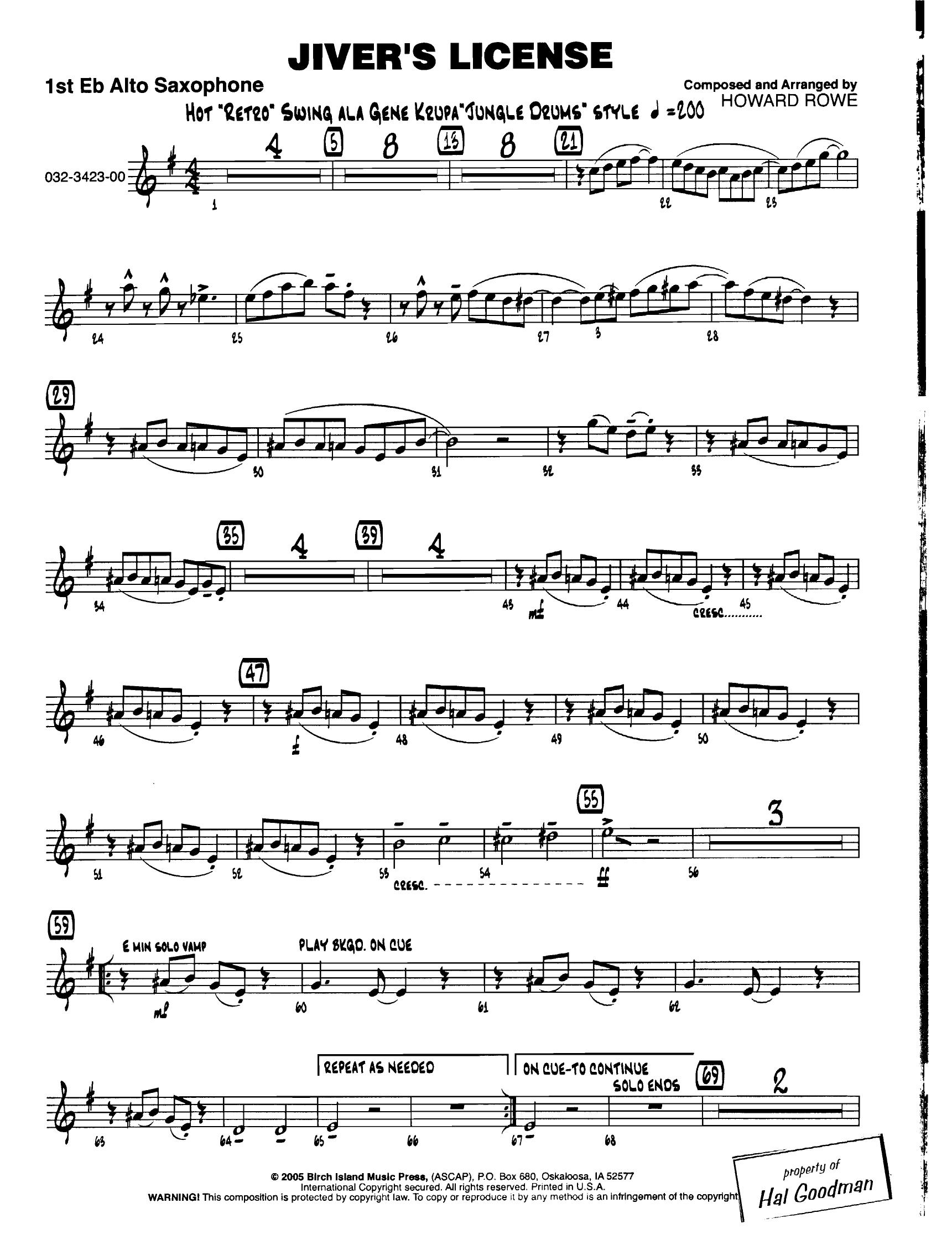
Jiver's License (H.Rowe)
Composed by Howard Rowe
Arranged by Howard Rowe
- Ensemble: Big Band
- Pages: 35
- Instruments (17): 1st Eb Alto Saxophone, 2nd Eb Alto Saxophone, 1st Bb Tenor Saxophone, 2nd Bb Tenor Saxophone, Eb Baritone Saxophone, 1st Bb Trumpet, 2nd Bb Trumpet, 3rd Bb Trumpet, 4th Bb Trumpet, 1st Trombone, 2nd Trombone, 3rd Trombone, 4th Trombone, Guitar, Piano, Bass, Drums
- Difficulty: medium
- Content: Individual Parts
- Format: PDF Download (Instant)
- Price: $24.99
Pulsing with the irrepressible energy of mid-century modern jazz, "Jiver's License" stands as a brilliant showcase of composer and arranger Howard Rowe’s mastery of swinging, blues-inflected big band orchestration. Rooted firmly in the swinging post-war jazz tradition that bridges classic Kansas City counterpoint with the sharp, sophisticated angles of early modern bop, this composition captures the kinetic thrill of late-night jazz clubs where technical wizardry met irresistible dance grooves. Rowe’s writing reflects an era when big bands were leaning into tighter, punchier horn section interplay and more adventurous harmonic extensions, making the work a fascinating study in contrast between relaxed, driving swing feels and razor-sharp ensemble precision. Blazing forward at an energetic medium-up swing tempo, the piece opens with a sharp, brass-heavy hook that immediately establishes its driving, confident mood. The harmonic landscape is rich with major-seventh colorations, flatted ninths, and passing diminished chords that give the progression a sophisticated yet utterly approachable bite. Rowe crafts a dynamic narrative across the 35 pages of the score, moving fluidly from intimate, muted trumpet statements to roaring, full-ensemble climaxes. The overall emotional trajectory shifts from playful urban sophistication to unbridled euphoria, evoking the spontaneous, high-wire excitement of a classic late-night jam session where every section of the band is pushed to engage at peak performance levels. Rowe’s structural approach relies heavily on clever sectional dialogue, featuring tightly knit sax soli passages that demand absolute rhythmic unison, set against staccato brass interjections that snap on the backbeats. The reeds—anchored by the rich harmonic voice of the baritone saxophone and doubled alto lines—frequently carry the thematic weight before handing off the baton to soaring trumpet ledgers. A standout feature of the arrangement is its masterfully constructed shout chorus, a masterclass in tension-and-release building blocks that utilizes sequential modulations and cascading dynamic swells. Solo opportunities are strategically integrated into the middle form, allowing featured improvisers over accessible, blues-based changes to stretch out while the rhythm section maintains an insistent, buoyant walking bass and ride-cymbal pulse. Advanced high school, collegiate, and professional community jazz orchestras will find this chart to be an exceptionally rewarding addition to their repertoire. While the rhythm section must possess a mature understanding of pocket and swing subdivision—particularly in maintaining drive beneath the shout choruses—the horn parts are meticulously articulated to reward careful sectional rehearsing. The technical demands are balanced by idiomatic writing that sits comfortably on the instruments, ensuring that ensembles investing time in its stylistic nuances will deliver a crowd-pleasing, authentic jazz performance that honors the golden age of big band arranging while keeping modern audiences completely engaged. Conductors should approach "Jiver's License" with a primary focus on articulation clarity and rhythmic crispness. The target tempo is a bright, driving medium-up swing (approximately quarter note = 180–188 BPM); avoid rushing the cadence, as the groove relies entirely on the rhythm section's unhurried, forward-leaning pulse. The saxophones must execute their fast-moving soli lines with light, detached tonguing, ensuring that eighth-note lines swing naturally rather than sounding rushed or square. Brass players should utilize cup and bucket mutes where indicated, keeping dynamic levels controlled during background figures to allow the featured soloists space to breathe. In rehearsal, isolate the shout chorus to balance the brass counterlines against the soaring saxophone upper register. Ensure the drummer maintains a crisp, conversational ride-cymbal pattern with a prominent 2-and-4 hi-hat chick, avoiding heavy foot-stomping that can muddy the lower-end interplay between the baritone saxophone and bass player. Q: What instruments and parts are included in this arrangement? A: The chart is scored for a standard 17-piece big band instrumentation, featuring Alto Saxophone 1, Alto Saxophone 2, Tenor Saxophone 1, Tenor Saxophone 2, Baritone Saxophone, four trumpets, four trombones, and a full rhythm section comprising piano, guitar, bass, and drums. Q: What is the difficulty level of "Jiver's License"? A: This arrangement is graded as advanced-intermediate to advanced, making it ideal for skilled high school, collegiate, and professional big bands that possess strong sectional blend and rhythmic consistency. Q: What is the historical style and musical context of this piece? A: Written by Howard Rowe, the piece reflects the sophisticated post-war swing and early bebop era, combining traditional blues structures with modern, extended harmonies and energetic ensemble counterpoint. Q: What makes Howard Rowe's arrangement unique? A: The arrangement stands out for its clever sectional dialogue, highly idiomatic saxophone solis, and a brilliantly constructed shout chorus that builds intense harmonic tension before resolving into a high-energy climax. Q: What is the recommended performance duration and tempo feel? A: The piece runs approximately 4 to 5 minutes in length and is driven by an energetic, medium-up swing groove set in 4/4 time.
Questions and answers
- What is included in the Jiver's License (H.Rowe) PDF?
- The verified current file contains individual parts across 35 pages.
- How many instruments or parts are listed for Jiver's License (H.Rowe)?
- The verified instrumentation list contains 17 entries for this Big Band arrangement.
- Who is credited for Jiver's License (H.Rowe)?
- Composer: Howard Rowe. Arranger: Howard Rowe.
- What difficulty is listed for Jiver's License (H.Rowe)?
- The verified difficulty level is medium.
- Can I preview Jiver's License (H.Rowe) before buying?
- Yes. The product page provides a preview generated from the current PDF file.
- How is Jiver's License (H.Rowe) delivered?
- After successful payment, the digital PDF is made available for download. The displayed price is $24.99.
Musicians Also Search For
Jiver's License Howard Rowe PDF • Jiver's License Howard Rowe sheet music • Jiver's License arranged by Howard Rowe • Howard Rowe big band charts • Howard Rowe jazz arrangements PDF • Jiver's License Howard Rowe big band arrangements • Jiver's License big band arrangements • Jiver's License big band PDF download • Jiver's License jazz sheet music • big band sheet music download • Jiver's License individual parts download • Jiver's License sheet music PDF • buy Jiver's License sheet music • download Jiver's License PDF • Jiver's License jazz charts • best Howard Rowe big band arrangements • Jiver's License printable sheet music • big band repertoire PDF