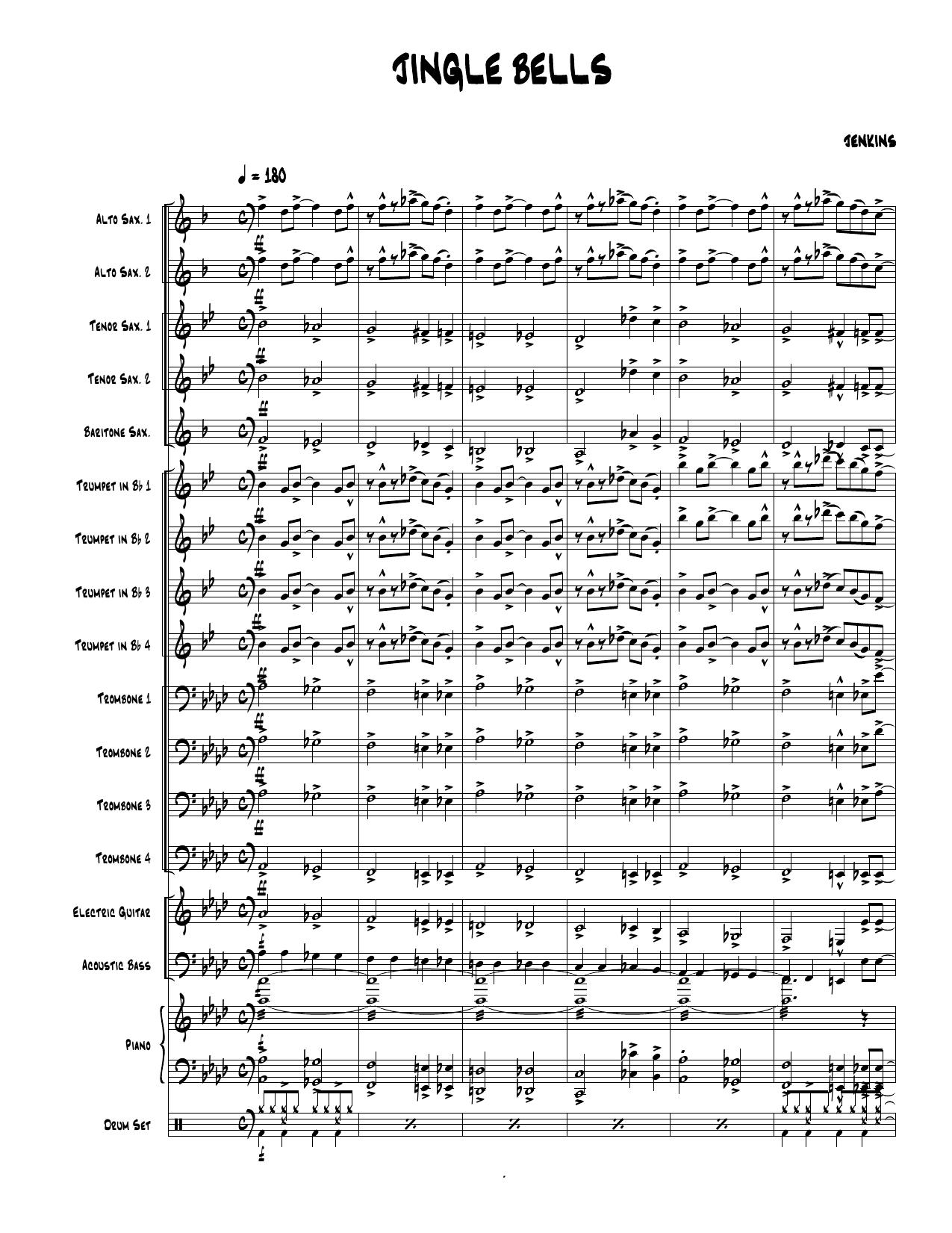
Jingle Bells (M.Jenkins)
Composed by James Lord Pierpont
Arranged by M.Jenkins
- Ensemble: Big Band
- Style: Jazz Standard
- Pages: 69
- Instruments (17): Alto Saxophone 1, Alto Saxophone 2, Tenor Saxophone 1, Tenor Saxophone 2, Baritone Saxophone, Trumpet in Bb 1, Trumpet in Bb 2, Trumpet in Bb 3, Trumpet in Bb 4, Trombone 1, Trombone 2, Trombone 3, Trombone 4, Electric Guitar, Acoustic Bass, Piano, Drum Set
- Difficulty: advanced
- Content: Individual Parts
- Format: PDF Download (Instant)
- Price: $24.99
James Lord Pierpont’s iconic 1857 winter melody undergoes a sophisticated transformation in this masterful big band adaptation, reframing a parlor tune into a swinging, sophisticated jazz standard firmly rooted in the mid-century tradition popularized by Count Basie and Nelson Riddle. While the original melody was penned as "One Horse Open Sleigh," it has endured as a global holiday staple; however, M.Jenkins reimagines the material through an advanced harmonic lens, stripping away the traditional schmaltz to reveal a robust, hard-swinging vehicle tailor-made for modern jazz ensembles. Propelled by an infectious, driving medium-up swing groove in 4/4 time, this chart balances exuberant holiday energy with cool, urbane sophistication. The arrangement opens with a snappy, syncopated brass figure before sliding effortlessly into an effortless, laid-back groove that showcases lush extended harmonies—including altered dominants, minor-major seventh colorings, and subtle bebop-inflected passing chords. M.Jenkins employs rich, block-chord sax solis and dynamic dynamic shifts, transitioning seamlessly from whisper-quiet comping behind the rhythm section to roaring, high-octane shout choruses that fully utilize the dynamic range of a full 17-piece big band. The melodic heavy-lifting is distributed democratically across the ensemble, though the lead alto saxophone and first trumpet take center stage during key thematic statements, punctuated by punchy trombone counterlines. Improvisational opportunities are built directly into the form, featuring designated solo changes for tenor saxophone and piano over classic, cyclical blues-inspired changes that allow soloists to stretch out stylistically. Technically rewarding without being overly prohibitive, the chart demands crisp articulation, accurate section blend, and a deep internal feel for swing subdivisions. The rhythm section parts—particularly the piano comping guides and walking basslines—provide an authentic foundation, while the drummer is given ample room to drive the ensemble with tasteful ride-cymbal variations and crisp hi-hat barks on beats two and four. Advanced high school, collegiate, and professional community big bands will find this arrangement an absolute showstopper for seasonal programming or spring jazz concerts. It strikes an ideal balance of crowd-pleasing familiarity and genuine jazz merit, ensuring that audiences will instantly recognize the tune while remaining captivated by the clever reharmonizations, punchy ensemble writing, and infectious, swinging momentum from the downbeat to the final sustained chord. Success with this arrangement hinges on achieving a unified, driving medium-swing feel rooted in the rhythm section. Conductors should ensure the bass plays a steady, acoustic-style walking quarter-note line with emphasis on beats two and four, while the drummer maintains an authentic ride-cymbal triplet pulse without overplaying the fills. Pay careful attention to short, clipped articulation markings on the eighth notes in the brass and saxophones; back-phrasing the upbeat eighth notes will give the chart its necessary authentic bite. The sax soli section requires meticulous dynamic control and intonation balance—listen closely to the lead alto to anchor the pitch center. Brass players should execute falls and doits with restraint, treating them as stylistic accents rather than exaggerated effects. Rehearsal time should be partitioned to isolate the complex rhythmic unisons in the shout chorus, ensuring the entire ensemble locks in before layering in the dynamic swells. Q: What instruments and parts are included in this package? A: The full 17-instrument big band instrumentation comprises Alto Saxophone 1 & 2, Tenor Saxophone 1 & 2, Baritone Saxophone, Trumpet 1 through 4, Trombone 1 through 4, Guitar, Piano, Bass, Drums, and a comprehensive conductor score spanning 69 total pages. Q: What is the difficulty level of this arrangement? A: This chart is graded as advanced intermediate to advanced, making it best suited for accomplished high school, collegiate, and professional community jazz orchestras equipped with strong section leaders and confident improvisers. Q: How does this arrangement fit into the jazz repertoire and historical style? A: M.Jenkins styles the work as a quintessential mid-century jazz standard, drawing inspiration from the swinging, blues-infused big band traditions of Count Basie and the sophisticated arranging approaches of the classic jazz era. Q: What specific elements make this M.Jenkins arrangement unique? A: It stands out through its clever reharmonization of a familiar holiday melody, featuring lush extended chord voicings, a tightly knit saxophone soli, and a powerhouse shout chorus that avoids holiday clichés in favor of genuine swinging grit. Q: What is the performance duration and recommended tempo? A: The arrangement clocks in at approximately 3.5 to 4 minutes when performed at the recommended medium-swing tempo of roughly 144 beats per minute.
Questions and answers
- What is included in the Jingle Bells (M.Jenkins) PDF?
- The verified current file contains a conductor score and individual parts across 69 pages.
- How many instruments or parts are listed for Jingle Bells (M.Jenkins)?
- The verified instrumentation list contains 17 entries for this Big Band arrangement.
- Who is credited for Jingle Bells (M.Jenkins)?
- Composer: James Lord Pierpont. Arranger: M.Jenkins.
- What difficulty is listed for Jingle Bells (M.Jenkins)?
- The verified difficulty level is advanced.
- What style is listed for Jingle Bells (M.Jenkins)?
- The catalog lists the style as Jazz Standard.
- Can I preview Jingle Bells (M.Jenkins) before buying?
- Yes. The product page provides a preview generated from the current PDF file.
- How is Jingle Bells (M.Jenkins) delivered?
- After successful payment, the digital PDF is made available for download. The displayed price is $24.99.
Musicians Also Search For
Jingle Bells M.Jenkins PDF • Jingle Bells M.Jenkins sheet music • Jingle Bells arranged by M.Jenkins • M.Jenkins big band charts • M.Jenkins jazz arrangements PDF • Jingle Bells James Lord Pierpont sheet music • Jingle Bells James Lord Pierpont big band arrangements • James Lord Pierpont big band charts • Jingle Bells big band arrangements • Jingle Bells big band PDF download • Jingle Bells jazz sheet music • big band sheet music download • Jingle Bells conductor score PDF • Jingle Bells individual parts download • Jingle Bells sheet music PDF • Jingle Bells Jazz Standard charts • Jazz Standard big band arrangements • buy Jingle Bells sheet music • download Jingle Bells PDF • Jingle Bells jazz charts • best M.Jenkins big band arrangements • James Lord Pierpont arranged by M.Jenkins • Jingle Bells printable sheet music • big band repertoire PDF