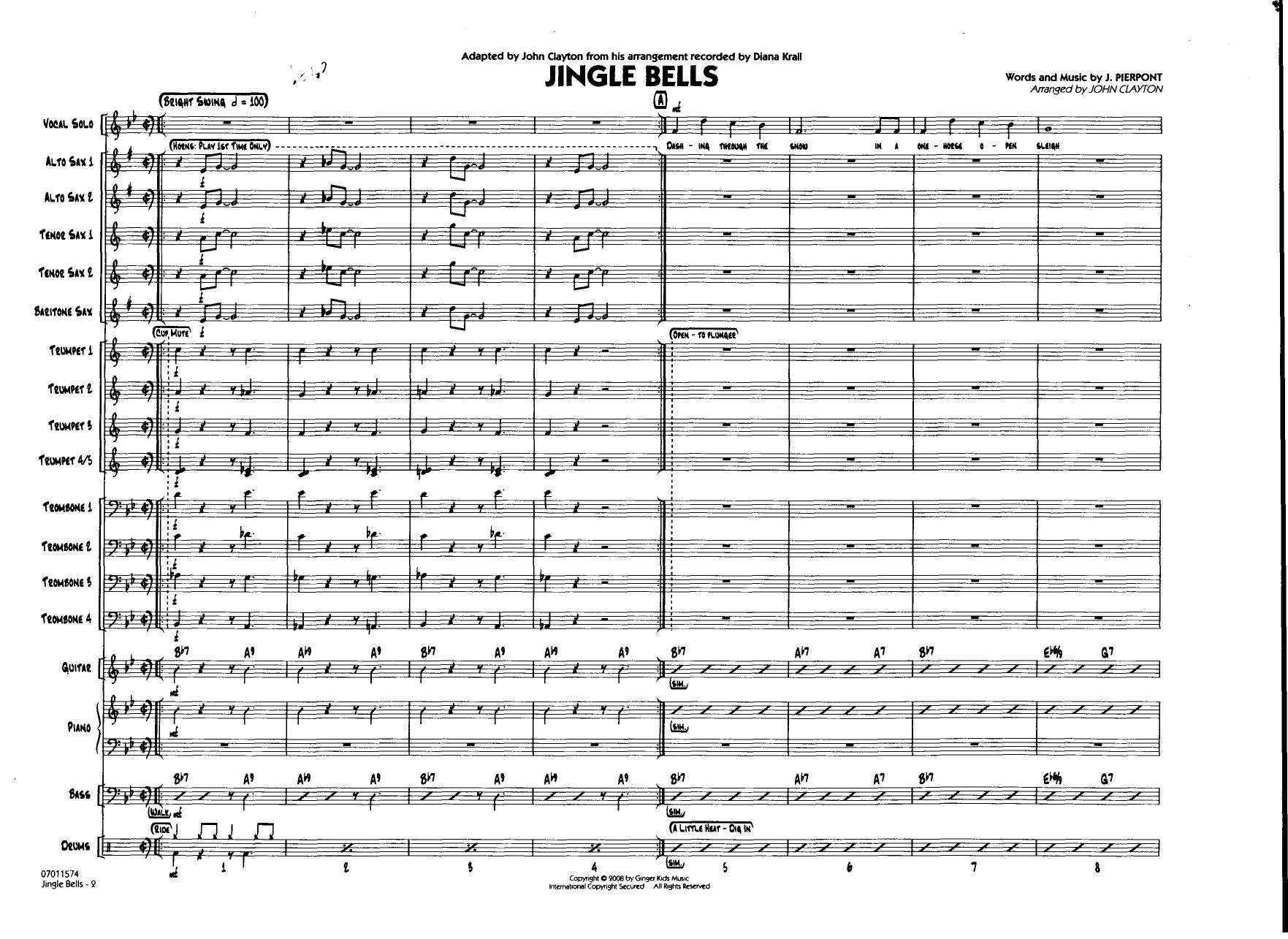
Jingle Bells (J.Clayton)
Composed by James Lord Pierpont
Arranged by John Clayton
- Ensemble: Big Band
- Pages: 80
- Instruments (19): Vocal Solo, Alto Sax 1, Alto Sax 2, Tenor Sax 1, Tenor Sax 2, Baritone Sax, Trumpet 1, Trumpet 2, Trumpet 3, Trumpet 4, Trumpet 5, Trombone 1, Trombone 2, Trombone 3, Trombone 4, Guitar, Piano, Bass, Drums
- Difficulty: advanced
- Content: Individual Parts
- Format: PDF Download (Instant)
- Price: $24.99
James Lord Pierpont originally published "Jingle Bells" in 1857 under the title "One Horse Open Sleigh," little knowing it would evolve into one of the most enduring secular holiday anthems in the American songbook. Over the decades, jazz icons from Duke Ellington to Benny Goodman transformed the tune into a vehicle for high-energy swing, proving that standard holiday fare could seamlessly assimilate into the idiom of American big band music. This timeless winter melody provides the thematic foundation for a sophisticated modern treatment crafted by one of the most respected masters of contemporary large ensemble writing. Master bassist, composer, and arranger John Clayton brings his signature elegance, harmonic sophistication, and deep-rooted swing feel to this definitive big band setting. The arrangement operates at a driving, infectious medium-up swing tempo (approximately 160–168 BPM), establishing an irrepressible groove from the opening measure. Clayton avoids cheap holiday gimmicks, opting instead for lush, sophisticated extended voicings, clever metric modulations, and razor-sharp ensemble writing that honors the jazz tradition while keeping the harmonic palette fresh and contemporary. The mood shifts effortlessly from playful, teasing interplay between the brass and reed sections to explosive, roaring shout choruses that demand total commitment from the ensemble. Clayton’s meticulous craftsmanship shines through in the structural pacing of the chart. The melody is introduced through clever sectional fragmentation, passing seamlessly from the saxophones to the brass before locking into a tightly-knit soli section that showcases the saxophones at their lyrical best. Advanced harmonic substitutions enrich the familiar changes, while well-placed dynamic contrasts build relentless tension leading into the main solo rotation and the subsequent grand climax. The rhythm section functions as the beating heart of the chart, requiring a sophisticated drummer who can master walking bass support and crisp ride-cymbal definition, alongside a pianist comfortable with comping sparse, tasteful Bud Powell- or Oscar Peterson-style voicings. Advanced high school, collegiate, and professional big bands will find this 80-page arrangement an exhilarating centerpiece for winter concert programming or festival performances. While the technical demands—particularly regarding precision articulation, dynamic control, and endurance—require an ensemble with solid foundational experience, the sheer joy and compositional brilliance embedded in every measure make the rehearsal process deeply rewarding. Clayton’s arrangement transforms a familiar holiday tune into a masterclass in modern big band swing, ensuring an unforgettable experience for both performers and audiences alike. Success with John Clayton’s chart hinges entirely on the rhythm section establishing an unhurried, buoyant medium-up swing feel from the downbeat; avoid rushing the tempo, as the groove relies on a relaxed, behind-the-beat placement. Horn players must obsess over uniform articulation, particularly matching short, crisp staccato notes and controlled fall-offs in the brass section to prevent the texture from muddying. The dynamic contrast is extreme—take the piano and guitar dynamics down to a whisper during the harmonized horn backgrounds to let the featured soloists project naturally without forcing their tone. During the sax soli, ensure the lead alto balances the section by riding the top of the voicings with a warm, projecting acoustic tone. Rehearsals should isolate the syncopated ensemble figures at slower tempos before pushing toward performance speed, paying strict attention to the razor-sharp placement of off-beat accents. Q: What instruments and parts are included in this arrangement? A: Scored for a standard big band configuration spanning 80 total pages, the chart includes parts for Alto Saxophone 1-2, Tenor Saxophone 1-2, Baritone Saxophone, Trumpet 1-4, Trombone 1-4, Piano, Guitar, Acoustic/Electric Bass, and Drum Set. Q: What is the difficulty level of this John Clayton arrangement? A: This arrangement is graded as advanced, making it best suited for accomplished collegiate, community, and professional big bands, as well as top-tier high school ensembles with strong section leaders and experienced rhythm section players. Q: What is the musical style and historical context of this version? A: Rooted in the classic American big band swing tradition, this arrangement reimagines James Lord Pierpont's 1857 holiday staple through a lens of sophisticated contemporary jazz harmony and dynamic ensemble pacing. Q: What makes this specific arrangement unique compared to other big band versions of "Jingle Bells"? A: John Clayton’s distinct compositional voice elevates the tune through clever sectional fragmentation, intricate harmonic substitutions, a brilliant saxophone soli, and a powerhouse shout chorus that avoids holiday clichés in favor of genuine jazz artistry. Q: What is the performance duration and suggested tempo for this chart? A: The arrangement runs approximately 3.5 to 4 minutes in duration when performed at the recommended medium-up swing tempo of roughly 160 to 168 beats per minute.
Questions and answers
- What is included in the Jingle Bells (J.Clayton) PDF?
- The verified current file contains a conductor score and individual parts across 80 pages.
- How many instruments or parts are listed for Jingle Bells (J.Clayton)?
- The verified instrumentation list contains 19 entries for this Big Band arrangement.
- Who is credited for Jingle Bells (J.Clayton)?
- Composer: James Lord Pierpont. Arranger: John Clayton.
- What difficulty is listed for Jingle Bells (J.Clayton)?
- The verified difficulty level is advanced.
- Can I preview Jingle Bells (J.Clayton) before buying?
- Yes. The product page provides a preview generated from the current PDF file.
- How is Jingle Bells (J.Clayton) delivered?
- After successful payment, the digital PDF is made available for download. The displayed price is $24.99.
Musicians Also Search For
Jingle Bells John Clayton PDF • Jingle Bells John Clayton sheet music • Jingle Bells arranged by John Clayton • John Clayton big band charts • John Clayton jazz arrangements PDF • Jingle Bells James Lord Pierpont sheet music • Jingle Bells James Lord Pierpont big band arrangements • James Lord Pierpont big band charts • Jingle Bells big band arrangements • Jingle Bells big band PDF download • Jingle Bells jazz sheet music • big band sheet music download • Jingle Bells conductor score PDF • Jingle Bells individual parts download • Jingle Bells sheet music PDF • buy Jingle Bells sheet music • download Jingle Bells PDF • Jingle Bells jazz charts • best John Clayton big band arrangements • James Lord Pierpont arranged by John Clayton • Jingle Bells printable sheet music • big band repertoire PDF