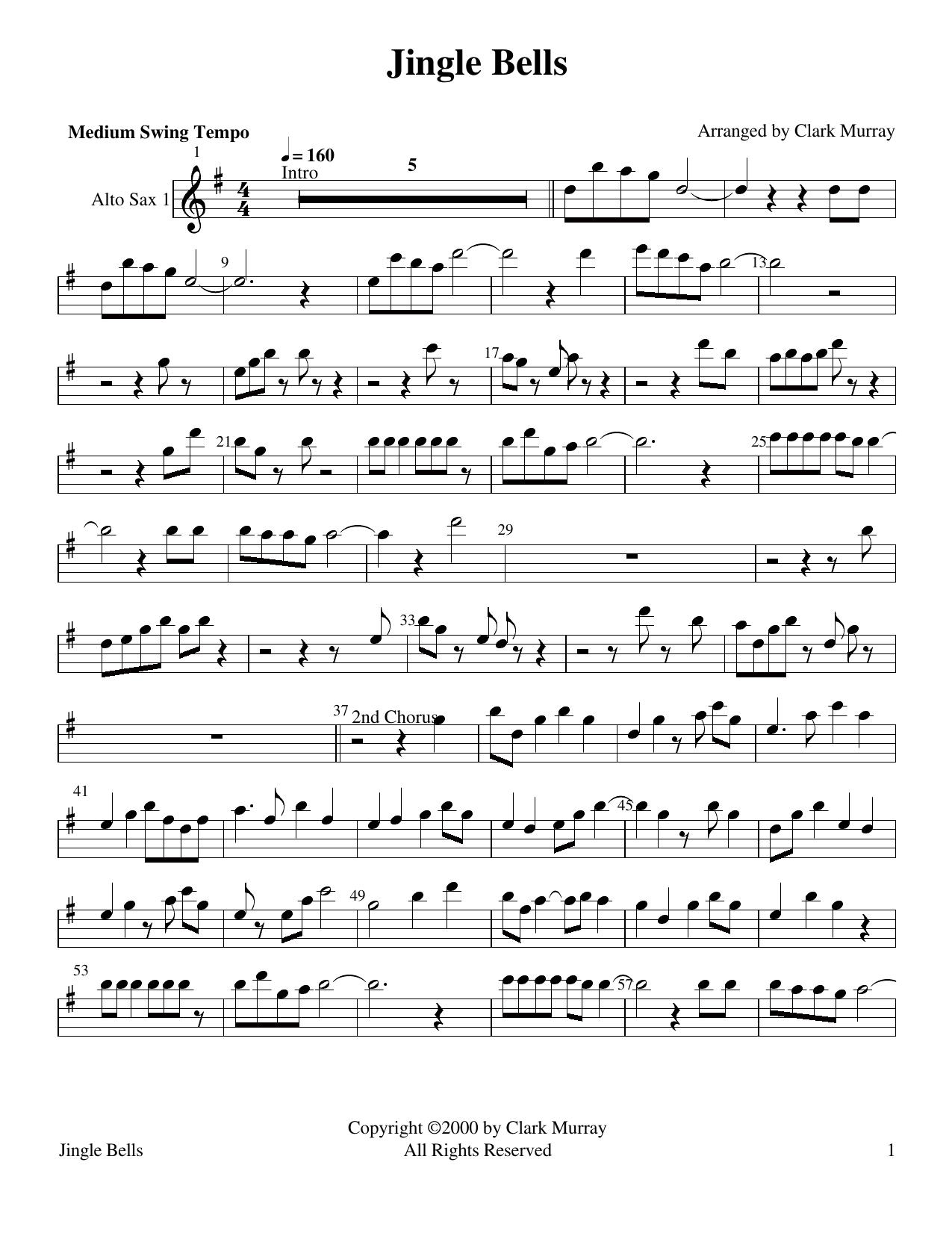
Jingle Bells (C.Murray) sheet music preview

Jingle Bells (C.Murray)

Composed by James Lord Pierpont

Arranged by C.Murray

  • Ensemble: Big Band
  • Style: Jazz Standard
  • Pages: 64
  • Instruments (16): Alto Sax 1, Alto Sax 2, Tenor Sax 1, Tenor Sax 2, Baritone Sax, Trumpet 1, Trumpet 2, Trumpet 3, Trumpet 4, Trombone 1, Trombone 2, Trombone 3, Trombone 4, Piano, Bass, Drums
  • Difficulty: advanced
  • Content: Individual Parts
  • Format: PDF Download (Instant)
  • Price: $24.99

James Lord Pierpont originally published "Jingle Bells" in 1857 under the title "One Horse Open Sleigh," little knowing that his secular winter tune would become one of the most malleable canvases in the American songbook. Over the decades, jazz icons from Duke Ellington to Benny Goodman transformed the ubiquitous melody into a vehicle for syncopated swing, utilizing its durable pentatonic phrasing and driving rhythmic profile. Within the jazz canon, holiday standards occupy a unique space where familiar seasonal motifs collide with sophisticated harmonic language, allowing big bands to showcase both crowd-pleasing accessibility and rigorous artistic depth. Swinging at a bright, infectious medium-up tempo, C.Murray’s big band treatment injects a vibrant, straight-ahead energy into the classic theme while maintaining a sophisticated, modern-mainstream harmonic palette. The arrangement opens with a crisp, hi-hat-driven groove before introducing the head through a clever, harmonically rich sax soli that re-imagines Pierpont’s melody with altered dominants and extended chord extensions. The mood shifts effortlessly from playful irony to a soaring, high-octane excitement, driven by punchy brass background figures and relentless swing momentum. The secondary bridge introduces a sophisticated minor-mode modulation that thickens the texture before launching into a powerhouse shout chorus designed to rattle the back walls of any auditorium. C.Murray demonstrates a masterclass in dynamic contrast and section-interplay throughout the 64-page score, ensuring that the heavy 16-instrument big band instrumentation remains transparent and balanced. The melody is shared democratically across the sections, passing seamlessly from a tight alto-led saxophone choir to open, brass-heavy ensemble passages with tasteful plunger and cup-mute colorations. Solos are open-ended for flexibility, providing dedicated blowing changes over a blues-infused AABA form that accommodates featured improvisers on trumpet or tenor saxophone. Technical demands center primarily on clean articulation, accurate execution of fast swing eighth notes, and maintaining uniform time feel across shifting ensemble textures during the more intricate modulatory transitional passages. Advanced high school ensembles with strong section players, as well as collegiate and professional community jazz orchestras, will find this chart an ideal centerpiece for winter concerts or festive spring repertoire. The arrangement strikes a rare balance: it is instantly recognizable to audiences yet musically challenging enough to engage sophisticated players through its clever reharmonizations and demanding ensemble interplay. Conductor and band alike will appreciate how the meticulous score and parts foster tight ensemble cohesion, making it a rewarding, show-stopping addition to any advanced jazz ensemble's library. Achieving an authentic jazz execution of C.Murray’s chart requires strict adherence to traditional swing eighth-note interpretation, ensuring that upbeats are naturally accented and compressed, particularly during the faster thematic statements. The rhythm section acts as the primary engine; the drummer should drive the ensemble with a crisp ride-cymbal pattern and sharp two-and-four hi-hat chokes, avoiding excessive heavy-handedness on the backbeat. Horn players must pay close attention to dynamic markings during the muted brass sections, ensuring that background figures never obscure the primary melodic voice carried by the saxophones. Brass players should prepare standard big band effects—including gentle falls and controlled doits—to match the playful yet sophisticated articulation style requested in the score. Rehearsals should initially focus on locking in the syncopated unison figures between the saxophones and trombones at a reduced tempo before accelerating to the marked performance speed. Q: What instrumentation and parts are included in this arrangement? A: The 64-page publication features a complete 16-instrument big band lineup, including a full conductor score, two alto saxophones, two tenor saxophones, baritone saxophone, standard brass sections, and a complete rhythm section. Q: What is the difficulty level of this big band chart? A: This arrangement is graded as advanced, making it best suited for accomplished high school jazz bands, collegiate ensembles, and professional community big bands due to its intricate harmonies and technical agility requirements. Q: How does this chart fit into the jazz repertoire historically? A: It builds upon the rich tradition of jazz holiday interpretations, transforming James Lord Pierpont's 1857 seasonal tune into a sophisticated, swinging vehicle reminiscent of classic mid-century big band arrangements. Q: What makes C.Murray’s arrangement unique compared to other versions of this song? A: It stands out through its clever reharmonizations, minor-mode bridge modulation, brilliant sax soli, and a powerful, multi-tiered shout chorus that elevates a simple holiday tune into a serious jazz chart. Q: What is the approximate performance duration and tempo feel? A: The arrangement runs for roughly 3.5 to 4 minutes and is set in a bright, driving 4/4 medium-up swing feel designed to keep both the band and audience fully engaged.

Questions and answers

What is included in the Jingle Bells (C.Murray) PDF?
The verified current file contains a conductor score and individual parts across 64 pages.
How many instruments or parts are listed for Jingle Bells (C.Murray)?
The verified instrumentation list contains 16 entries for this Big Band arrangement.
Who is credited for Jingle Bells (C.Murray)?
Composer: James Lord Pierpont. Arranger: C.Murray.
What difficulty is listed for Jingle Bells (C.Murray)?
The verified difficulty level is advanced.
What style is listed for Jingle Bells (C.Murray)?
The catalog lists the style as Jazz Standard.
Can I preview Jingle Bells (C.Murray) before buying?
Yes. The product page provides a preview generated from the current PDF file.
How is Jingle Bells (C.Murray) delivered?
After successful payment, the digital PDF is made available for download. The displayed price is $24.99.

Musicians Also Search For

Jingle Bells C.Murray PDFJingle Bells C.Murray sheet musicJingle Bells arranged by C.MurrayC.Murray big band chartsC.Murray jazz arrangements PDFJingle Bells James Lord Pierpont sheet musicJingle Bells James Lord Pierpont big band arrangementsJames Lord Pierpont big band chartsJingle Bells big band arrangementsJingle Bells big band PDF downloadJingle Bells jazz sheet musicbig band sheet music downloadJingle Bells conductor score PDFJingle Bells individual parts downloadJingle Bells sheet music PDFJingle Bells Jazz Standard chartsJazz Standard big band arrangementsbuy Jingle Bells sheet musicdownload Jingle Bells PDFJingle Bells jazz chartsbest C.Murray big band arrangementsJames Lord Pierpont arranged by C.MurrayJingle Bells printable sheet musicbig band repertoire PDF

All arrangements by C.Murray All James Lord Pierpont sheet music