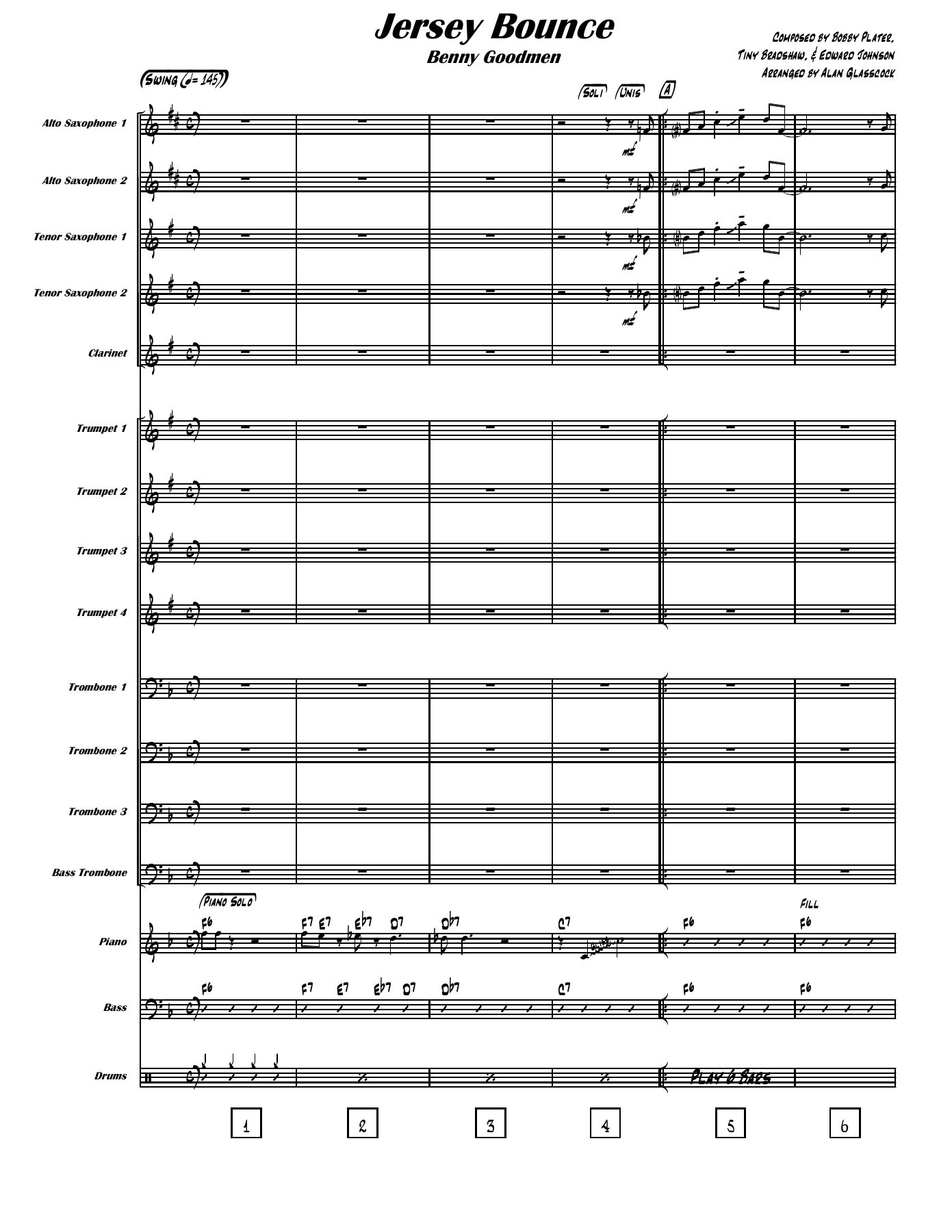
Jersey Bounce (A.measures)
Composed by Edward Johnson
Arranged by Alan Glasscock - Benny Goodman - 89 measures
- Ensemble: Big Band
- Style: Jazz Standard
- Pages: 39
- Instruments (16): Alto Saxophone 1, Alto Saxophone 2, Tenor Saxophone 1, Tenor Saxophone 2, Clarinet, Trumpet 1, Trumpet 2, Trumpet 3, Trumpet 4, Trombone 1, Trombone 2, Trombone 3, Bass Trombone, Piano/Guitar, Bass, Drums
- Difficulty: medium
- Content: Individual Parts
- Format: PDF Download (Instant)
- Price: $24.99
"Jersey Bounce," originally composed by Edward Johnson, Bobby Plater, Tiny Bradshaw, and Buddy Feyne, burst onto the American music scene in 1941, quickly becoming a quintessential jazz standard of the Swing Era. Its infectious melody and driving rhythm captured the optimistic spirit of the early 1940s, a time when big bands dominated the airwaves and dance halls. The tune was famously popularized by the Benny Goodman Orchestra, whose iconic 1942 recording cemented its place in the jazz canon, showcasing Goodman's unparalleled clarinet virtuosity and his band's tight, energetic ensemble playing. It embodies the classic medium-up swing feel, characterized by a buoyant 4/4 meter, a bright tempo, and a melodic construction that is both memorable and conducive to improvisation. The original typically features a clear AABA form, making it a staple for both dancers and listeners. This particular arrangement, credited to Alan Glasscock and drawing inspiration from the Benny Goodman tradition, meticulously captures the authentic mid-century big band sound while offering a fresh, yet respectful, interpretation. Glasscock's treatment maintains the original's bright, medium-swing feel, typically set in the key of F major, evoking a mood of sophisticated exuberance. The arrangement opens with a classic big band fanfare, immediately establishing the piece's energetic character. Throughout its 89 measures, Glasscock employs crisp, articulate voicings, particularly in the saxophone soli sections, which are a highlight, showcasing intricate melodic lines passed between the alto and tenor sections. The brass writing is punchy and precise, featuring well-placed ensemble hits that drive the momentum forward without overpowering the melodic content. Performance-wise, the melody is primarily carried by the saxophone section, often in unison or tight harmonies, with brass interjections providing rhythmic punctuation and harmonic color. There are ample opportunities for featured solos, typically for Tenor Saxophone and Trumpet, allowing improvisers to explore the tune's familiar harmonic progression. Glasscock's arrangement includes a powerful shout chorus that builds dynamically, culminating in a full-band ensemble section that is both thrilling and challenging. Technical demands include precise articulation in the saxes, clean brass attacks, and a consistent, driving swing feel from the rhythm section. The rewarding aspect lies in achieving the collective energy and precision characteristic of a top-tier swing band, making it an excellent vehicle for developing ensemble cohesion and stylistic authenticity. This arrangement is ideally suited for college-level jazz ensembles, advanced high school bands, and community big bands seeking to perform an iconic swing standard with authenticity and flair. The detailed scoring and clear stylistic direction provide a robust framework for musicians to engage with the nuances of the Swing Era, while the technical challenges offer significant growth opportunities in ensemble playing, articulation, and dynamic control. Its rich historical context and enduring popularity make it a crowd-pleaser that also serves as a valuable educational tool for understanding classic big band arranging techniques. Conductors should aim for a bright, medium-up swing tempo, around quarter note = 180-200 BPM, ensuring a consistent, driving feel without rushing. The rhythm section needs to establish a strong, four-on-the-floor swing groove from the outset, with the bass providing a walking line and the drums emphasizing the ride cymbal pattern. Articulation is paramount; saxophones should strive for crisp, detached eighth notes in soli sections, while brass attacks must be precise and unified. Pay close attention to dynamic contrasts, particularly in the build-up to the shout chorus, ensuring a clear dynamic arc. Encourage soloists to embrace the melodic and rhythmic vocabulary of the Swing Era. Rehearsal time should focus on clean ensemble releases, balanced voicings within sections, and the rhythmic accuracy of the brass interjections. Q: What instruments are included in this arrangement of "Jersey Bounce (A.measures)"? A: This big band arrangement includes parts for 17 instruments: Alto Saxophone 1, Alto Saxophone 2, Tenor Saxophone 1, Tenor Saxophone 2, Baritone Saxophone, Trumpet 1, Trumpet 2, Trumpet 3, Trumpet 4, Trombone 1, Trombone 2, Trombone 3, Trombone 4, Piano, Bass, Drums, and Guitar. Q: What is the difficulty level of this arrangement? A: This arrangement is considered advanced high school to college level. It requires proficient instrumentalists capable of navigating intricate soli passages, precise ensemble articulation, and maintaining a consistent, driving medium-up swing feel. Q: What is the musical style and historical context of "Jersey Bounce (A.measures)"? A: "Jersey Bounce" is a classic jazz standard from the Swing Era (early 1940s), popularized by the Benny Goodman Orchestra. This arrangement captures the authentic medium-up swing style, reflecting the energetic and danceable big band sound of that period. Q: What makes this specific arrangement by Alan Glasscock unique? A: Alan Glasscock's arrangement, inspired by Benny Goodman, is distinguished by its authentic Swing Era voicings, particularly in the intricate saxophone soli sections, precise brass writing, and a powerful shout chorus. It faithfully recreates the classic sound while offering a well-crafted interpretation. Q: What is the approximate performance duration of this arrangement? A: This arrangement spans 89 measures. At a typical medium-up swing tempo of around quarter note = 180-200 BPM, the performance duration is approximately 2 minutes and 30 seconds to 3 minutes, depending on the length of improvised solos.
Questions and answers
- What is included in the Jersey Bounce (A.measures) PDF?
- The verified current file contains a conductor score and individual parts across 39 pages.
- How many instruments or parts are listed for Jersey Bounce (A.measures)?
- The verified instrumentation list contains 16 entries for this Big Band arrangement.
- Who is credited for Jersey Bounce (A.measures)?
- Composer: Edward Johnson. Arranger: Alan Glasscock - Benny Goodman - 89 measures.
- What difficulty is listed for Jersey Bounce (A.measures)?
- The verified difficulty level is medium.
- What style is listed for Jersey Bounce (A.measures)?
- The catalog lists the style as Jazz Standard.
- Can I preview Jersey Bounce (A.measures) before buying?
- Yes. The product page provides a preview generated from the current PDF file.
- How is Jersey Bounce (A.measures) delivered?
- After successful payment, the digital PDF is made available for download. The displayed price is $24.99.
Musicians Also Search For
Jersey Bounce Alan Glasscock - Benny Goodman - 89 measures PDF • Jersey Bounce Alan Glasscock - Benny Goodman - 89 measures sheet music • Jersey Bounce arranged by Alan Glasscock - Benny Goodman - 89 measures • Alan Glasscock - Benny Goodman - 89 measures big band charts • Alan Glasscock - Benny Goodman - 89 measures jazz arrangements PDF • Jersey Bounce Edward Johnson sheet music • Jersey Bounce Edward Johnson big band arrangements • Edward Johnson big band charts • Jersey Bounce big band arrangements • Jersey Bounce big band PDF download • Jersey Bounce jazz sheet music • big band sheet music download • Jersey Bounce conductor score PDF • Jersey Bounce individual parts download • Jersey Bounce sheet music PDF • Jersey Bounce Jazz Standard charts • Jazz Standard big band arrangements • buy Jersey Bounce sheet music • download Jersey Bounce PDF • Jersey Bounce jazz charts • best Alan Glasscock - Benny Goodman - 89 measures big band arrangements • Edward Johnson arranged by Alan Glasscock - Benny Goodman - 89 measures • Jersey Bounce printable sheet music • big band repertoire PDF