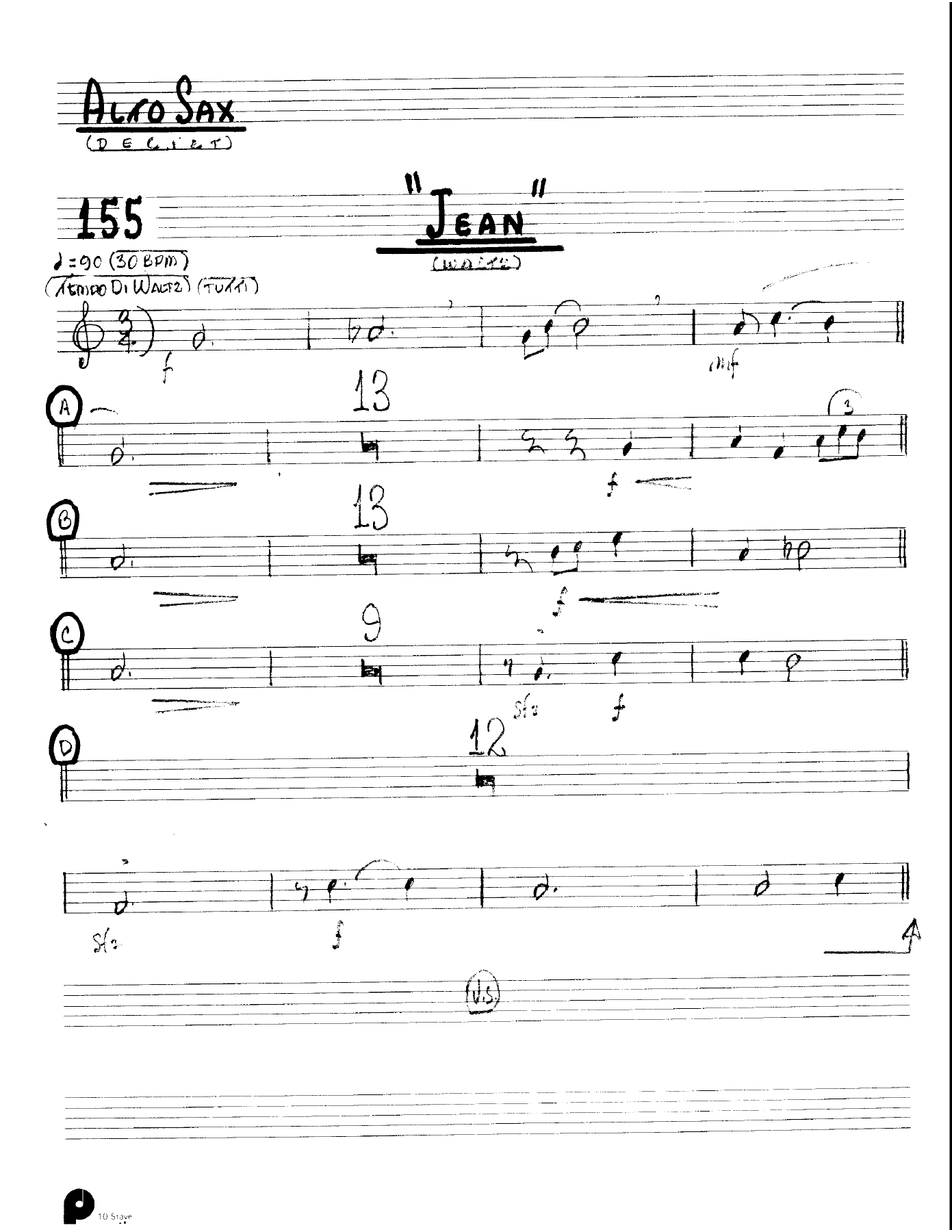
Jean (Kenton Dectet #155) sheet music preview

Jean (Kenton Dectet #155)

Composed by Rod McKuen

Arranged by Stan Kenton Dected 176

  • Ensemble: Small Ensemble
  • Style: Jazz Standard
  • Pages: 23
  • Instruments (9): Alto Sax, Tenor Sax, Baritone Sax, Trumpet 1, Trumpet 2, Trombone, Piano, Bass, Drums
  • Difficulty: easy
  • Content: Individual Parts
  • Format: PDF Download (Instant)
  • Price: $12.99

Rod McKuen's poignant ballad "Jean" first captivated audiences in 1969 as the theme song for the film *The Prime of Miss Jean Brodie*, quickly ascending to the top of the charts and earning an Academy Award nomination for Best Original Song. While not traditionally a jazz standard at its inception, its enduring melodic beauty and harmonic depth have made it a compelling canvas for jazz interpretation, much like other popular tunes of its era. This particular arrangement, "Jean (Kenton Dectet #155)", offers a distinctive small ensemble take on the tune, showcasing the sophisticated and often dramatic approach synonymous with the Stan Kenton Dectet 176 style. The original piece, imbued with a wistful, reflective mood, speaks to themes of fleeting beauty and cherished memories, qualities that are amplified and recontextualized within this jazz setting. The arrangement unfolds at a reflective medium-slow ballad tempo, typically around 60-70 beats per minute, maintaining the original's tender emotional core while infusing it with subtle jazz inflections. The primary key of F major, with judicious modulations, allows for both warmth and moments of harmonic tension and release. Expect rich, often dense voicings characteristic of the Kenton sound, even within this smaller instrumentation. The mood is one of introspective elegance, evoking a sense of nostalgic beauty rather than overt swing or fiery improvisation. The energy is sustained through careful dynamic shaping and the interplay between the voices, creating a sustained emotional arc that rewards careful listening and nuanced performance. Stan Kenton Dectet 176's treatment of "Jean" is immediately recognizable for its sophisticated harmonic language and meticulous scoring. The arrangement opens with a lush, almost orchestral introduction, setting a contemplative tone before the melody emerges. The lead voice often shifts, featuring the trumpet, trombone, and alto saxophone in various melodic roles, sometimes in unison, sometimes in close harmony. Expect characteristic Kenton-esque block chord voicings and intricate counter-melodies that weave through the texture. While there isn't a traditional "shout chorus" in the big band sense, the arrangement builds to a powerful, harmonically rich climax before returning to a more subdued, reflective coda. The technical challenges lie in achieving precise balance and blend within the complex voicings, maintaining intonation through sustained phrases, and executing the subtle dynamic shifts that are crucial to the emotional impact. A featured improvisational section, typically for a melodic instrument like trumpet or alto saxophone, provides an opportunity for expressive soloing over the rich harmonic progression. This arrangement is ideally suited for college-level jazz ensembles, advanced community bands, or professional small groups seeking a challenging yet deeply rewarding piece. The demands on individual musicians for intonation, blend, and musicality are significant, requiring mature players who can navigate complex harmonies and contribute to a cohesive ensemble sound. Its 23 pages are packed with musical substance, offering a substantial and memorable addition to any concert program. The sheer beauty of McKuen's melody, filtered through the distinctive lens of Stan Kenton Dectet 176, makes "Jean" a truly special performance experience. Conductors should emphasize precise intonation and blend, particularly in the dense, sustained chord voicings that are a hallmark of this arrangement. The medium-slow ballad tempo (around quarter note = 60-70 BPM) requires a steady pulse and careful attention to rhythmic subdivision to maintain forward motion without rushing or dragging. Encourage musicians to listen across the ensemble, especially in the soli sections, to achieve a unified sound. Dynamics are critical; the arrangement features a wide dynamic range, from hushed pianissimos to full-bodied fortissimos, and these must be executed with sensitivity to convey the emotional depth. While specific special techniques are minimal, a warm, controlled vibrato is essential for the melodic lines, and subtle falls or scoops can be employed tastefully on sustained notes to enhance the jazz aesthetic. Rehearsal time should focus on balancing the intricate inner voices and shaping the long melodic phrases, ensuring that the emotional arc of the piece is clearly communicated. Q: What instruments are included in this arrangement? A: This small ensemble arrangement typically includes parts for trumpet, trombone, alto saxophone, tenor saxophone, baritone saxophone, piano, bass, and drums, reflecting a common Kenton Dectet instrumentation. Q: What is the difficulty level of "Jean (Kenton Dectet #155)"? A: This arrangement is considered advanced, suitable for college-level jazz ensembles, advanced community bands, or professional small groups due to its complex harmonies, intricate voicings, and demands on individual musicianship and blend. Q: What is the musical style and historical context of this arrangement? A: This is a jazz standard arrangement of Rod McKuen's 1969 ballad "Jean," presented in the sophisticated, harmonically rich style characteristic of the Stan Kenton Dectet 176, blending the original's reflective mood with jazz improvisation and voicings. Q: What makes this arrangement unique compared to other versions of "Jean"? A: Its uniqueness lies in the distinctive Stan Kenton Dectet 176 treatment, featuring lush, often dense voicings, intricate counter-melodies, and a sophisticated harmonic approach that reinterprets the original ballad with a signature jazz elegance. Q: What is the typical performance duration or tempo for this piece? A: The arrangement is performed at a medium-slow ballad tempo, generally around 60-70 beats per minute, resulting in a performance duration of approximately 4-5 minutes, depending on the improvisational section.

Questions and answers

What is included in the Jean (Kenton Dectet #155) PDF?
The verified current file contains individual parts across 23 pages.
How many instruments or parts are listed for Jean (Kenton Dectet #155)?
The verified instrumentation list contains 9 entries for this Small Ensemble arrangement.
Who is credited for Jean (Kenton Dectet #155)?
Composer: Rod McKuen. Arranger: Stan Kenton Dected 176.
What difficulty is listed for Jean (Kenton Dectet #155)?
The verified difficulty level is easy.
What style is listed for Jean (Kenton Dectet #155)?
The catalog lists the style as Jazz Standard.
Can I preview Jean (Kenton Dectet #155) before buying?
Yes. The product page provides a preview generated from the current PDF file.
How is Jean (Kenton Dectet #155) delivered?
After successful payment, the digital PDF is made available for download. The displayed price is $12.99.

Musicians Also Search For

Jean Stan Kenton Dected 176 PDFJean Stan Kenton Dected 176 sheet musicJean arranged by Stan Kenton Dected 176Stan Kenton Dected 176 small ensemble chartsStan Kenton Dected 176 jazz arrangements PDFJean Rod McKuen sheet musicJean Rod McKuen small ensemble arrangementsRod McKuen small ensemble chartsJean small ensemble arrangementsJean small ensemble PDF downloadJean jazz sheet musicsmall ensemble sheet music downloadJean individual parts downloadJean sheet music PDFJean Jazz Standard chartsJazz Standard small ensemble arrangementsbuy Jean sheet musicdownload Jean PDFJean jazz chartsbest Stan Kenton Dected 176 small ensemble arrangementsRod McKuen arranged by Stan Kenton Dected 176Jean printable sheet musicsmall ensemble repertoire PDF

All arrangements by Stan Kenton Dected 176 All Rod McKuen sheet music