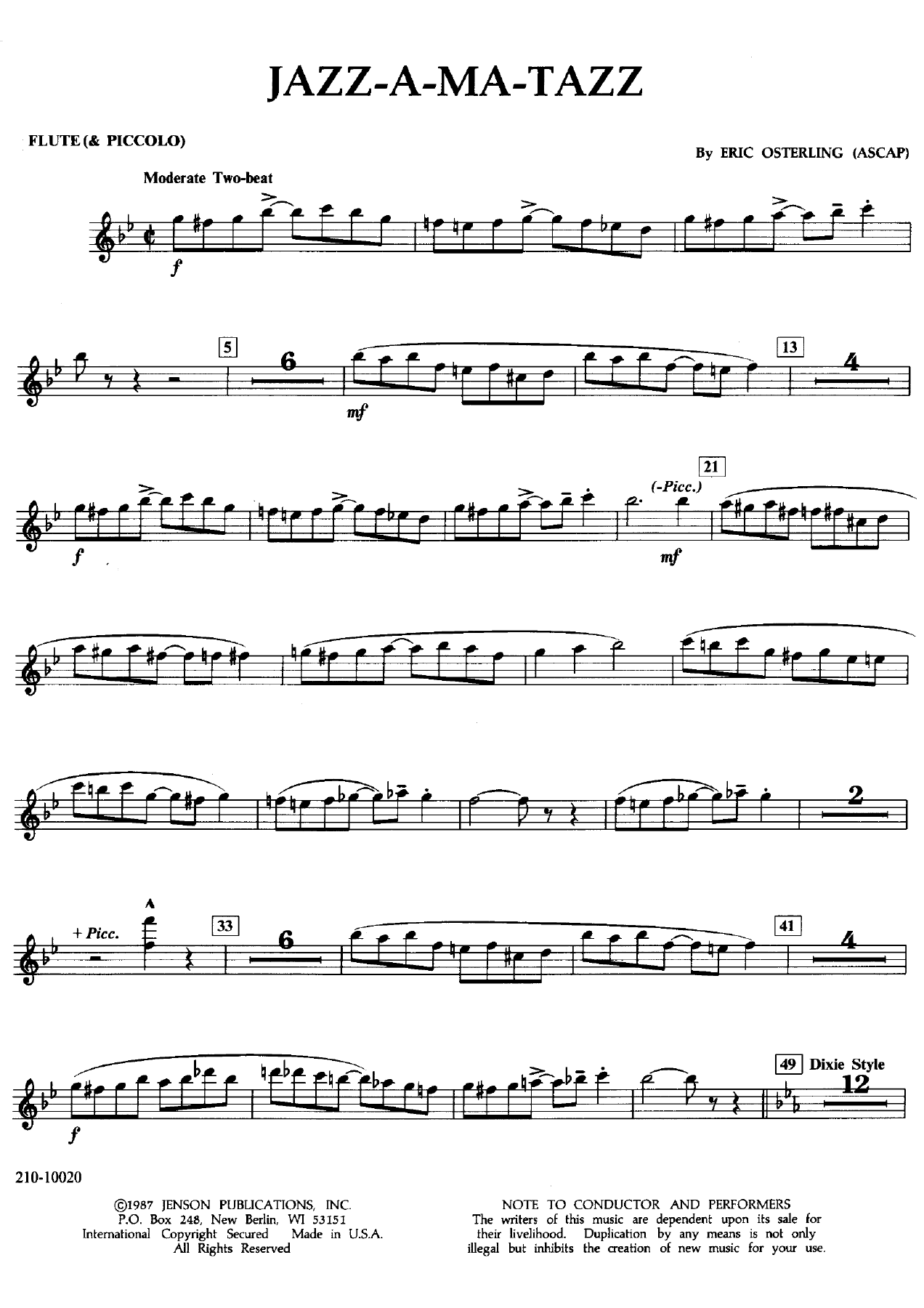
Jazz-A-Ma-Tazz (E.Osterling)
Composed by Eugene Osterling
Arranged by E.Osterling
- Ensemble: Concert Band
- Style: Swing
- Pages: 72
- Instruments (32): Flute (& Piccolo), Oboe, Bb Clarinet 1, Bb Clarinet 2, Bb Clarinet 3, Eb Alto Clarinet, Bb Bass Clarinet, Bassoon, Eb Alto Saxophone 1, Eb Alto Saxophone 2, Bb Tenor Saxophone, Eb Baritone Saxophone, Bb Trumpet 1, Bb Trumpet 2, Bb Trumpet 3, Eb Horn 1, Eb Horn 2, F Horn 1, F Horn 2, Trombone 1, 1st Trombone Bb, Trombone 2, Bb Trombone 2, Baritone B.C., Baritone T.C., Bb Bass, Tuba, String Bass, Percussion I (Optional Drum Set), Percussion II, Mallet Percussion, Timpani
- Difficulty: advanced
- Content: Individual Parts
- Format: PDF Download (Instant)
- Price: $22.99
Eugene Osterling's "Jazz-A-Ma-Tazz" stands as a foundational work within the concert band jazz repertoire, representing the vibrant energy and accessible swing style that characterized mid-20th century American music education. Composed by Osterling himself, this original piece is not a jazz standard in the traditional sense but has become a pedagogical standard, introducing countless young musicians to the nuances of big band swing. Its enduring popularity stems from its ability to capture the essence of the swing era—an era defined by danceable rhythms, catchy melodies, and the infectious interplay between sections—in a format perfectly suited for developing concert bands. It embodies the spirit of classic big band charts from the 1940s and 50s, without the inherent complexity often found in professional-level arrangements. Musically, "Jazz-A-Ma-Tazz" is a quintessential medium swing piece, typically performed in a bright 4/4 tempo, often around 120-140 BPM. The primary key is generally Bb Major, offering a comfortable range for most wind instruments, with occasional excursions to related keys or modal inflections that add harmonic interest without undue difficulty. The mood is consistently upbeat and celebratory, evoking the joyous, foot-tapping energy of a classic dance hall. Its melodic lines are memorable and often feature call-and-response patterns, contributing to a lively and engaging soundscape. The piece is structured to highlight different sections of the band, building dynamic contrast and textural variety throughout its duration. E. Osterling's approach to arranging, particularly evident in "Jazz-A-Ma-Tazz," is characterized by clarity, effective scoring, and pedagogical foresight. His voicings are full and resonant, designed to make a developing concert band sound much larger and more cohesive than its individual parts might suggest. Expect well-crafted soli sections for the saxophones and brass, often in unison or tight block chords, which are both exciting to play and impactful to hear. While extended harmonies are used judiciously, they serve to color the swing feel rather than complicate it. Osterling's signature lies in his ability to create a genuine big band sound using standard concert band instrumentation, often employing percussion creatively to drive the swing rhythm without relying on a dedicated drum set. The piece features no improvised solos, ensuring every musician plays a written part, fostering ensemble precision and balance. Performance of "Jazz-A-Ma-Tazz" is highly rewarding for intermediate-level concert bands, typically high school, advanced middle school, or community ensembles. The main melodic themes are often carried by the trumpets and upper woodwinds, with counter-melodies and rhythmic accompaniment distributed effectively across the entire ensemble. Technical challenges are carefully managed; while there are moments requiring clean articulation and rhythmic precision, the ranges are accessible, and the rhythmic figures are idiomatic to swing without being overly complex. The piece's inherent drive and the satisfaction of nailing its cohesive swing feel make it a perennial favorite for both performers and audiences, serving as an excellent vehicle for teaching swing style, ensemble blend, and dynamic control within a concert band setting. "Jazz-A-Ma-Tazz" thrives on a consistent, driving medium swing feel. Conductors should emphasize a relaxed, yet precise, subdivision of the beat, encouraging musicians to internalize the "long-short" swing eighth-note pattern. A tempo range of quarter note = 120-140 BPM is ideal. Key technical challenges include maintaining clean articulation, particularly in brass soli sections, and ensuring rhythmic accuracy across the ensemble, especially during syncopated passages. Focus on dynamic contrast to bring out the call-and-response elements and build excitement towards the climactic moments. Rehearsal should prioritize listening across sections for balance and blend, ensuring the bass line (often low brass/low reeds) provides a solid foundation. No special techniques like plunger mutes or falls are explicitly required, allowing the focus to remain on fundamental swing performance practices. Q: What instruments are included in this arrangement of "Jazz-A-Ma-Tazz"? A: This concert band arrangement typically includes full instrumentation for standard concert band, such as flutes, oboes, clarinets, saxophones, trumpets, horns, trombones, euphonium, tuba, and a comprehensive percussion section. Specific part counts may vary slightly but cover the full spectrum of a traditional wind ensemble. Q: What is the difficulty level of "Jazz-A-Ma-Tazz (E.Osterling)"? A: This arrangement is considered to be at an intermediate level (Grade 3-3.5), making it highly suitable for high school concert bands, advanced middle school groups, and community ensembles. It presents accessible technical demands while effectively teaching swing style and ensemble performance. Q: What musical style and historical context does "Jazz-A-Ma-Tazz" represent? A: "Jazz-A-Ma-Tazz" is an original composition by Eugene Osterling in a classic medium swing style, reminiscent of the big band era of the mid-20th century. It embodies the energetic and accessible characteristics of swing music, making it an excellent introduction to the genre for concert bands. Q: What makes E. Osterling's arrangement of "Jazz-A-Ma-Tazz" unique? A: Osterling's arrangement is unique for its pedagogical effectiveness, providing a genuine big band swing sound through standard concert band instrumentation. It features clear voicings, engaging soli sections, and no improvised solos, focusing instead on ensemble precision, blend, and a cohesive swing feel. Q: What is the typical performance duration and tempo for this piece? A: The typical performance duration for "Jazz-A-Ma-Tazz" is approximately 2.5 to 3 minutes. It is best performed at a medium swing tempo, generally around 120-140 beats per minute (quarter note), to capture its intended energetic and danceable character.
Questions and answers
- What is included in the Jazz-A-Ma-Tazz (E.Osterling) PDF?
- The verified current file contains a conductor score and individual parts across 72 pages.
- How many instruments or parts are listed for Jazz-A-Ma-Tazz (E.Osterling)?
- The verified instrumentation list contains 32 entries for this Concert Band arrangement.
- Who is credited for Jazz-A-Ma-Tazz (E.Osterling)?
- Composer: Eugene Osterling. Arranger: E.Osterling.
- What difficulty is listed for Jazz-A-Ma-Tazz (E.Osterling)?
- The verified difficulty level is advanced.
- What style is listed for Jazz-A-Ma-Tazz (E.Osterling)?
- The catalog lists the style as Swing.
- Can I preview Jazz-A-Ma-Tazz (E.Osterling) before buying?
- Yes. The product page provides a preview generated from the current PDF file.
- How is Jazz-A-Ma-Tazz (E.Osterling) delivered?
- After successful payment, the digital PDF is made available for download. The displayed price is $22.99.
Musicians Also Search For
Jazz-A-Ma-Tazz E.Osterling PDF • Jazz-A-Ma-Tazz E.Osterling sheet music • Jazz-A-Ma-Tazz arranged by E.Osterling • E.Osterling concert band charts • E.Osterling jazz arrangements PDF • Jazz-A-Ma-Tazz Eugene Osterling sheet music • Jazz-A-Ma-Tazz Eugene Osterling concert band arrangements • Eugene Osterling concert band charts • Jazz-A-Ma-Tazz concert band arrangements • Jazz-A-Ma-Tazz concert band PDF download • Jazz-A-Ma-Tazz jazz sheet music • concert band sheet music download • Jazz-A-Ma-Tazz conductor score PDF • Jazz-A-Ma-Tazz individual parts download • Jazz-A-Ma-Tazz sheet music PDF • Jazz-A-Ma-Tazz Swing charts • Swing concert band arrangements • buy Jazz-A-Ma-Tazz sheet music • download Jazz-A-Ma-Tazz PDF • Jazz-A-Ma-Tazz jazz charts • best E.Osterling concert band arrangements • Eugene Osterling arranged by E.Osterling • Jazz-A-Ma-Tazz printable sheet music • concert band repertoire PDF