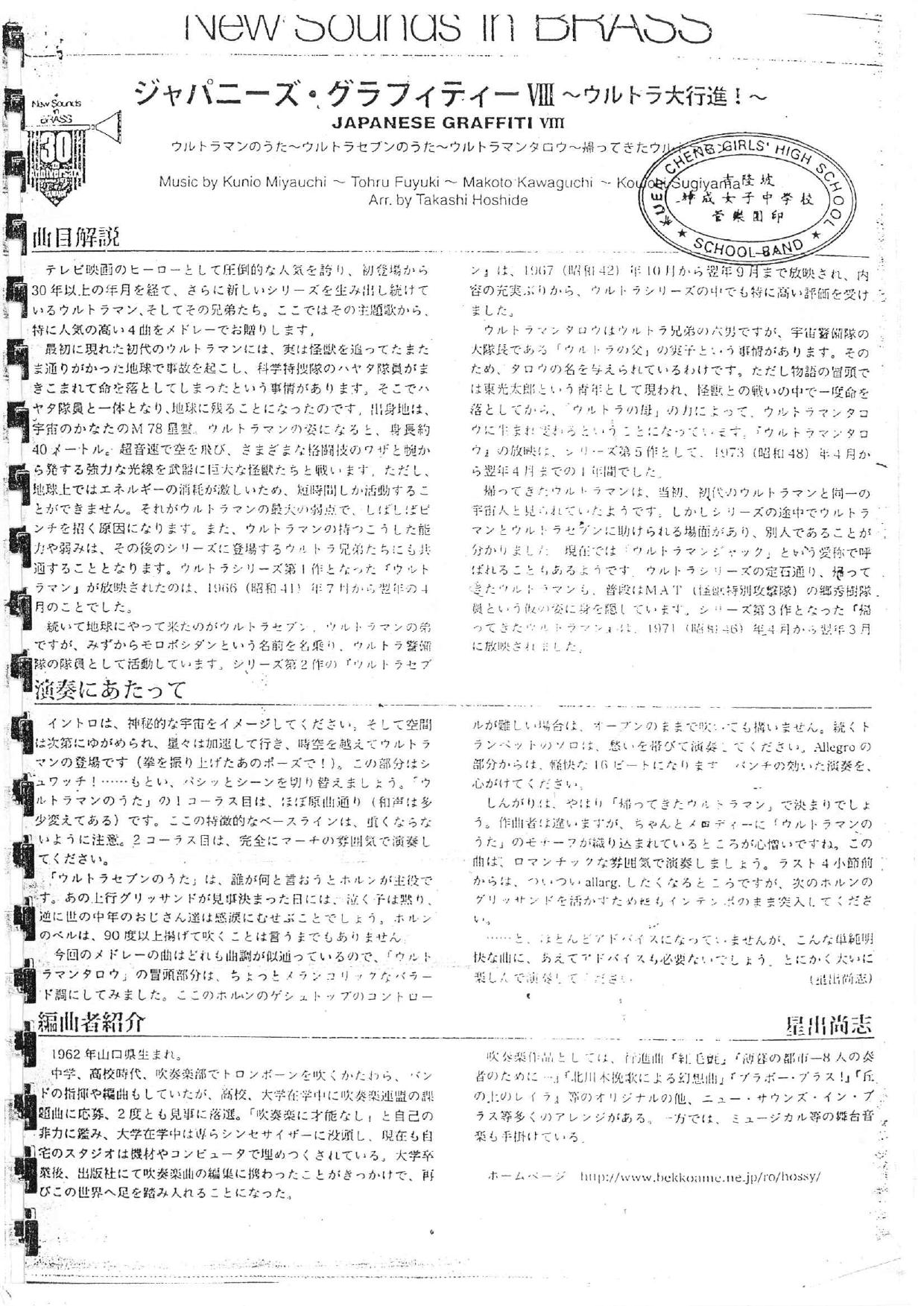
Japanese graffiti 8 conduct (T.Hoshide) sheet music preview

Japanese graffiti 8 conduct (T.Hoshide)

Composed by Kunio Miyauchi, Tohru Fuyuki, Makoto Kawaguchi

Arranged by Takashi Hoshide

  • Ensemble: Concert Band
  • Style: Jazz Standard
  • Pages: 30
  • Instruments (37): Piccolo, 1st Flute, 2nd Flute, Oboe, Bassoon, Eb Clarinet, 1st Bb Clarinet, 2nd Bb Clarinet, 3rd Bb Clarinet, Eb Alto Clarinet, Bb Bass Clarinet, 1st Eb Alto Saxophone, 2nd Eb Alto Saxophone, Bb Tenor Saxophone, Eb Baritone Saxophone, 1st Bb Trumpet, 2nd Bb Trumpet, 3rd Bb Trumpet, 1st Horn in F, 2nd Horn in F, 3rd Horn in F, 4th Horn in F, 1st Trombone, 2nd Trombone, Bass Trombone, Euphonium, Bass in C, Electric Bass, Electric Guitar, Drums, Timpani, Suspended Cymbal, Glockenspiel, Xylophone, Marimba, Tambourine, Wind Chime
  • Difficulty: medium
  • Content: Individual Parts
  • Format: PDF Download (Instant)
  • Price: $22.99

"Japanese Graffiti 8 Conduct (T. Hoshide)" presents a vibrant and sophisticated concert band arrangement of a medley of iconic Japanese television and film themes. While not a traditional "jazz standard" in the Western sense, this piece draws from a rich vein of popular Japanese music, often incorporating jazz-inflected harmonies and rhythmic sensibilities that resonate deeply with audiences. The original compositions, primarily by Kunio Miyauchi, Tohru Fuyuki, and Makoto Kawaguchi, hail from the mid-to-late 20th century, representing a golden age of Japanese pop culture and its accompanying soundtracks. These melodies are instantly recognizable to generations, evoking nostalgia and a sense of shared cultural heritage, making them ripe for reinterpretation in a jazz-influenced concert band setting. Takashi Hoshide’s arrangement transforms these familiar themes into a dynamic and engaging musical journey. The musical character is primarily an up-tempo, celebratory feel, often shifting between a driving swing and a powerful, fanfare-like march, punctuated by moments of lyrical beauty. Hoshide masterfully employs a variety of keys and harmonic colors, creating a sense of continuous evolution and surprise. The energy is consistently high, building through intricate soli sections and powerful tutti passages that showcase the full breadth of the concert band's capabilities. This arrangement evokes feelings of excitement, heroism, and playful nostalgia, making it a truly engaging experience for both performers and listeners. Hoshide's distinctive approach is evident in his masterful orchestration and harmonic ingenuity. He skillfully weaves the original melodic fragments through various sections of the band, ensuring every voice contributes to the rich tapestry. Expect sophisticated voicings that add a contemporary jazz sheen to the classic melodies, alongside powerful shout choruses that build to exhilarating climaxes. His arrangements are known for their meticulous attention to detail, often featuring intricate countermelodies and rhythmic interplay that demand precision from each section. The piece features prominent melodic lines carried by the trumpets, saxophones, and clarinets, often in call-and-response with the low brass and woodwinds. While there are no explicit improvised solos, Hoshide crafts compelling written soli sections that give the illusion of improvisation, showcasing individual sections. The technical challenges lie in maintaining rhythmic precision across complex syncopated figures, achieving blend and balance in dense harmonies, and executing rapid articulation. The reward is a thrilling performance that captivates with its blend of familiarity and fresh interpretation. This arrangement is ideally suited for advanced high school, collegiate, and community concert bands. Its demands on technical proficiency, rhythmic accuracy, and dynamic control require experienced musicians. The intricate ensemble writing and sophisticated harmonic language provide an excellent opportunity for bands to develop their jazz-inflected concert band performance skills, pushing their boundaries while performing beloved melodies. The piece's inherent popularity and energetic nature also make it a fantastic choice for concert closers or festival performances, guaranteed to leave a lasting impression. "Japanese Graffiti 8 Conduct (T. Hoshide)" thrives on rhythmic precision and dynamic contrast. The primary technical challenge lies in executing the rapid, often syncopated figures cleanly and uniformly across sections, particularly in the woodwind and brass soli passages. Conductors should emphasize a crystal-clear articulation, especially for eighth-note lines, to maintain the driving up-tempo feel. The piece benefits from a strong, consistent pulse, whether in the swing sections or the more march-like fanfares; a metronome should be a frequent companion in early rehearsals. Pay close attention to Hoshide's dynamic markings, as the dramatic shifts between forte and piano are crucial to the piece's character. Rehearsal tips include isolating challenging rhythmic motives for individual sections before reassembling, and focusing on intonation within the often dense, extended harmonies. While no special techniques like plunger mutes are explicitly required, encouraging a bright, energetic tone from the brass and a fluid, connected sound from the woodwinds will enhance the overall jazz aesthetic. Q: What instruments and parts are included in this arrangement? A: This concert band arrangement includes a full conductor score and individual parts for standard concert band instrumentation, typically encompassing flutes, oboes, bassoons, clarinets, saxophones, trumpets, horns, trombones, euphonium, tuba, string bass, and a comprehensive percussion section. Q: What is the difficulty level of "Japanese Graffiti 8 Conduct (T. Hoshide)"? A: This arrangement is considered advanced, suitable for high school, collegiate, and community concert bands with experienced musicians. It demands strong technical proficiency, rhythmic accuracy, and dynamic control from all sections. Q: What is the musical style and historical context of the pieces featured in this arrangement? A: The arrangement is a medley of popular Japanese television and film themes from the mid-to-late 20th century, primarily by Kunio Miyauchi, Tohru Fuyuki, and Makoto Kawaguchi. While not traditional jazz standards, Hoshide's arrangement reinterprets these melodies with a strong jazz-inflected concert band style, blending pop culture nostalgia with sophisticated harmonies. Q: What makes Takashi Hoshide's arrangement of "Japanese Graffiti 8 Conduct" unique? A: Hoshide's arrangement is distinguished by its masterful orchestration, sophisticated jazz-influenced voicings, intricate soli sections that mimic improvisation, and dynamic shifts that transform familiar melodies into a powerful and engaging concert band experience. Q: What is the typical performance duration or tempo for this piece? A: "Japanese Graffiti 8 Conduct (T. Hoshide)" is primarily an up-tempo piece with a driving, celebratory feel, often shifting between swing and fanfare-like sections. The exact performance duration will vary slightly with interpretation but typically falls within the 6-8 minute range.

Questions and answers

What is included in the Japanese graffiti 8 conduct (T.Hoshide) PDF?
The verified current file contains a conductor score across 30 pages.
How many instruments or parts are listed for Japanese graffiti 8 conduct (T.Hoshide)?
The verified instrumentation list contains 37 entries for this Concert Band arrangement.
Who is credited for Japanese graffiti 8 conduct (T.Hoshide)?
Composer: Kunio Miyauchi, Tohru Fuyuki, Makoto Kawaguchi. Arranger: Takashi Hoshide.
What difficulty is listed for Japanese graffiti 8 conduct (T.Hoshide)?
The verified difficulty level is medium.
What style is listed for Japanese graffiti 8 conduct (T.Hoshide)?
The catalog lists the style as Jazz Standard.
Can I preview Japanese graffiti 8 conduct (T.Hoshide) before buying?
Yes. The product page provides a preview generated from the current PDF file.
How is Japanese graffiti 8 conduct (T.Hoshide) delivered?
After successful payment, the digital PDF is made available for download. The displayed price is $22.99.

Musicians Also Search For

Japanese graffiti 8 conduct Takashi Hoshide PDFJapanese graffiti 8 conduct Takashi Hoshide sheet musicJapanese graffiti 8 conduct arranged by Takashi HoshideTakashi Hoshide concert band chartsTakashi Hoshide jazz arrangements PDFJapanese graffiti 8 conduct Kunio Miyauchi, Tohru Fuyuki, Makoto Kawaguchi sheet musicJapanese graffiti 8 conduct Kunio Miyauchi, Tohru Fuyuki, Makoto Kawaguchi concert band arrangementsKunio Miyauchi, Tohru Fuyuki, Makoto Kawaguchi concert band chartsJapanese graffiti 8 conduct concert band arrangementsJapanese graffiti 8 conduct concert band PDF downloadJapanese graffiti 8 conduct jazz sheet musicconcert band sheet music downloadJapanese graffiti 8 conduct conductor score PDFJapanese graffiti 8 conduct sheet music PDFJapanese graffiti 8 conduct Jazz Standard chartsJazz Standard concert band arrangementsbuy Japanese graffiti 8 conduct sheet musicdownload Japanese graffiti 8 conduct PDFJapanese graffiti 8 conduct jazz chartsbest Takashi Hoshide concert band arrangementsKunio Miyauchi, Tohru Fuyuki, Makoto Kawaguchi arranged by Takashi HoshideJapanese graffiti 8 conduct printable sheet musicconcert band repertoire PDF

All arrangements by Takashi Hoshide All Kunio Miyauchi, Tohru Fuyuki, Makoto Kawaguchi sheet music