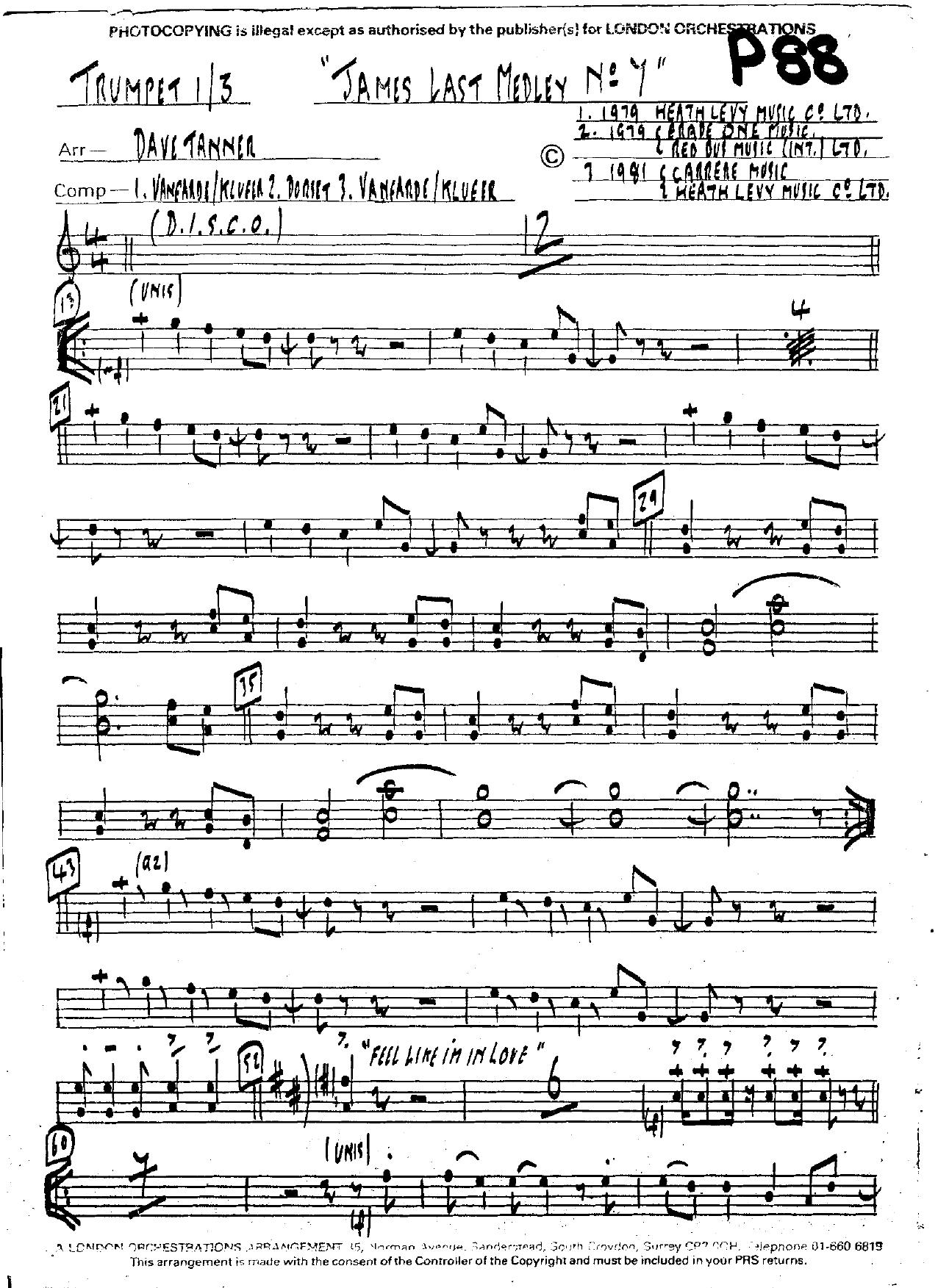
James Last Medley No (D.Tanner) sheet music preview

James Last Medley No (D.Tanner)

Composed by Dave Tanner

Arranged by Dave Tanner

  • Ensemble: Big Band
  • Pages: 41
  • Instruments (13): Trumpet 1/3, Trumpet 2/4, Trombone 1, Trombone 2/3, Alto Sax 1/2, Tenor Sax 1/2, Baritone Sax, Flute, Bass Guitar, Drums, Keyboard, Guitar, Vocals
  • Difficulty: medium
  • Content: Individual Parts
  • Format: PDF Download (Instant)
  • Price: $24.99

Channeling the lush, grandiose, and irresistibly danceable orchestral jazz-pop aesthetic pioneered by the legendary German bandleader James Last, this ambitious big band setting transports listeners straight to the golden era of European easy-listening radio and high-energy concert halls. James Last, renowned globally for his trademark "Happy Sound," transformed popular melodies, swing classics, and cinematic themes into massive, brass-heavy spectacles throughout the 1960s, 70s, and 80s. Arranger Dave Tanner captures this very ethos, distilling the massive wall-of-sound production values of Last’s touring orchestra into a tightly structured, highly combustible big band chart that merges retro European dance-hall exuberance with sophisticated contemporary jazz harmony. Musically, the medley unfolds with an infectious, buoyant medium-up groove that effortlessly balances swinging rhythmic drive with lush, cinematic sophistication. Built upon a brightly driving 4/4 rhythm section foundation, the arrangement shifts dynamically between buoyant, harmonically rich ensemble passages and sweeping, lyrical refrains that evoke images of a packed ballroom floor. Tanner employs thick, contemporary chord extensions—utilizing major sevenths, sharp-elevated elevenths, and soaring brass voicings—to elevate simple melodic motifs into sophisticated jazz vehicles. The mood is unabashedly joyful, optimistic, and energetic, driven by pulsing basslines, crisp cymbal work, and cascading woodwind counterlines that keep the momentum relentlessly pushing forward. Tanner’s arranging approach shines brightest in how he handles texture and color across the ensemble. Rather than relying on standard, predictable block-chord scoring, he treats the 8-instrument configuration with chamber-like precision, carving out intricate conversational counterpoint between the saxophones and brass. The reed section—anchored by alto, tenor, and baritone saxophones—frequently delivers cascading, harmonized solis that recall the signature woodwind blend of the Last orchestra, while the trumpet and trombone sections provide brilliant, punchy stabs and warm, enveloping background pads. A magnificent, high-energy shout chorus serves as the emotional and sonic apex of the chart, forcing the ensemble to lock in dynamically before resolving into a triumphant, glittering final cadence. Tailored specifically for advanced high school, collegiate, and professional community big bands looking to inject a unique, crowd-pleasing European flavor into their concert repertoire, this comprehensive 41-page package offers a masterclass in stylistic versatility. While the individual wind parts demand strong technical facility—particularly in the saxophone soli sections and upper-register trumpet markings—the ensemble rewards careful preparation with an unmistakable audience reaction. Directors will find that the chart provides exceptional educational opportunities for teaching blend, balance, and stylistic light-and-shade, making it a standout selection for festival programs, pops concerts, and celebratory community performances alike. Success with Dave Tanner’s "James Last Medley No (D.Tanner)" hinges on capturing the bright, buoyant European dance-band feel without sacrificing jazz articulation. The tempo should remain steady and forward-moving; avoid dragging, as the infectious energy relies on crisp, eighth-note swing subdivision where indicated and clean, driving straight-eighth sections where the pop influence takes over. The primary technical challenge lies in the dynamic contrast and precise blend required across the 8-instrument ensemble. Because the scoring is compact yet thick with extended harmonies, inner voices must project clearly without covering the lead melody. Saxophone players should practice their unison and harmonized lines with a light, classical-meets-jazz embouchure to emulate the signature James Last woodwind sheen. Brass players should utilize controlled, warm tones rather than aggressive, screaming volume, saving their power for the climactic shout chorus. Conductors should pay close attention to articulation markings: short notes must be clipped and uniform, while the lush ballad-esque transitions require a seamless, legato approach with seamless breath support. Rehearsals should initially isolate the rhythm section to lock in the foundational groove before layering the horns section by section. Q: What instruments and parts are included in this arrangement? A: This chart is scored for an 8-instrument ensemble featuring Alto Saxophone, Tenor Saxophone, Baritone Saxophone, Trumpet, Trombone, and a complete rhythm section framework spanning 41 total pages of detailed manuscript. Q: What is the difficulty level of this arrangement? A: This arrangement is graded as advanced, making it best suited for accomplished high school, collegiate, and professional community big bands with strong section players and confident lead capabilities. Q: What style and historical context does this piece represent? A: It is written in a jazz-inflected orchestral pop style inspired by the legendary German bandleader James Last and his famous 1970s "Happy Sound" touring and recording productions. Q: What makes this specific arrangement by Dave Tanner unique? A: It successfully condenses the massive, wall-of-sound production values and lush harmonic voicings of a full European pop orchestra into a compact big band format complete with intricate woodwind solis and a driving shout chorus. Q: What is the performance duration and tempo feel of the medley? A: The arrangement generally runs between 4 to 6 minutes depending on the chosen medley pacing, driven by a bright, infectious medium-up tempo feel that keeps audiences engaged from start to finish.

Questions and answers

What is included in the James Last Medley No (D.Tanner) PDF?
The verified current file contains individual parts across 41 pages.
How many instruments or parts are listed for James Last Medley No (D.Tanner)?
The verified instrumentation list contains 13 entries for this Big Band arrangement.
Who is credited for James Last Medley No (D.Tanner)?
Composer: Dave Tanner. Arranger: Dave Tanner.
What difficulty is listed for James Last Medley No (D.Tanner)?
The verified difficulty level is medium.
Can I preview James Last Medley No (D.Tanner) before buying?
Yes. The product page provides a preview generated from the current PDF file.
How is James Last Medley No (D.Tanner) delivered?
After successful payment, the digital PDF is made available for download. The displayed price is $24.99.

Musicians Also Search For

James Last Medley No Dave Tanner PDFJames Last Medley No Dave Tanner sheet musicJames Last Medley No arranged by Dave TannerDave Tanner big band chartsDave Tanner jazz arrangements PDFJames Last Medley No Dave Tanner big band arrangementsJames Last Medley No big band arrangementsJames Last Medley No big band PDF downloadJames Last Medley No jazz sheet musicbig band sheet music downloadJames Last Medley No individual parts downloadJames Last Medley No sheet music PDFbuy James Last Medley No sheet musicdownload James Last Medley No PDFJames Last Medley No jazz chartsbest Dave Tanner big band arrangementsJames Last Medley No printable sheet musicbig band repertoire PDF

All arrangements by Dave Tanner All Dave Tanner sheet music