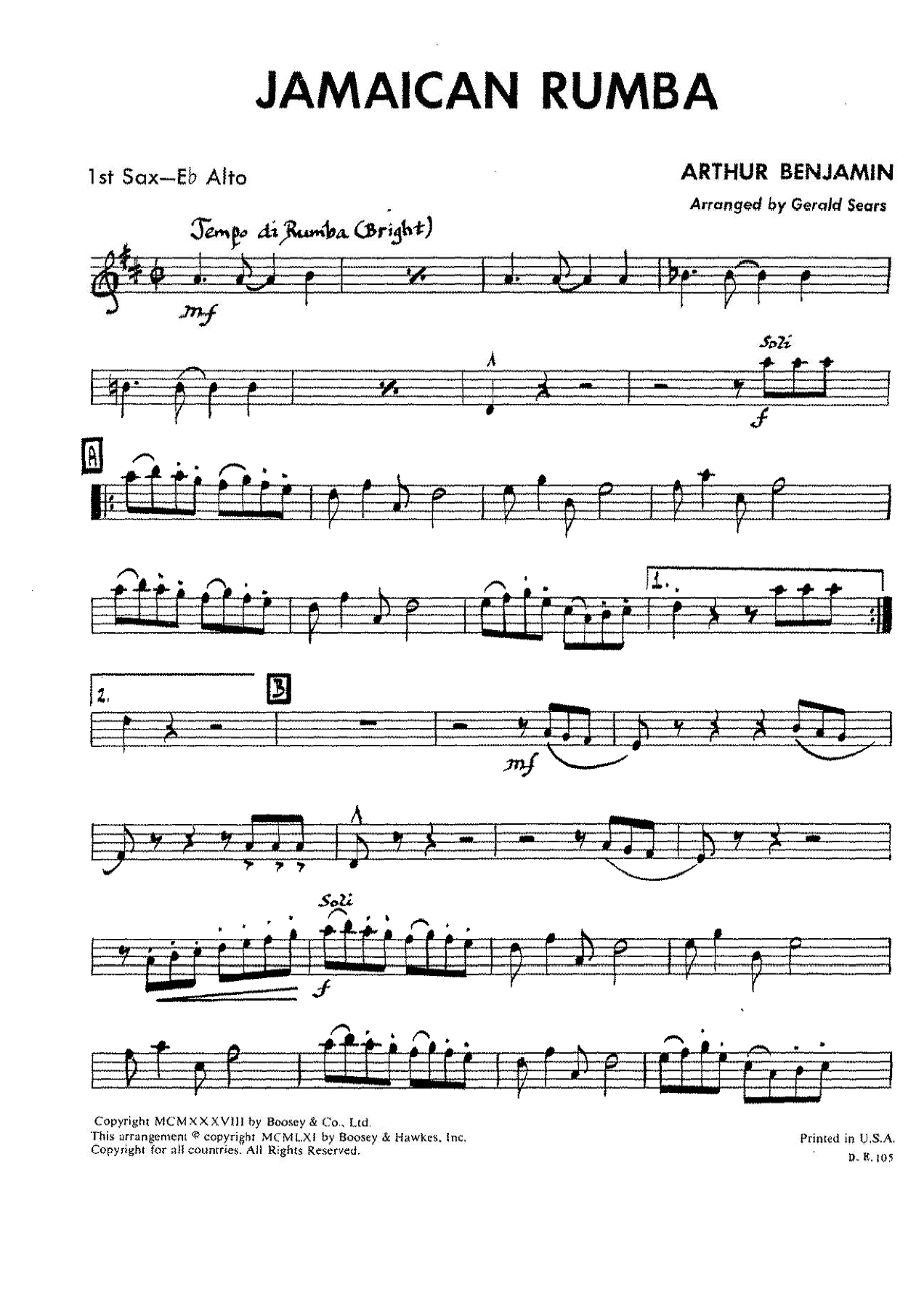
Jamacian Rhumba (G.Sears)
Composed by Arthur Benjamin
Arranged by G. Sears
- Ensemble: Big Band Dance
- Style: Rumba
- Pages: 34
- Instruments (17): 1st Sax-Eb Alto, 3rd Sax-Eb Alto, 2nd Sax-Bb Tenor, 4th Sax-Bb Tenor, 5th Sax-Eb Baritone, 1st Bb Trumpet, 2nd Bb Trumpet, 3rd Bb Trumpet, 4th Bb Trumpet, 1st Trombone, 2nd Trombone, 3rd Trombone, 4th Trombone, Guitar, Piano, Bass, Drums
- Difficulty: medium
- Content: Individual Parts
- Format: PDF Download (Instant)
- Price: $24.99
Arthur Benjamin's "Jamaican Rumba," composed in 1938 as part of his "Two Jamaican Pieces," stands as a vibrant and enduring classical work that has transcended its original genre to become a beloved staple in various musical settings. While not a jazz standard in the traditional sense, its infectious syncopation, memorable melodic lines, and inherent rhythmic drive made it ripe for interpretation by dance orchestras and big bands during the mid-20th century. Its popularity soared, captivating audiences with its exotic charm and sophisticated yet accessible rumba rhythm, a reflection of the era's fascination with Latin American musical styles. Benjamin’s original composition masterfully blended classical structure with Caribbean folk influences, creating a piece that is both elegant and irresistibly danceable, a quality that resonated deeply with the big band era's emphasis on rhythmic vitality and melodic appeal. G. Sears' big band dance arrangement of "Jamaican Rhumba" reimagines Benjamin's classic through the lens of a sophisticated 1940s-era dance orchestra. This arrangement is set in the key of C Major, maintaining the original's bright, inviting character, and establishes a medium-tempo Latin groove, specifically a refined rumba feel. The overall mood is one of elegant vivacity and playful sophistication, evoking images of a grand ballroom or a classic Hollywood musical number. Sears' treatment emphasizes clarity and melodic integrity, ensuring that the original's charm shines through while being expertly adapted for the power and color of a full big band. The arrangement's energy is consistently engaging, building subtly through dynamic contrasts and instrumental layering rather than relying on aggressive brass shouts. Sears' distinctive arranging style is evident in his meticulous voicings and thoughtful allocation of melodic duties. The iconic main theme is initially presented by the alto saxophones, offering a smooth, lyrical entry point before being passed to the full sax section in a rich, harmonized soli. Brass sections are used judiciously, providing warm counter-melodies, rhythmic punctuations, and powerful ensemble passages that never overpower the rumba's inherent grace. There are no extended improvised solos in this arrangement; instead, the focus is on the ensemble's collective performance, with brief, written-out melodic fills and call-and-response figures adding texture. The arrangement features several dynamic shifts and subtle reharmonizations that add depth without straying from the original's harmonic language, culminating in a full, resonant ensemble statement of the theme that brings the piece to a satisfying close. Performing this arrangement offers a rewarding experience for a high school, college, or community big band with solid fundamental skills. The primary technical challenges lie in maintaining the precise rumba rhythm with a consistent, unhurried feel, ensuring clean articulation in the saxophone soli sections, and achieving balanced ensemble blend, particularly between the brass and saxes. The absence of improvised solos makes it highly accessible for bands focusing on ensemble precision and stylistic authenticity. The piece's inherent musicality and the arranger's faithful yet imaginative adaptation make it an excellent choice for a concert opener, a dance set feature, or a showcase for a band's ability to interpret classic repertoire with elegance and rhythmic flair. Conductors should emphasize a relaxed, yet precise medium Latin groove, specifically a rumba feel, rather than a driving swing. The tempo should be around quarter note = 120-128 BPM, allowing the syncopated figures to breathe without rushing. Key technical challenges include maintaining rhythmic accuracy in the unison and harmonized saxophone lines, particularly the sustained eighth-note patterns, and ensuring clean brass attacks and releases. Articulation should be light and crisp, avoiding heavy accents unless explicitly marked. Rehearsal time should be dedicated to balancing the ensemble, ensuring the bass and drums lock into a consistent rumba pattern, and practicing dynamic contrasts. There are no special techniques like mutes or falls required, focusing instead on fundamental ensemble blend and stylistic integrity. Q: What instruments and parts are included in this arrangement? A: This arrangement is scored for a standard 17-piece big band, including Alto Saxophone 1, Alto Saxophone 2, Tenor Saxophone 1, Tenor Saxophone 2, Baritone Saxophone, Trumpet 1-4, Trombone 1-4, Piano, Bass, Drums, and Guitar. Q: What is the difficulty level of "Jamaican Rhumba (G. Sears)"? A: This arrangement is suitable for high school, college, or community big bands. It requires solid ensemble playing and rhythmic precision but avoids complex improvised solos, making it accessible for developing bands. Q: What is the musical style and historical context of this piece? A: This is a big band dance arrangement of Arthur Benjamin's classical composition "Jamaican Rumba" from 1938. It features a medium-tempo Latin groove (rumba) and reflects the sophisticated dance orchestra style of the 1940s. Q: What makes G. Sears' arrangement of "Jamaican Rhumba" unique? A: G. Sears' arrangement is distinctive for its faithful yet imaginative adaptation for big band, focusing on elegant voicings, rich saxophone solis, and a refined rumba feel, prioritizing ensemble precision over improvised solos. Q: What is the approximate performance duration and recommended tempo for this arrangement? A: The approximate performance duration is 3:00-3:30 minutes. The recommended tempo is a medium rumba groove, around quarter note = 120-128 BPM.
Questions and answers
- What is included in the Jamacian Rhumba (G.Sears) PDF?
- The verified current file contains individual parts across 34 pages.
- How many instruments or parts are listed for Jamacian Rhumba (G.Sears)?
- The verified instrumentation list contains 17 entries for this Big Band Dance arrangement.
- Who is credited for Jamacian Rhumba (G.Sears)?
- Composer: Arthur Benjamin. Arranger: G. Sears.
- What difficulty is listed for Jamacian Rhumba (G.Sears)?
- The verified difficulty level is medium.
- What style is listed for Jamacian Rhumba (G.Sears)?
- The catalog lists the style as Rumba.
- Can I preview Jamacian Rhumba (G.Sears) before buying?
- Yes. The product page provides a preview generated from the current PDF file.
- How is Jamacian Rhumba (G.Sears) delivered?
- After successful payment, the digital PDF is made available for download. The displayed price is $24.99.
Musicians Also Search For
Jamacian Rhumba G. Sears PDF • Jamacian Rhumba G. Sears sheet music • Jamacian Rhumba arranged by G. Sears • G. Sears big band dance charts • G. Sears jazz arrangements PDF • Jamacian Rhumba Arthur Benjamin sheet music • Jamacian Rhumba Arthur Benjamin big band dance arrangements • Arthur Benjamin big band dance charts • Jamacian Rhumba big band dance arrangements • Jamacian Rhumba big band dance PDF download • Jamacian Rhumba jazz sheet music • big band dance sheet music download • Jamacian Rhumba individual parts download • Jamacian Rhumba sheet music PDF • Jamacian Rhumba Rumba charts • Rumba big band dance arrangements • buy Jamacian Rhumba sheet music • download Jamacian Rhumba PDF • Jamacian Rhumba jazz charts • best G. Sears big band dance arrangements • Arthur Benjamin arranged by G. Sears • Jamacian Rhumba printable sheet music • big band dance repertoire PDF