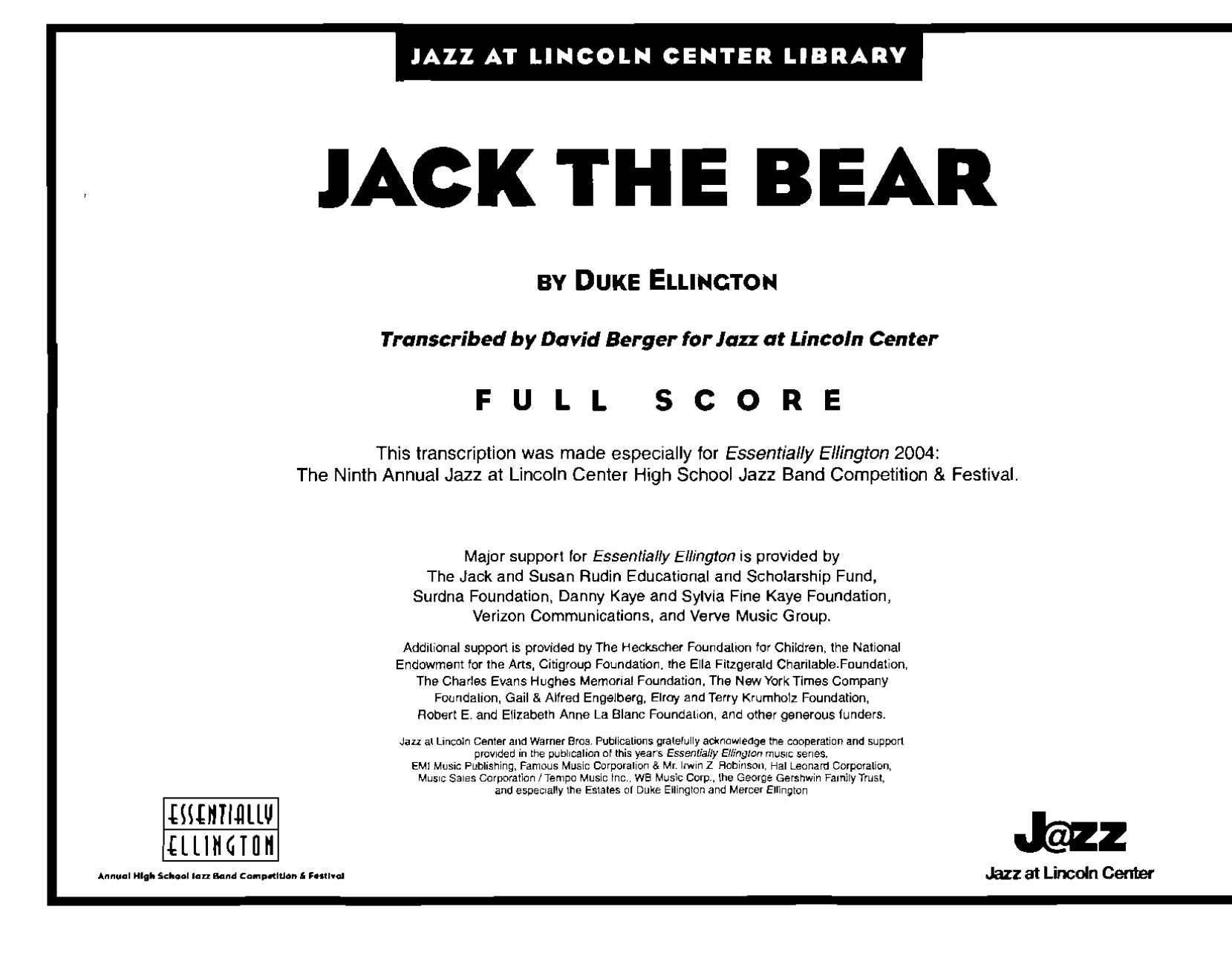
Jack The Bear (D.Ellington)
Composed by Duke Ellington
Arranged by Duke Ellington & B.Strayhorn.D.Berger
- Ensemble: Big Band
- Pages: 63
- Instruments (15): Reed 1 - Alto Sax, Reed 2 - Alto Sax, Reed 3 - Clarinet, Reed 4 - Tenor Sax, Reed 5 - Baritone Sax, Trumpet 1, Trumpet 2, Trumpet 3 (Cornet), Trombone 1, Trombone 2, Trombone 3 (Valve), Guitar, Piano, Bass, Drums
- Difficulty: advanced
- Content: Individual Parts
- Format: PDF Download (Instant)
- Price: $24.99
Originally recorded by Duke Ellington and His Famous Orchestra in July 1940 for Victor Records, "Jack the Bear" stands as a monumental showcase for virtuoso bassist Jimmy Blanton, whose revolutionary approach fundamentally transformed the role of the upright bass in jazz. Composed by Duke Ellington during the legendary Blanton-Webster era—widely regarded as the creative peak of the Ellington orchestra—this piece bridges the gap between early Harlem stride, Kansas City swing, and the modern small-group concepts that would soon fuel the bebop movement. The composition is celebrated not merely as a feature vehicle, but as an intricately structured miniature tone poem that breaks away from conventional 32-bar song forms to explore contrasting moods, minor keys, and conversational counterpoint between the rhythm section and the horn tiers. A pulsing, swaggering medium-tempo swing defines the rhythmic engine of the chart, anchored by an infectious blues-infused minor tonality that alternates with sweeping, major-mode release sections. The emotional landscape shifts dramatically between playful, alley-cat stealth and roaring, high-energy big band power. Ellington and Billy Strayhorn’s compositional genius shines through dense, colorful chord clusters and idiosyncratic voicings that exploit the rich lower registers of the band. The arrangement utilizes a sophisticated palette of Duke's signature textural devices, blending growling brass with reedy, re-voiced woodwind combinations that sound remarkably modern yet retain the earthy, blues-drenched roots of the orchestra's Cotton Club days. Melodic weight is shared dynamically across the ensemble, though the spotlight frequently returns to a virtuosic bass voice that navigates chromatic walking lines and double-stopped cadenzas, supported by David Berger’s meticulous transcription work which restores the nuance of the original manuscript. Saxophone solis glide with effortless, sophisticated swing, while the brass section delivers biting, muted counterlines that demand precise articulation and dynamic control. Technical challenges center around maintaining an unhurried, buoyant groove at moderate tempos while executing intricate section unisons and sudden dynamic shifts. Performers will find immense satisfaction in unlocking the subtle stylistic inflections—such as characteristic Ellingtonian slurs, drop-offs, and growls—that transform the written notes into authentic swing-era idioms. Advanced college ensembles, professional repertory orchestras, and elite high school jazz bands with exceptionally strong rhythm sections will find this arrangement an ideal centerpiece for concert programs. Because the success of the chart hinges on a commanding, rhythmically authoritative acoustic bass player and mature stylistic awareness, it serves as an invaluable educational tool for teaching the history of jazz bass and ensemble interplay. Directors looking to challenge their students with historically significant, deeply swinging repertoire that demands both intellectual rigor and raw emotional expression will discover that this 16-instrument chart delivers an unforgettable concert experience. Success with "Jack the Bear" depends heavily on the rhythm section establishing a rock-solid, driving medium-swing feel that never rushes, even during dense ensemble passages. The bass part requires a player comfortable with high-register movement, double-stops, and articulating walking lines with deep, blues-inflected articulation rather than a rigid classical approach. Horn players must master a wide array of coloristic effects, including plunger mutes, half-valve treatments, and subtle falls, ensuring that these techniques enhance rather than obscure the harmonic integrity of the chart. Directors should rehearse the brass and reed sections separately to balance the dense, Ellingtonian chord voicings before integrating them with the rhythm section. Pay close attention to dynamic contrast; the softer passages require a slinky, transparent texture, while the shout sections demand a full-throated, blues-soaked roar without sacrificing intonation. Q: What instruments and parts are included in this arrangement? A: This chart is scored for a standard 16-instrument big band instrumentation, featuring Alto Sax 1, Alto Sax 2, Tenor Sax 1, Tenor Sax 2, Baritone Sax, Trumpets 1-3, Trombones 1-2, and a full rhythm section including piano, bass, and drums, totaling 63 pages of music. Q: What is the difficulty level of this arrangement? A: This arrangement is rated as advanced, primarily due to the sophisticated stylistic demands, intricate ensemble unisons, historical stylistic nuances, and the virtuosic technical requirements placed on the bass player. Q: What is the historical style and context of "Jack the Bear"? A: Composed in 1940 during Duke Ellington's famed Blanton-Webster era, this piece is a historic swing-era masterpiece originally designed to showcase the pioneering, virtuosic upright bass playing of Jimmy Blanton. Q: What makes this specific transcription and arrangement unique? A: Edited and restored by jazz scholar and arranger David Berger, this chart meticulously captures the authentic voicings, dynamic contrasts, and subtle instrumental colors of the original 1940 Victor recording that standard stock charts often miss. Q: What is the performance duration and tempo of the piece? A: The arrangement is set at a swaggering, medium-swing tempo (approximately quarter note = 120-126 BPM) and typically runs around 3 minutes and 15 seconds in performance duration.
Questions and answers
- What is included in the Jack The Bear (D.Ellington) PDF?
- The verified current file contains a conductor score and individual parts across 63 pages.
- How many instruments or parts are listed for Jack The Bear (D.Ellington)?
- The verified instrumentation list contains 15 entries for this Big Band arrangement.
- Who is credited for Jack The Bear (D.Ellington)?
- Composer: Duke Ellington. Arranger: Duke Ellington & B.Strayhorn.D.Berger.
- What difficulty is listed for Jack The Bear (D.Ellington)?
- The verified difficulty level is advanced.
- Can I preview Jack The Bear (D.Ellington) before buying?
- Yes. The product page provides a preview generated from the current PDF file.
- How is Jack The Bear (D.Ellington) delivered?
- After successful payment, the digital PDF is made available for download. The displayed price is $24.99.
Musicians Also Search For
Jack The Bear Duke Ellington & B.Strayhorn.D.Berger PDF • Jack The Bear Duke Ellington & B.Strayhorn.D.Berger sheet music • Jack The Bear arranged by Duke Ellington & B.Strayhorn.D.Berger • Duke Ellington & B.Strayhorn.D.Berger big band charts • Duke Ellington & B.Strayhorn.D.Berger jazz arrangements PDF • Jack The Bear Duke Ellington sheet music • Jack The Bear Duke Ellington big band arrangements • Duke Ellington big band charts • Jack The Bear big band arrangements • Jack The Bear big band PDF download • Jack The Bear jazz sheet music • big band sheet music download • Jack The Bear conductor score PDF • Jack The Bear individual parts download • Jack The Bear sheet music PDF • buy Jack The Bear sheet music • download Jack The Bear PDF • Jack The Bear jazz charts • best Duke Ellington & B.Strayhorn.D.Berger big band arrangements • Duke Ellington arranged by Duke Ellington & B.Strayhorn.D.Berger • Jack The Bear printable sheet music • big band repertoire PDF