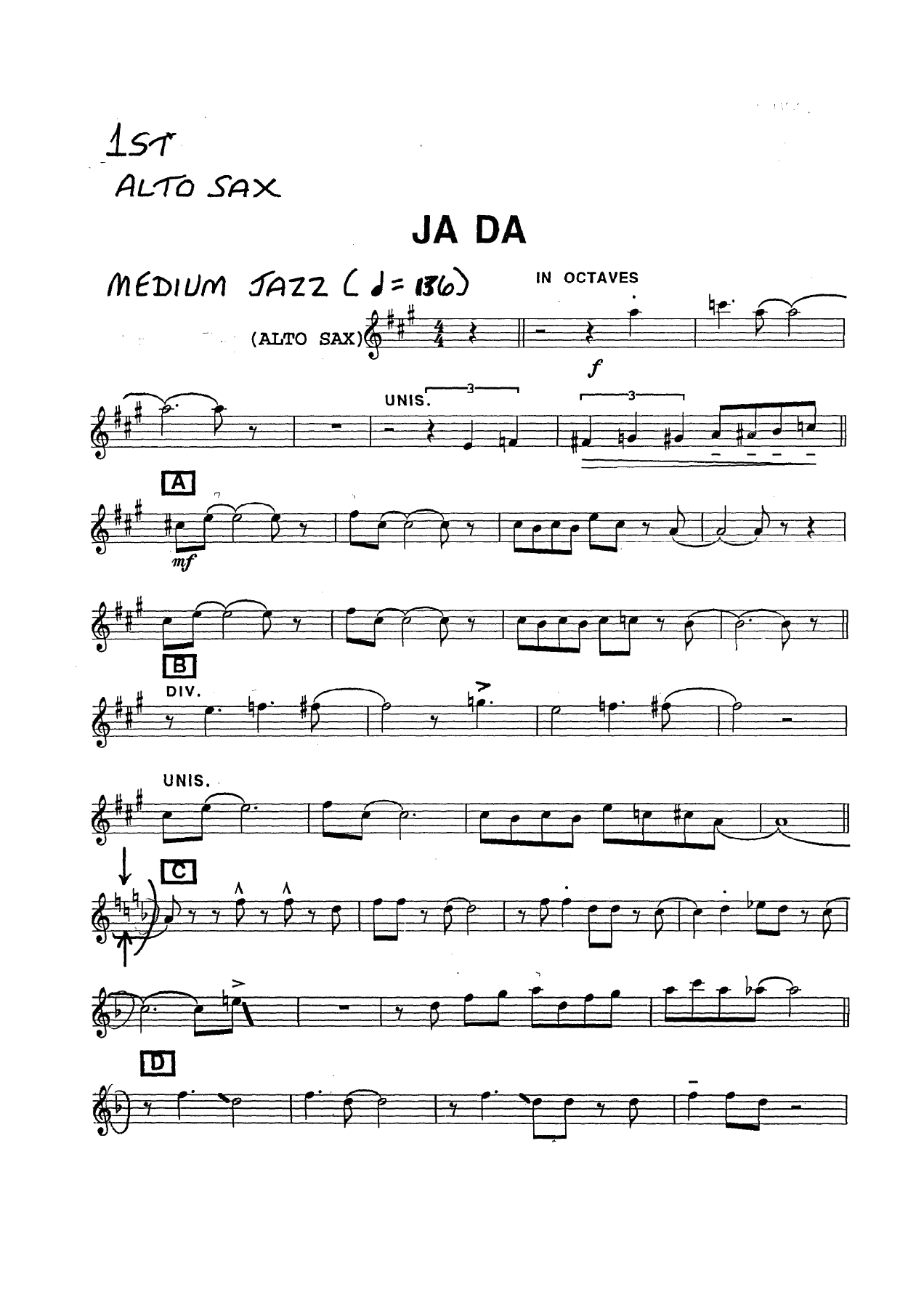
Ja-Da (B.Holman)
Composed by Bob Carleton
Arranged by Bill Holman
- Ensemble: Big Band
- Style: Jazz Standard
- Pages: 52
- Instruments (17): 1st Alto Saxophone, 2nd Alto Saxophone, 1st Tenor Saxophone, 2nd Tenor Saxophone, Baritone Saxophone, 1st Trumpet, 2nd Trumpet, 3rd Trumpet, 4th Trumpet (Jazz), 1st Trombone, 2nd Trombone, 3rd Trombone, 4th Bass Trombone, Piano, Acoustic Bass, Drums, Vibraphone
- Difficulty: advanced
- Content: Individual Parts
- Format: PDF Download (Instant)
- Price: $24.99
Originally penned by Bob Carleton in 1918, "Ja-Da" emerged from the vaudeville and early jazz era, quickly becoming a beloved standard for its infectious, simple melody and singable quality. Its enduring appeal lies in its straightforward, optimistic charm, a characteristic that cemented its place in the Great American Songbook. While not a complex harmonic vehicle, its memorable theme has invited countless interpretations across various jazz styles, from Dixieland to swing and beyond. It represents a foundational piece in the jazz repertoire, often serving as an entry point for musicians into improvisation and swing feel, and has been famously performed by artists ranging from Louis Armstrong to Frank Sinatra. Bill Holman's masterful arrangement of "Ja-Da" for big band transforms this early 20th-century standard into a sophisticated, yet undeniably swinging, contemporary jazz chart. Set at a medium-up swing tempo, the arrangement is primarily in the key of F major, though Holman's signature harmonic language introduces rich, extended voicings and unexpected chromaticisms that elevate the original's simplicity. The mood is one of buoyant energy and understated cool, characteristic of Holman's West Coast jazz sensibilities. He masterfully balances intricate ensemble writing with moments of open space, allowing the band to breathe and the groove to settle deeply. Holman's distinctive approach is immediately evident in the ingenious reharmonization and the dynamic interplay between sections. The melody is initially carried by the saxophones in a tightly voiced soli, showcasing Holman's brilliant use of close harmony and counterpoint. Later, the brass sections take over, often with muted textures that add a layer of sophistication. A standout feature is the meticulously crafted shout chorus, where the entire ensemble erupts with powerful, yet precisely articulated, figures that build tension and excitement. While there are no explicitly written-out improvised solos, the arrangement offers ample opportunity for a tenor saxophone or trumpet soloist to interpret the changes during an open solo section, allowing for individual expression within the ensemble framework. Technical challenges include navigating Holman's often angular melodic lines and complex rhythms, particularly in the brass, and achieving a cohesive ensemble sound with his dense voicings. The reward lies in performing a truly iconic arranger's take on a classic, experiencing the thrill of a tightly knit, swinging big band. This arrangement is ideally suited for advanced high school, collegiate, community, and professional big bands. Its demands for precise articulation, blend, and rhythmic accuracy make it an excellent vehicle for developing ensemble discipline, while its sophisticated harmonic and melodic content offers a rich learning experience. The chart provides a superb opportunity for bands to delve into the nuanced world of West Coast cool jazz through the lens of one of its most celebrated architects, offering both educational value and immense audience appeal. Conductors should establish a solid medium-up swing feel (around quarter note = 160-180 BPM) from the outset, emphasizing a relaxed yet driving pulse. The primary technical challenges involve precise articulation and blend within Holman's often dense voicings, particularly in the saxophone soli sections and the intricate brass figures. Encourage players to listen across sections to achieve a unified sound and accurate intonation on the extended harmonies. The brass section, especially trumpets, will need strong technical command for the upper register passages and precise rhythmic execution in the shout chorus. Pay close attention to dynamics, as Holman uses a wide range to create dramatic shifts in energy. Muted brass sections (cup and straight mutes) require careful balance to avoid overpowering the ensemble. Rehearsal time should focus on rhythmic accuracy in the ensemble figures, ensuring that all entrances are clean and attacks are uniform, especially after sustained notes or rests. Emphasize a light, buoyant approach to the swing eighth notes throughout. Q: What instruments and parts are included in this arrangement? A: This arrangement is scored for a standard 17-piece big band, including Alto Saxophone 1 & 2, Tenor Saxophone 1 & 2, Baritone Saxophone, Trumpet 1-4, Trombone 1-4, Piano, Bass, and Drums. Q: What is the difficulty level of Bill Holman's "Ja-Da" arrangement? A: This arrangement is considered advanced, suitable for experienced high school, collegiate, community, and professional big bands due to its complex harmonies, intricate rhythms, and demands for precise ensemble playing. Q: What style and historical context does this arrangement represent? A: While the original "Ja-Da" is an early 20th-century jazz standard, Bill Holman's arrangement reimagines it in a sophisticated West Coast cool jazz style, characterized by his signature voicings and intricate ensemble writing. Q: What makes this particular arrangement unique compared to other versions of "Ja-Da"? A: Bill Holman's distinctive harmonic language, sophisticated reharmonizations, and brilliant use of counterpoint and ensemble soli sections elevate this arrangement, transforming a simple standard into a complex and swinging big band showpiece. Q: What is the typical performance duration and tempo for this arrangement? A: The typical performance duration for this arrangement is approximately 3-4 minutes, performed at a medium-up swing tempo, generally ranging from 160 to 180 beats per minute.
Questions and answers
- What is included in the Ja-Da (B.Holman) PDF?
- The verified current file contains individual parts across 52 pages.
- How many instruments or parts are listed for Ja-Da (B.Holman)?
- The verified instrumentation list contains 17 entries for this Big Band arrangement.
- Who is credited for Ja-Da (B.Holman)?
- Composer: Bob Carleton. Arranger: Bill Holman.
- What difficulty is listed for Ja-Da (B.Holman)?
- The verified difficulty level is advanced.
- What style is listed for Ja-Da (B.Holman)?
- The catalog lists the style as Jazz Standard.
- Can I preview Ja-Da (B.Holman) before buying?
- Yes. The product page provides a preview generated from the current PDF file.
- How is Ja-Da (B.Holman) delivered?
- After successful payment, the digital PDF is made available for download. The displayed price is $24.99.
Musicians Also Search For
Ja-Da Bill Holman PDF • Ja-Da Bill Holman sheet music • Ja-Da arranged by Bill Holman • Bill Holman big band charts • Bill Holman jazz arrangements PDF • Ja-Da Bob Carleton sheet music • Ja-Da Bob Carleton big band arrangements • Bob Carleton big band charts • Ja-Da big band arrangements • Ja-Da big band PDF download • Ja-Da jazz sheet music • big band sheet music download • Ja-Da individual parts download • Ja-Da sheet music PDF • Ja-Da Jazz Standard charts • Jazz Standard big band arrangements • buy Ja-Da sheet music • download Ja-Da PDF • Ja-Da jazz charts • best Bill Holman big band arrangements • Bob Carleton arranged by Bill Holman • Ja-Da printable sheet music • big band repertoire PDF