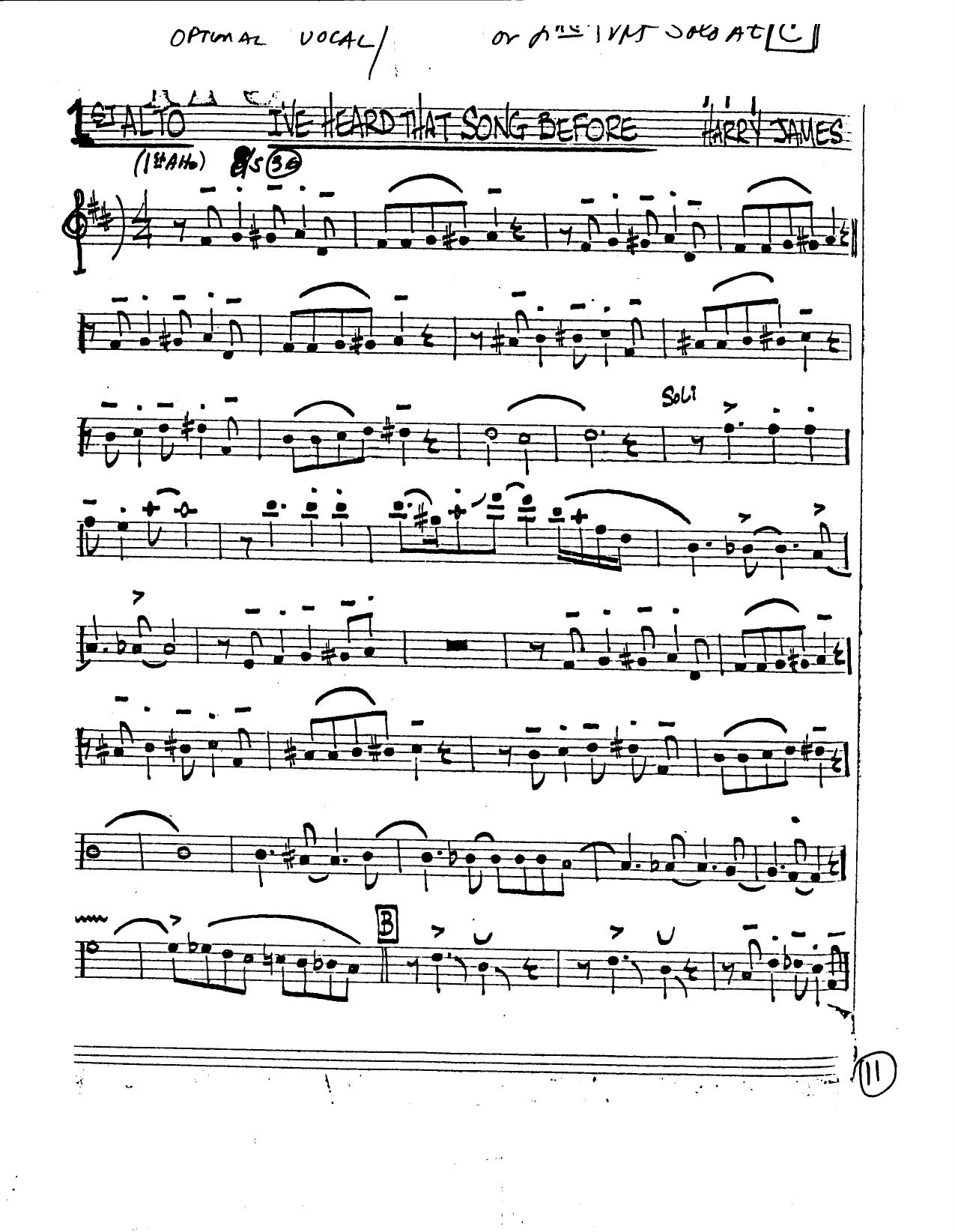
I'Ve Heard That Song Before (H.James) sheet music preview

I'Ve Heard That Song Before (H.James)

Composed by Jule Styne, Sammy Cahn

Arranged by Harry James

  • Ensemble: Big Band
  • Pages: 37
  • Instruments (18): 1st Alto Saxophone, 3rd Alto Saxophone, 2nd Tenor Saxophone, 4th Tenor Saxophone, 5th Baritone Saxophone, 1st Trumpet (Solo), 2nd Trumpet, 3rd Trumpet, 4th Trumpet, 1st Trombone, 2nd Trombone, 3rd Trombone, 4th Trombone, Piano, Guitar, Bass, Drums, Vocal
  • Difficulty: medium
  • Content: Individual Parts
  • Format: PDF Download (Instant)
  • Price: $24.99

Written originally by the legendary songwriting duo Jule Styne and Sammy Cahn, "I've Heard That Song Before" captured the wartime longing and hopeful resilience of 1942, rising swiftly to the top of the charts and earning an Academy Award nomination. Immortalized by Harry James and his Orchestra featuring vocalist Helen Forrest, the tune became an anthem of the American swing era. In the hands of James, the song transitioned from a popular vocal hit into a high-octane instrumental showcase that combined soaring, pyrotechnic trumpet virtuosity with the rich, dense harmonic textures of a premier 1940s big band. This definitive treatment bridges the gap between commercial pop accessibility and uncompromising jazz-swing craftsmanship, making it an enduring staple of classic big band repertoire. Propelled by an infectious, driving medium-up swing groove in 4/4 time, this arrangement radiates high-octane energy and nostalgic bravado. The emotional trajectory shifts seamlessly from bright, confident optimism to explosive, brass-heavy excitement. The opening passages establish a swinging, danceable foundation before expanding into full-ensemble dynamic swells that evoke the quintessential Saturday-night ballroom atmosphere. Listeners will instantly recognize the signature swagger of the 1940s West Coast and East Coast dance circuits, where precision rhythm sections and roaring brass sections defined the cutting edge of popular American music. Harry James brings his signature compositional and performance brilliance to the podium, structuring the chart to highlight the powerhouse capabilities of a full 17-piece big band. Distinctive voicings feature tight, harmonized sax blocks that weave counter-melodies against biting, muted brass figures. The arrangement showcases classic James-style trumpet flourishes, complete with virtuosic upward smears and crystalline high-register accents. A masterclass in pacing, the chart builds tension through a sequence of call-and-response sections between the reeds and brass, culminating in a blistering, multi-tiered shout chorus that demands stamina, precision, and absolute stylistic unity from the entire ensemble. Carrying the melodic weight are the lead trumpet and lead alto saxophone, backed by robust soli sections that test the band's articulation and swing phrasing. Principal solo space invites a confident trumpet or tenor saxophone improviser to stretch out over standard swing changes, supported by a rhythm section that must maintain a feather-light yet rock-solid pulse. Advanced high school, collegiate, and professional jazz orchestras will find this chart deeply rewarding; it demands a mature section concept of balance, dynamic control, and historical stylistic awareness. Successfully executing the subtle micro-rhythms of the swing era within this arrangement provides an exhilarating challenge that will leave audiences cheering. Executing this arrangement successfully requires a deep understanding of 1940s swing articulation, specifically the implementation of long-short phrasing on eighth-note lines and crisp, clipped accents on off-beats. The tempo should sit comfortably at a bright medium swing (approx. 160–168 BPM), ensuring the rhythm section maintains an unhurried, driving pulse without rushing the peaks. Brass players must master stylistic nuances such as plunger mutes, dramatic falls, and controlled doits to capture the authentic Harry James tonal palette. Conductors should pay close attention to the dynamic balance between the shouting brass and the intricate saxophone solis; the rhythm section—particularly the drummer—needs to drive the ensemble using feathered bass drum and crisp ride cymbal patterns rather than heavy, modern rock-fusion timekeeping. Rehearsal should prioritize sectional isolation of the syncopated shout chorus to lock in ensemble intonation and articulation before bringing the full 17-piece band together. Q: What instruments and parts are included in this arrangement? A: This chart is scored for a standard 17-piece big band instrumentation, consisting of 4 trumpets, 4 trombones, 5 saxophones (2 altos, 2 tenors, 1 baritone), and a 4-piece rhythm section featuring piano, guitar, bass, and drums, spanning a comprehensive 37-page manuscript. Q: What is the difficulty level of this big band chart? A: This arrangement is graded as advanced, making it best suited for collegiate, advanced high school, community, and professional jazz ensembles that possess strong technical facility and mature swing style. Q: What is the historical background of this specific arrangement? A: Originally written by Jule Styne and Sammy Cahn in 1942, this arrangement reflects the signature style of trumpet virtuoso Harry James, who made the tune a definitive swing-era instrumental showcase. Q: What makes this Harry James arrangement unique compared to other versions? A: It features characteristic high-register trumpet pyrotechnics, intricate brass-versus-reed call-and-response passages, and a thrilling, multi-tiered shout chorus tailored specifically to the James Orchestra's dynamic performance style. Q: What is the performance duration and recommended tempo for this piece? A: The arrangement runs approximately 3 to 4 minutes when performed at the recommended bright medium-swing tempo of roughly 160 to 168 beats per minute.

Questions and answers

What is included in the I'Ve Heard That Song Before (H.James) PDF?
The verified current file contains individual parts across 37 pages.
How many instruments or parts are listed for I'Ve Heard That Song Before (H.James)?
The verified instrumentation list contains 18 entries for this Big Band arrangement.
Who is credited for I'Ve Heard That Song Before (H.James)?
Composer: Jule Styne, Sammy Cahn. Arranger: Harry James.
What difficulty is listed for I'Ve Heard That Song Before (H.James)?
The verified difficulty level is medium.
Can I preview I'Ve Heard That Song Before (H.James) before buying?
Yes. The product page provides a preview generated from the current PDF file.
How is I'Ve Heard That Song Before (H.James) delivered?
After successful payment, the digital PDF is made available for download. The displayed price is $24.99.

Musicians Also Search For

I'Ve Heard That Song Before Harry James PDFI'Ve Heard That Song Before Harry James sheet musicI'Ve Heard That Song Before arranged by Harry JamesHarry James big band chartsHarry James jazz arrangements PDFI'Ve Heard That Song Before Jule Styne, Sammy Cahn sheet musicI'Ve Heard That Song Before Jule Styne, Sammy Cahn big band arrangementsJule Styne, Sammy Cahn big band chartsI'Ve Heard That Song Before big band arrangementsI'Ve Heard That Song Before big band PDF downloadI'Ve Heard That Song Before jazz sheet musicbig band sheet music downloadI'Ve Heard That Song Before individual parts downloadI'Ve Heard That Song Before sheet music PDFbuy I'Ve Heard That Song Before sheet musicdownload I'Ve Heard That Song Before PDFI'Ve Heard That Song Before jazz chartsbest Harry James big band arrangementsJule Styne, Sammy Cahn arranged by Harry JamesI'Ve Heard That Song Before printable sheet musicbig band repertoire PDF

All arrangements by Harry James All Jule Styne, Sammy Cahn sheet music