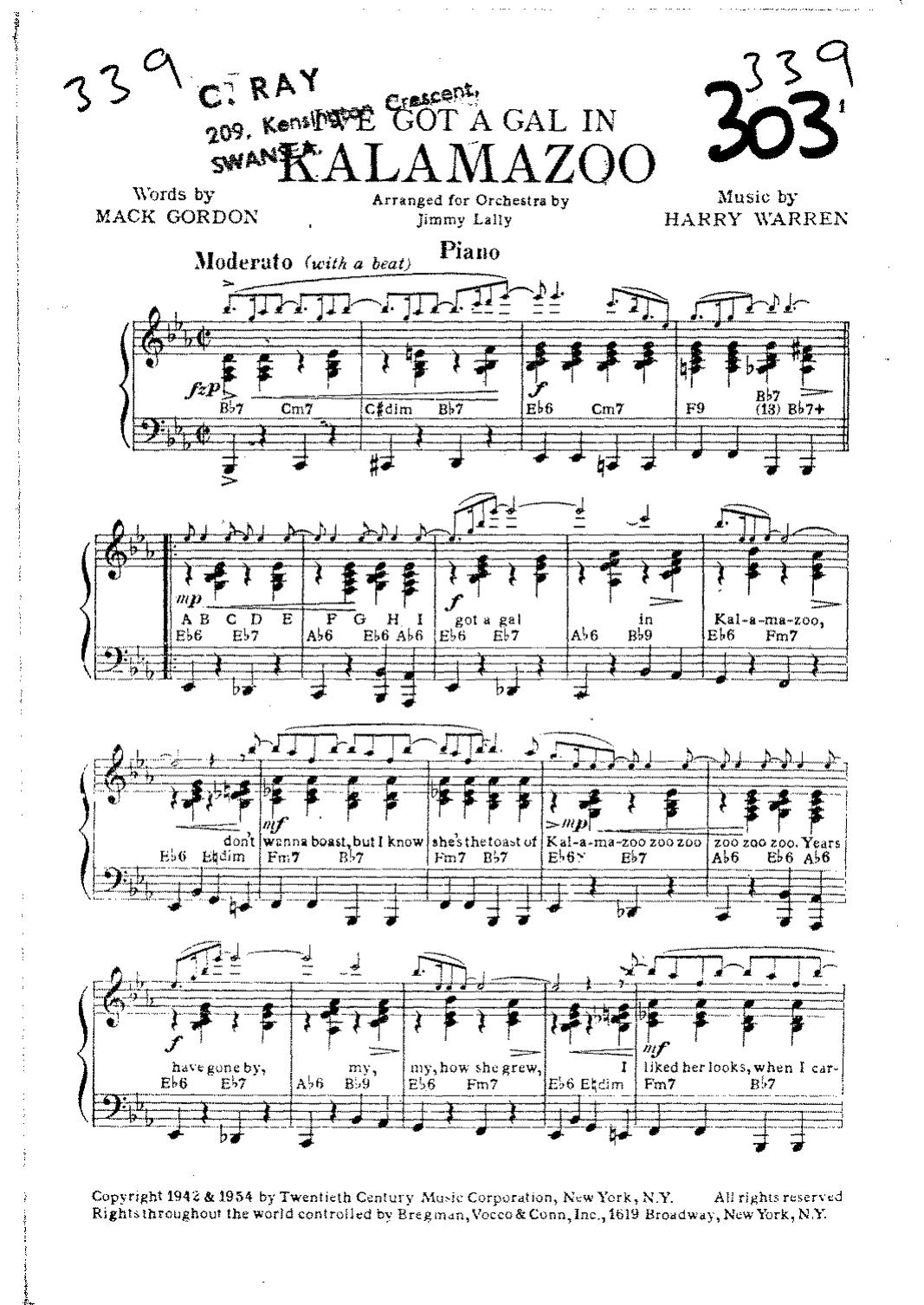
I'Ve Got A Gal In Kalamazoo (J.Lally)
Composed by Harry Warren
Arranged by Jimmy Lally
- Ensemble: Big Band
- Pages: 33
- Instruments (17): Piano, Guitar, Bass, Drums, 1st Eb Alto Saxophone, 2nd Eb Alto Saxophone, 1st Bb Tenor Saxophone, 2nd Bb Tenor Saxophone, Eb Baritone Saxophone, 1st Trombone, 2nd Trombone, 3rd Trombone, 4th Trombone, 1st Trumpet in Bb, 2nd Trumpet in Bb, 3rd Trumpet in Bb, 4th Trumpet
- Difficulty: medium
- Content: Individual Parts
- Format: PDF Download (Instant)
- Price: $24.99
Harry Warren and Mack Gordon penned "I've Got a Gal in Kalamazoo" for the 1942 musical film *Orchestra Wives*, where it was famously introduced and popularized by Glenn Miller and His Orchestra. Earning an Academy Award nomination for Best Original Song, this high-spirited tune quickly became an emblem of the World War II era, capturing the buoyant optimism, patriotic travel themes, and infectious swing rhythms that defined the peak of the big band golden age. Its clever lyricism, memorable call-and-response vocal interludes, and irrepressible drive cemented its status as an enduring swing-era standard, frequently revisited by traditionalists and modern revivalists alike. Jimmy Lally’s masterwork arrangement captures the quintessential Glenn Miller-inspired dance band aesthetic while injecting a fresh, contemporary vitality suited for modern ensembles. Set in a bright, driving medium-up swing tempo (approx. 160–168 BPM), the chart radiates a joyful, energetic mood characterized by sparkling brass counterlines and tight, harmonized reed writing. Lally meticulously honors the classic Glenn Miller voicing technique—featuring a clarinet leading a four-sax block—while expanding the harmonic palette with clever chromatic passing tones and rich, satisfying dominant extensions that keep both performers and listeners fully engaged. The arrangement opens with a bright, instantly recognizable thematic statement before passing the melody seamlessly through various sections of the ensemble. The saxes enjoy several lush soli passages that demand precise articulation and unified intonation, particularly in navigating the swinging eighth-note subdivisions. Brass players will find ample opportunity to showcase dynamic control, moving effortlessly from crisp, punchy background figures to a roaring, multi-layered shout chorus that builds steadily to an exhilarating climax. Open solo sections provide featured instrumentalists—typically trumpet or tenor saxophone—a comfortable yet inspiring framework to stretch out over standard blues-influenced changes before the entire band rejoins for a grand, high-energy finish. Advanced high school, collegiate, and accomplished community jazz orchestras will find this chart an ideal centerpiece for standard concert programs, dance sets, or festival repertoires. While the technical demands are approachable for proficient players, the true challenge and reward lie in achieving authentic stylistic cohesion: locking in the rhythm section's macro-swing feel, balancing the intricate reed-and-brass counterpoint, and maintaining an effervescent, danceable energy from the first downbeat to the final chord. Success with this arrangement hinges on achieving an authentic, relaxed swing feel at a brisk tempo. The rhythm section must anchor the groove with a steady, driving ride cymbal pattern and a buoyant walking bassline that avoids rushing the quarter notes. Horn players should focus on light, buoyant articulation, treating eighth notes with a traditional swing triplet feel while keeping accents crisp and intentional. Pay close attention to dynamic contrast between the rhythmically sparse backgrounds and the full-ensemble shout chorus; letting the accompanying voices drop to a true *mezzo-piano* will allow featured soloists and lead lines to project effortlessly without overblowing. Directors should rehearse the sax soli strictly behind a metronome at first to ensure absolute rhythmic unison before layering in the dynamic nuances. Encourage brass players to execute falls and doits with stylistic taste rather than exaggeration, maintaining a warm, resonant core to their tone throughout. Q: What instruments and parts are included in this big band arrangement? A: This chart is scored for a standard 17-piece big band instrumentation, comprising 5 saxophones (Alto 1, Alto 2, Tenor 1, Tenor 2, Baritone), 4 trumpets, 4 trombones, and a full rhythm section including piano, guitar, bass, and drums. Q: What is the difficulty level of Jimmy Lally’s arrangement? A: It is graded as medium-advanced, making it exceptionally well-suited for high school jazz ensembles with strong section leaders, as well as collegiate and community big bands looking for an authentic, crowd-pleasing swing chart. Q: What is the historical background and musical style of this piece? A: Originally composed by Harry Warren and made famous by Glenn Miller in 1942, this piece is a cornerstone of the swing era, characterized by a bright 4/4 swing feel, infectious melodies, and classic big band orchestration. Q: What makes this specific arrangement by Jimmy Lally unique? A: Lally brilliantly balances nostalgic Glenn Miller-esque voicings—including traditional clarinet-led sax styling—with slightly expanded modern harmonies and tightly crafted counterlines that give the classic tune a renewed energy and sophistication. Q: What is the recommended performance duration and tempo for this arrangement? A: The arrangement performs best at a bright medium-up swing tempo of approximately 160–168 BPM, with a total duration of roughly 3 to 4 minutes depending on solo extensions.
Questions and answers
- What is included in the I'Ve Got A Gal In Kalamazoo (J.Lally) PDF?
- The verified current file contains individual parts across 33 pages.
- How many instruments or parts are listed for I'Ve Got A Gal In Kalamazoo (J.Lally)?
- The verified instrumentation list contains 17 entries for this Big Band arrangement.
- Who is credited for I'Ve Got A Gal In Kalamazoo (J.Lally)?
- Composer: Harry Warren. Arranger: Jimmy Lally.
- What difficulty is listed for I'Ve Got A Gal In Kalamazoo (J.Lally)?
- The verified difficulty level is medium.
- Can I preview I'Ve Got A Gal In Kalamazoo (J.Lally) before buying?
- Yes. The product page provides a preview generated from the current PDF file.
- How is I'Ve Got A Gal In Kalamazoo (J.Lally) delivered?
- After successful payment, the digital PDF is made available for download. The displayed price is $24.99.
Musicians Also Search For
I'Ve Got A Gal In Kalamazoo Jimmy Lally PDF • I'Ve Got A Gal In Kalamazoo Jimmy Lally sheet music • I'Ve Got A Gal In Kalamazoo arranged by Jimmy Lally • Jimmy Lally big band charts • Jimmy Lally jazz arrangements PDF • I'Ve Got A Gal In Kalamazoo Harry Warren sheet music • I'Ve Got A Gal In Kalamazoo Harry Warren big band arrangements • Harry Warren big band charts • I'Ve Got A Gal In Kalamazoo big band arrangements • I'Ve Got A Gal In Kalamazoo big band PDF download • I'Ve Got A Gal In Kalamazoo jazz sheet music • big band sheet music download • I'Ve Got A Gal In Kalamazoo individual parts download • I'Ve Got A Gal In Kalamazoo sheet music PDF • buy I'Ve Got A Gal In Kalamazoo sheet music • download I'Ve Got A Gal In Kalamazoo PDF • I'Ve Got A Gal In Kalamazoo jazz charts • best Jimmy Lally big band arrangements • Harry Warren arranged by Jimmy Lally • I'Ve Got A Gal In Kalamazoo printable sheet music • big band repertoire PDF